[Asia Economy Reporter Jo Gang-wook] As the government and the ruling party plan to lower the legal maximum interest rate from 24% per annum to 20% as early as July next year, opinions are divided over the potential repercussions of this move.
Each time the legal maximum interest rate was lowered in the past to ease the high-interest burden on low-income groups, a significant number of low-credit borrowers were pushed out of the formal financial sector into illegal loan markets.
However, there is a large discrepancy in estimates regarding the number of people who might shift to unregistered lenders or illegal financial markets such as private loans. The government estimates about 40,000 people could be affected, while the private sector fears that as many as 600,000 people?approximately 15 times the government's estimate?could be driven into illegal financial markets.
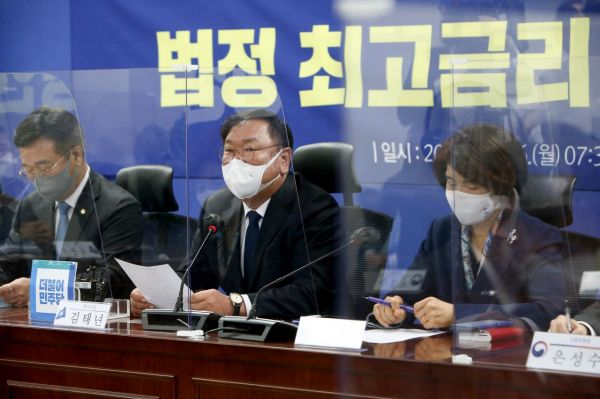
On the 16th, the ruling party, the Democratic Party of Korea, and the Financial Services Commission held a party-government meeting and announced plans to lower the legal maximum interest rate to 20% to alleviate the high-interest burden on low-income earners. The maximum interest rate, which was 27.9% in March 2016, was lowered to 24% in February 2018, and now it will be reduced to 20% within two years.
The reduction is expected to take effect as early as the second half of next year, considering the time needed for revising enforcement ordinances and the resolution of uncertainties following the COVID-19 pandemic.
According to the government's disclosed 'Plan to Lower the Legal Maximum Interest Rate,' lowering the rate from 24% to 20% in the second half of next year is expected to benefit 2.08 million out of 2.39 million borrowers who currently use loan products with interest rates exceeding 20%, resulting in an annual interest reduction of 483 billion KRW.
However, it is also anticipated that 316,000 people will be unable to extend or obtain loans totaling about 2 trillion KRW, effectively blocking their access to private financial services. Among them, 39,000 are expected to move into unregistered lending or illegal financial markets, with the scale estimated at 230 billion KRW.
When the legal maximum interest rate was lowered from 27.9% to 24% in February 2018, it was analyzed that about 40,000 to 50,000 people (amounting to 300 to 350 billion KRW) entered illegal financial markets.
However, the private sector views the government's estimates as overly optimistic. Since illegal financial markets operate underground, accurately estimating their size is difficult. Some even suggest that about 600,000 people could be pushed outside the formal financial system.
At the '11th Consumer Finance Conference' hosted by the Korea Financial Services Association at the end of last month, Professor Choi Cheol of Sookmyung Women's University presented on 'Institutional Improvements in the Loan Finance Market for Inclusive Low-Income Finance.' He stated, “If the maximum interest rate in the loan finance market is lowered by 4 percentage points from the current 24% to 20%, the estimated excess demand would be about 3 trillion KRW, with an average loan amount per person calculated at 5.247 million KRW.” He added, “In this case, approximately 600,000 excess demanders are expected, and if loan suspensions in the loan industry increase due to the interest rate cut, the number of people unable to obtain loans despite demand will likely rise further.”
Professor Choi particularly emphasized, “Since excessive minimum wage increases had a negative impact on the economy, direct market interventions and controls such as lowering the maximum interest rate require careful consideration.”
He also stressed, “The loan finance market has high supply interest rate elasticity, so a reduction in the maximum interest rate inevitably leads to a sharp contraction in lending by suppliers. Combined with excess demand, financial consumers will turn to high-interest illegal financial services, and in the mid to long term, the contraction of the loan finance market could cause more severe financial exclusion.”
Ultimately, the aftershocks of lowering the legal maximum interest rate appear inevitable. Although the 20% maximum interest rate will be applied from the second half of next year, the industry widely expects financial companies to begin tightening lending from now.
In particular, a reduction in lending is expected to be prominent in the secondary financial sector, such as savings banks and credit card companies, which are major lending channels for middle- and low-credit borrowers.
According to the Korea Federation of Savings Banks, among 105 credit loan products operated by 35 savings banks, 31 products apply interest rates exceeding 20% for certain credit grades. More than half of the 35 savings banks?20 banks?offer loans with annual interest rates exceeding 20%. The savings bank industry estimates that annual interest income will decrease by more than 20% due to the lowering of the legal maximum interest rate.
A savings bank official pointed out, “Pressure on management could increase even before the reduced interest rates are actually applied,” adding, “The burden from the interest rate cut will be felt most acutely by low-income people.”
© The Asia Business Daily(www.asiae.co.kr). All rights reserved.
![Clutching a Stolen Dior Bag, Saying "I Hate Being Poor but Real"... The Grotesque Con of a "Human Knockoff" [Slate]](https://cwcontent.asiae.co.kr/asiaresize/183/2026021902243444107_1771435474.jpg)















