Goddess Finance Research Institute
'Post-COVID, Social Demand for Contactless Payments and Adoption of Biometric Authentication' Report
[Asia Economy Reporter Ki Ha-young] Due to the increased preference for contactless payments amid the impact of the novel coronavirus infection (COVID-19), there is an analysis emphasizing the need to pay attention to contactless biometric authentication payment technology.
According to the report titled 'Post-COVID, Social Demand for Contactless Payments and Biometric Authentication Adoption' recently released by the Credit Finance Research Institute on the 21st, various contactless biometric authentication technologies such as vein, facial, and fingerprint recognition cards are being introduced overseas in countries including the United States, Europe, and China as contactless payment authentication methods.
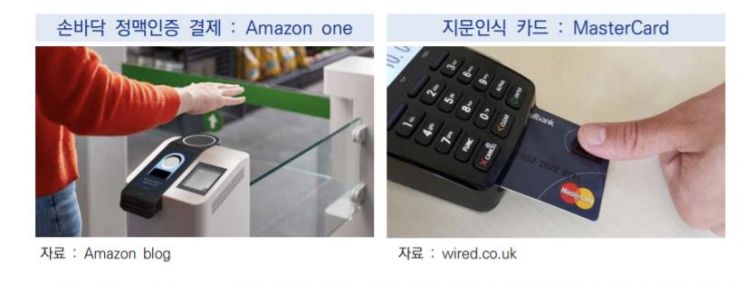
In the United States, big tech company Amazon launched a palm authentication payment service called 'Amazon One' last September. It verifies users by analyzing the unique characteristics of the palm shape and veins beneath the skin. Palm authentication has the advantage of being difficult to forge compared to other biometric authentication methods. Amazon plans to expand its application starting with its unmanned store Amazon Go.
In France, BNP Paribas plans to provide 10,000 to 15,000 fingerprint recognition cards this year in partnership with Visa. Additionally, Credit Agricole plans to launch fingerprint recognition cards at three regional banks. The fingerprint recognition card scans the finger on a fingerprint recognition module embedded on the surface. It is compatible with existing contact and contactless payment terminals that allow IC chip payments, giving it an advantage in payment infrastructure compared to other biometric authentications.
In China, Alipay launched the facial recognition payment service 'Smile to Pay' in 2017. It scans the face and inputs the phone number into the terminal. However, it has shown limitations in popularization due to low convenience and accuracy, as well as concerns over privacy invasion.
Like Alipay's Smile to Pay, the introduction of biometric authentication payment services faces obstacles to popularization such as anxiety over personal information leakage, terminal cost burdens, concerns about biometric recognition accuracy, and privacy invasion. In fact, Alipay's Smile to Pay requires installing a facial recognition terminal costing about 300,000 KRW, and recently, local Chinese media reported that Chinese facial photos were traded on the internet secondhand platform Zhuanzhuan at about 1,600 KRW (10 yuan) per 5,000 photos. Especially, since biometric information cannot be changed once leaked, proactive security measures are pointed out as crucial.
However, the Credit Finance Research Institute diagnosed that a favorable atmosphere is being created for the introduction of biometric authentication in the payment sector in the post-COVID era. This is because acceptance of digital innovation is increasing, and consumer experience in utilizing biometric information has accumulated due to the popularization of smartphones. Senior Researcher Lim Yoon-hwa of the Credit Finance Research Institute advised, "In Korea as well, it is necessary to pay more attention to contactless biometric authentication payment technology not only to meet social demands for untact but also to prepare for a 'device-less society.'"
© The Asia Business Daily(www.asiae.co.kr). All rights reserved.
![Clutching a Stolen Dior Bag, Saying "I Hate Being Poor but Real"... The Grotesque Con of a "Human Knockoff" [Slate]](https://cwcontent.asiae.co.kr/asiaresize/183/2026021902243444107_1771435474.jpg)
















