Paju Balloon Effect in Gyeonggi Fully Emerges
Apartment Transaction Volume Reaches Record High
House Prices Also Stir in Gyeryong and Gongju
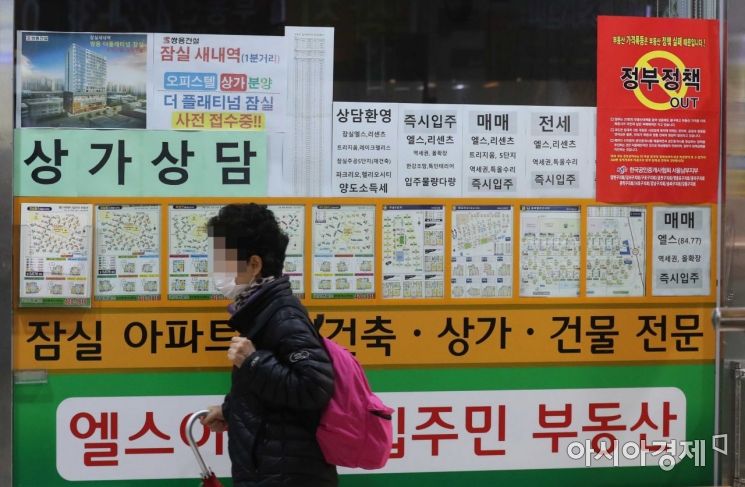 On the 19th, when the government announced its 24th real estate policy, the listing information and posters were displayed at a real estate agency in Songpa-gu, Seoul.
[Asia Economy Reporter Donghyun Choi] Although the government has added seven areas nationwide, including Gimpo-si in Gyeonggi Province and Haeundae-gu in Busan, to the list of regulated areas, signs are already emerging in the market that house prices in other non-regulated areas will start to fluctuate. These areas include Paju-si in Gyeonggi Province, Gyeryong-si in Chungnam, and Ulsan. Due to the government's patchwork measures that target specific regions like a mole-whacking game, there is a high possibility that the 'balloon effect,' where suppressing one area causes another to rise, will repeat once again.
According to industry sources on the 20th, after the government designated Gimpo-si in Gyeonggi Province, Haeundae, Suyeong, Dongnae, Yeonje, and Nam-gu in Busan, and Suseong-gu in Daegu as regulated areas the day before, various online real estate communities are actively debating where the 'second Gimpo' in the metropolitan area might be.
With only a few non-regulated areas left in the metropolitan area following this regulatory announcement, Paju-si is mainly mentioned as a likely beneficiary candidate. In fact, apartment transaction volumes in Paju-si have been rapidly increasing recently. According to the Gyeonggi Province Real Estate Information Portal, apartment transactions in Paju-si last month reached 1,063, the highest since June (1,113). Considering the 30-day reporting deadline for actual transactions, industry observers expect the total transaction volume for October to surpass that of June. As of this day, the transaction volume for this month has already reached 462.
Prices have also been rising sharply recently. According to the Korea Real Estate Board's weekly apartment price trend, as of the 9th, the apartment price increase rate in Paju-si was 0.47%, the highest in the metropolitan area after Gimpo. The increase rate for the previous week was 0.37%. An 84㎡ unit in Hanbit Village 5 Complex Castle & Cantavil in Yadang-dong, Paju-si, was sold for 575 million KRW on the 11th of this month. This price is 66 million KRW higher than the actual transaction price of 509 million KRW last month. According to reports from frontline real estate agencies, inquiries about apartments near Unjeong Station, the starting point of the metropolitan wide-area rapid transit (GTX) Line A, and Unjeong New Town are increasing. A representative from A Real Estate Agency in Unjeong-dong said, "Interest had been lower compared to Gimpo, but recently, investors making gap investments to buy multiple houses have noticeably increased," adding, "Apartment turnover around Unjeong Station is also relatively frequent."
The balloon effect in non-regulated areas is also showing signs of appearing in local regions. In particular, house prices in Gyeryong-si, Gongju-si, and Seobuk-gu in Cheonan-si, which are close to Sejong City, have risen by around 3% over the past three months. Ulsan, which recorded a cumulative house price increase rate of 6.54% this year, along with Changwon, has been included only as simple monitoring target areas, raising concerns about potential market overheating. Jang Jaehyun, head of research at Real Today, pointed out, "Because regulated areas are designated locally, the balloon effect is inevitable," and added, "When designating regulated areas, it is necessary to consider the impact on surrounding areas and establish related measures accordingly."
© The Asia Business Daily(www.asiae.co.kr). All rights reserved.
![Clutching a Stolen Dior Bag, Saying "I Hate Being Poor but Real"... The Grotesque Con of a "Human Knockoff" [Slate]](https://cwcontent.asiae.co.kr/asiaresize/183/2026021902243444107_1771435474.jpg)















