Zigzagging Moves in the National Assembly... Google Fair Trade Act Stalls
Suddenly Advocates Caution
Urges "Commission Reduction Like Apple"
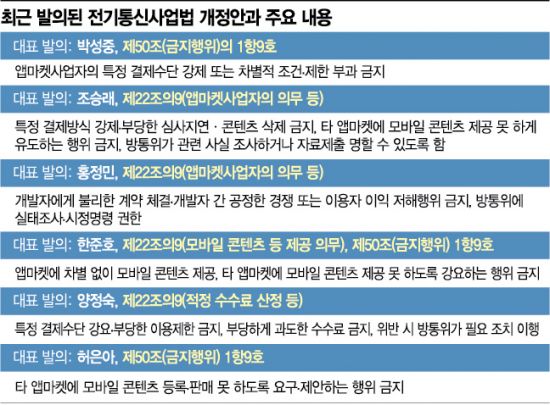
[Asia Economy Reporter Koo Chae-eun] As the National Assembly shows a zigzagging stance over Google's '30% toll tax (app market commission increase)', the fate of the 'Google Gapjil Prevention Act (Amendment to the Telecommunications Business Act)' is also swinging between cold and hot. Park Sung-joong, chairman of the Bill Review Subcommittee 2 and a key figure in the bill discussions from the People Power Party, issued a statement saying, "Google should reduce its commission like Apple," but remains lukewarm about the core passage of the bill. Discussions have progressed from the bill's proposal (August 11, Park Sung-joong's bill) → bipartisan agreement on passing the Google Gapjil Prevention Act (October 7) → public hearing (November 4), but the opposition party suddenly adopted a 'cautious stance,' putting the bill's passage on hold.
Google Endures Using the Opposition Party as a Shield
On the 20th, eight organizations including the Korea Internet Corporations Association and the Korea Creative Story Writers Association raised their voices demanding the swift passage of the 'Google Gapjil Prevention Act.' The Korea Internet Corporations Association held a forum titled 'Estimation of Damage to the Content Industry Due to Google's Expansion of Forced In-App Payment Policy and Countermeasures,' criticizing Google and the opposition party. Park Sung-ho, Secretary General of the Korea Internet Corporations Association, pointed out, "Google's recent policy change could adversely affect not only companies but also creators, consumers, and the entire internet ecosystem," adding, "The forced Google in-app payment policy will significantly reduce sales in the mobile content industry."
The National Assembly situation is also chaotic. On the 19th, a day earlier, People Power Party lawmakers including Park Sung-joong, the floor leader, stated, "Apple's half-price commission policy is very timely," and urged, "Google should also reduce commissions to 15% or less for small and medium developers to revitalize the app ecosystem." The opposition party, previously passive about the Google Gapjil Prevention Act, launched a direct attack targeting Google.
Earlier, Apple announced a sudden reduction of the App Store commission from 30% to 15% for small app developers earning less than $1 million (about 1.1 billion KRW) annually. Since the majority of the 1.8 million apps traded on the App Store are estimated to have sales below $1 million, many companies will benefit. As critical public opinion against Google's contrasting behavior to Apple's change intensified, the opposition party appears to have shifted its stance. However, the opposition party remains passive about the Google Gapjil Prevention Act, drawing criticism for a 'double standard.'
The opposition party argues that trade issues such as the Korea-US Free Trade Agreement (FTA) are a concern, and since existing apps have a grace period until September 30 next year, sufficient discussion is necessary, warning that a push-through law enforcement could cause side effects. An ICT industry insider criticized this as "inconsistent and contradictory behavior." The insider said, "Trade friction issues have been sufficiently reflected in the bipartisan compromise, and new app developers will be subject to the law starting January, so prompt passage of the bill is necessary," adding, "The parties had already agreed on major industry demands, but suddenly changed their minds and are resetting all discussions to square one."
Industry Inside and Outside: "Must Be Processed Within the Year"

On the same day, the Korea Creative Story Writers Association stated, "While some content companies have grown through in-app payments, others have developed their own platforms independently, gathering numerous creators and content," criticizing Google by saying, "Forcing only in-app payments ignores the functions of other content creators and platforms and means the app market operator wants to monopolize everything." Calls to expedite the National Assembly's legal processing were also raised. Kim Hyun-kyung, a professor at the Graduate School of IT Policy at Seoul National University of Science and Technology, emphasized, "Domestic developers have to compete with Google while giving 30% of their sales to them, so if in-app payments become a reality, many startups could wither away." Ahn Jeong-sang, senior expert of the Democratic Party, mentioned, "It is urgent to amend the law within the year as originally agreed by both parties to protect companies and users."
© The Asia Business Daily(www.asiae.co.kr). All rights reserved.
![Clutching a Stolen Dior Bag, Saying "I Hate Being Poor but Real"... The Grotesque Con of a "Human Knockoff" [Slate]](https://cwcontent.asiae.co.kr/asiaresize/183/2026021902243444107_1771435474.jpg)
















