[Asia Economy reporters Seulgina Jo and Aeri Boo] With the gathering of six 'Artificial Intelligence (AI) Avengers' companies?Samsung Electronics, SK Telecom, KT, LG Uplus, Naver, and Kakao?at one place, the national competitiveness in AI is expected to advance to a new level. These six companies are leading domestic ICT representatives that have responded most actively since President Moon Jae-in unveiled the AI national strategy at the end of last year.
Government Leading with AI Avengers
Next week’s AI event hosted by the government will conduct a comprehensive review of the AI competitiveness of domestic companies. This is based on the judgment that without the support of companies making large-scale investments aiming to become global AI platform leaders, it is virtually impossible to leap forward as an AI powerhouse. The event will review the technological development achievements over the past year since the AI national strategy was announced and secure new growth strategies.
In particular, the government’s policy is to make this event a platform to encourage the entire industry by showcasing the leading technologies and research and development (R&D) of the six companies most actively investing in AI?Samsung Electronics, the three mobile carriers, Naver, and Kakao. It is also expected that the industry will request various regulatory reforms and talent acquisition measures that currently hinder AI activation.
Samsung Electronics is recognized for leading the 'human-centered AI implementation' by integrating AI into various products such as semiconductors, smartphones, and home appliances. The AI semiconductor, led and developed by SK Telecom, aims to become the 'No. 1 AI semiconductor'?a key goal of the AI national strategy.
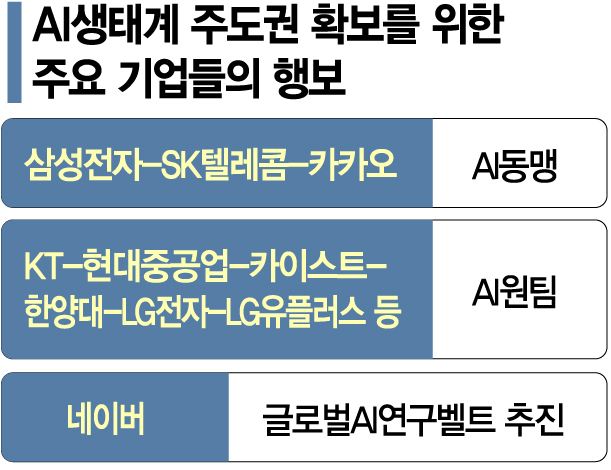
Samsung Electronics, SK Telecom, and Kakao have also formed an 'AI alliance' to compete against global giants like Google and Amazon. KT and LG Uplus have established an industry-academia-research consortium called 'AI One Team' to accelerate technology development. Naver, through AI research organizations such as Naver Labs, has been recognized for its research capabilities by presenting more than 40 papers at the world’s top AI conferences this year.
President Moon, who declared the ambition to become a leading AI nation, has repeatedly emphasized the importance of securing AI supremacy. In October last year, he became the first sitting president to attend a developer conference and first revealed his AI vision, followed by the announcement of the AI national strategy in December of the same year. AI-related content was also included in the first government work report conducted in January this year. The national project 'Korean New Deal,' currently being promoted to prepare for the post-COVID-19 era, also has AI as a major pillar.
This is evaluated to be driven by a sense of urgency that AI will open the door to a superintelligent society and fundamentally change politics, economy, and society as a whole. AI has already rapidly penetrated various aspects of daily life such as manufacturing, finance, logistics, and services. A government official emphasized, "AI is causing a paradigm shift across all areas beyond a mere technological dimension," adding, "We believe that preparation across the nation and society as a whole is necessary."
Korea’s AI technology significantly lags behind the United States, China, and Europe, which have taken the lead in the global dominance race. According to the Institute for Information & Communications Technology Planning & Evaluation (IITP), when the U.S. AI technology level is set at 100 in 2018, Korea’s level was only 81.6, lower than Europe (90), China (88), and Japan (86).
Industry Voices AI Talent Shortage
At this event, participating companies are expected to demand measures from the government to resolve the talent shortage. For the Moon Jae-in administration’s pursuit of becoming the 'No. 1 AI nation,' securing AI talent must be proactively achieved, but the reality is otherwise. Han Seong-sook, CEO of Naver, recently met with Prime Minister Chung Sye-kyun and lamented, "Even if we want to hire, there are no developers to hire." Yeo Min-soo, co-CEO of Kakao, appealed, "There is plenty of data and equipment for analysis can be purchased with money. But what is needed is people who understand, process, analyze, and apply the data."
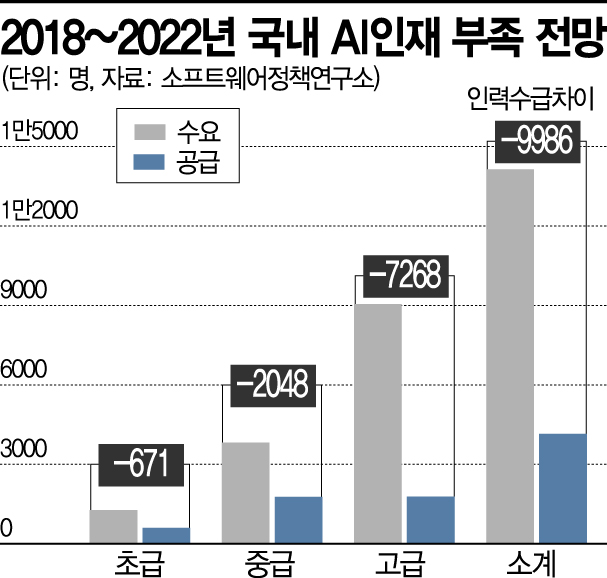
Korea’s AI talent competitiveness is less than half compared to the U.S., China, and Japan. According to the Korea Economic Research Institute, the domestic AI workforce shortage rate was 60.6%. The Software Policy & Research Institute estimated that by 2022, nearly 10,000 personnel shortages would occur in Korea’s AI software sector alone.
It also falls behind in talent competitiveness such as expertise. When the U.S. AI talent competitiveness is rated as 10, Korea’s level was only half (5.2). China was 8.1, and Japan was 6.0.
The Moon administration also views the shortage of AI professionals seriously and plans to reform the education system focusing on software and AI, but there is still a long way to go. As AI rapidly permeates areas such as healthcare and welfare, concerns are rising that the talent shortage will deepen further. AI expert Professor Lee Kyung-jun of Kyung Hee University suggested, "Government-led AI retraining is also a method," citing the example of the 1997 International Monetary Fund (IMF) financial crisis when the government provided internet education to unemployed people to cultivate internet experts as a good precedent."
© The Asia Business Daily(www.asiae.co.kr). All rights reserved.
![Clutching a Stolen Dior Bag, Saying "I Hate Being Poor but Real"... The Grotesque Con of a "Human Knockoff" [Slate]](https://cwcontent.asiae.co.kr/asiaresize/183/2026021902243444107_1771435474.jpg)
















