KIEP to Hold Press Briefing on the 12th
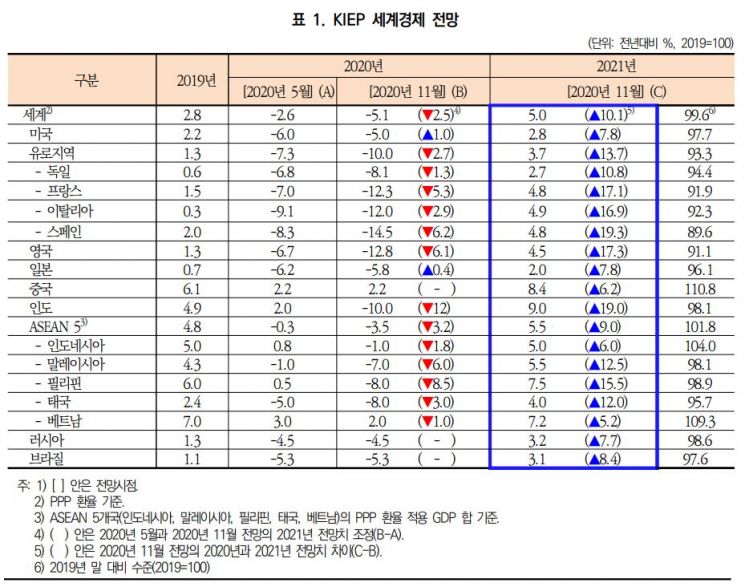
[Sejong=Asia Economy Reporter Kim Hyunjung] The Korea Institute for International Economic Policy (KIEP), a government-funded research institute, forecasted that the global economic growth rate will reach 5.0% next year. However, it also predicted that if the number of confirmed COVID-19 cases surges again, the growth rate could drop to as low as 2.2%. For this year, it projected a growth rate of -5.1%, revising downward by 2.5 percentage points from the previous estimate (-2.6%).
On the 12th, KIEP held the "2020 Second Half Press Briefing" at the Ministry of Economy and Finance in the Government Complex Sejong and announced the global economic outlook for next year. Among domestic government-funded research institutes, KIEP is the only one to provide forecasts on global economic growth rates.
The institute expects the global economy to record a growth rate of 5.0% (based on PPP exchange rates), which is 10.1 percentage points higher than this year, assuming the following: ▲the slowdown and stabilization of COVID-19 spread ▲vaccines will not be supplied until mid-2021, and social distancing will continue for the time being ▲major countries such as the United States will maintain current benchmark interest rates with gradual changes in monetary policy ▲no abrupt changes in investor risk aversion and low likelihood of rapid capital movement from emerging to advanced economies ▲China’s economic growth rate will be stably achieved within the Chinese government’s target ▲the average annual oil price in 2021 (WTI basis) will be $43.7 per barrel.
Major advanced economies are expected to show some recovery from recession and record positive growth. The U.S. is projected to grow by 2.8%, up 7.8 percentage points from this year; the European region is expected to recover by 13.7 percentage points to 3.7%; and Japan is forecasted to grow by 2.0%, up 7.8 percentage points.
Emerging economies are expected to recover relatively quickly from recession, assuming the COVID-19 resurgence subsides. In particular, China is anticipated to record a growth rate of 8.4%, up 6.2 percentage points from 2020, supported by positive factors such as ▲COVID-19 response stimulus measures ▲recovery in investment and consumption ▲a shift to global economic recovery, along with the active implementation of various government policies approaching a long-term growth path. India and Russia are forecasted at 9.0% and 3.2%, respectively.
Regarding this year’s growth rate, the global economy is expected to contract by -5.1%, down 2.3 percentage points from the previous year. This is a downward revision of 2.5 percentage points from the earlier forecast (-2.6% in May). Downside risks include ▲delays in vaccine development and distribution and resurgence of COVID-19 ▲prolonged U.S.-China conflicts ▲discrepancies between the financial and real sectors.
All major advanced economies are expected to show recovery in the second half of the year after the second quarter, but returning to previous growth trajectories will be difficult. The U.S. is projected to contract by -5.0%, down 7.2 percentage points from 2019, due to massive unemployment, sharp declines in private consumption expenditure, export slumps caused by reduced external demand, and COVID-19 resurgence. Although there are concerns that corporate environments may worsen due to potential corporate tax hikes and stricter regulations on large IT companies following Joe Biden’s election, KIEP noted that expanded fiscal spending aimed at actively addressing climate change and creating quality jobs will also act as positive factors.
The Eurozone is expected to contract by -10.0%, down 11.3 percentage points from the previous year, and Japan by -5.8%, down 6.5 percentage points. Among emerging economies, China is forecasted to grow by 2.2%, down 3.9 percentage points from last year, and India to contract by -10.0%, down 14.9 percentage points.
In a survey conducted using KIEP’s own panel (October 30 to November 5, 57 respondents), the median forecast for next year’s global economic growth rate by international economic experts was 3.0%. Experts diagnosed that the impact of COVID-19 on the global economy will last an average of 22 months. They anticipated that it will take about 1 to 3 years to recover to previous growth paths.
From a policy perspective, experts evaluated that health and quarantine policies and expanded government spending were the most effective in overcoming COVID-19, while policies related to fiscal soundness and widening inequality are urgent. Regarding the effectiveness of policies introduced by countries worldwide, respondents ranked ▲health and quarantine policies (36%) ▲expanded government spending (35%) ▲monetary policy and liquidity expansion (19%) ▲international cooperation (5%). Urgent policy tasks were identified as ▲fiscal soundness (35%) ▲widening inequality (19%) ▲retreat of globalization (16%) ▲financial market instability (12%) ▲inflation (11%).
In a survey on changes in the world order after the U.S. presidential election, experts predicted that nationalism will persist, globalization will retreat, and financial markets will remain unstable. They expected emerging economies such as China and India to rise, continued U.S.-China conflicts, and multinational conglomerates to strengthen their dominance in the global market. They also anticipated strengthened responses to climate change and continued expansion of the digital economy and digital trade. The average oil price next year is forecasted at $42 per barrel.
KIEP President Kim Heungjong explained regarding the forecast, "KIEP views the global economic growth forecast more pessimistically than other international organizations because we believe recovery will take more time," adding, "This is a result of very careful consideration of the fact that an exogenous variable such as disease is the most important factor and the capabilities of health authorities in each country."
© The Asia Business Daily(www.asiae.co.kr). All rights reserved.