eBay Korea Analyzes Sales Data During 'Big Smile Day' Period (1st-8th)
[Asia Economy Reporter Lim Hye-seon] Due to the impact of the novel coronavirus infection (COVID-19), a consumer pattern has emerged where people purchase daily necessities in bulk at lower prices while boldly buying high-priced products.
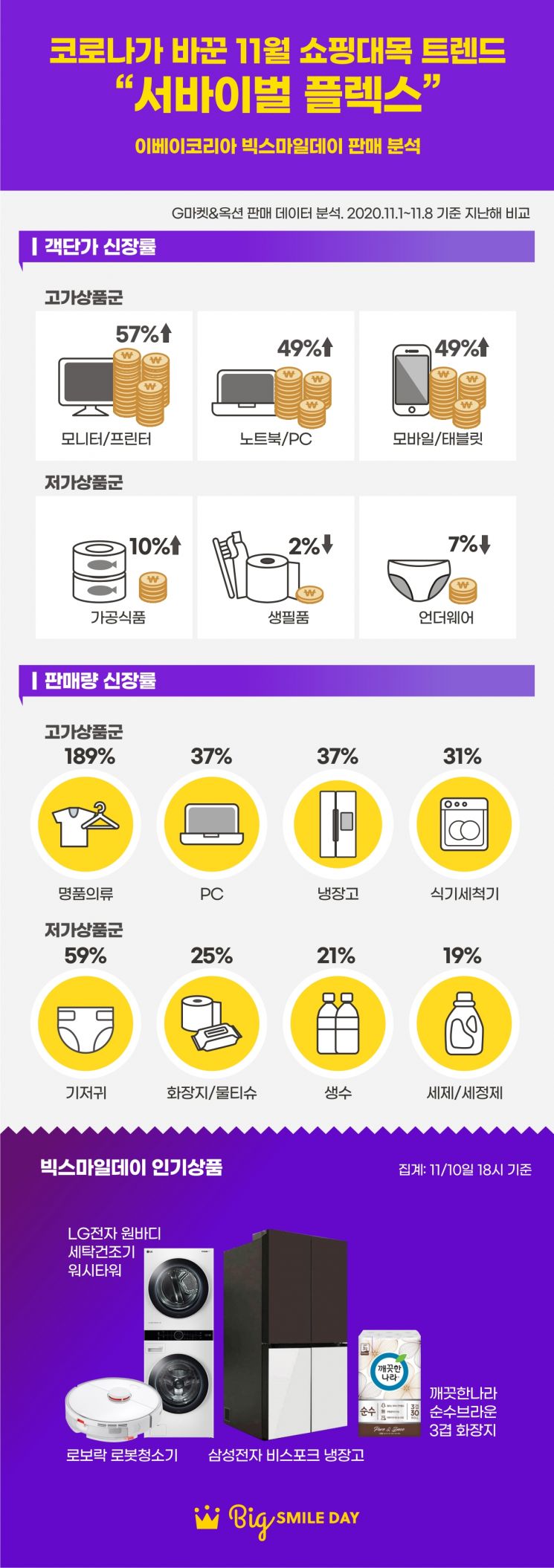
According to eBay Korea on the 11th, comparing the "average spending per person" (hereafter referred to as average spending) during the 'Big Smile Day' (November 1-8) held by Gmarket, Auction, and G9 with the same period last year, the average spending on low-priced daily consumer goods generally decreased, whereas the average spending on high-priced products significantly increased.
In fact, categories with relatively higher price ranges such as monitors and printers (57%), laptops and PCs (49%), mobiles and tablets (49%), home and beauty appliances (43%), and furniture and interior (28%) ranked 1st to 5th in terms of growth rate in average spending. This means that if a 1 million KRW monitor was purchased during last year's Big Smile Day, this year, a monitor worth 1.57 million KRW was added to the shopping cart. On the other hand, average spending on relatively low-priced daily consumer goods such as body and hair care (12%), maternity and childcare (11%), processed foods (10%), daily necessities (-2%), and underwear (-7%) showed only slight increases or even decreases.
Although there were differences in average spending trends, sales volumes of both daily consumer goods and high-priced products increased compared to the previous year. Representative daily consumer goods such as "toilet paper and wet tissues" saw a 25% increase in sales, and sales of "detergents/cleaners" rose by 19%. Bathroom products like "body care" and "oral care" also sold 35% and 17% more, respectively. The representative childcare product "diapers" showed a 59% sales growth. Items suitable for long-term storage at home such as "bottled water" (21%), "noodles" (22%), "instant rice" (13%), and "processed meat products" (51%) also gained popularity.
The popularity of high-priced product categories remained strong, reflecting the impact of COVID-19. Due to remote work and remote learning, sales of "PCs" increased by 37%. Large kitchen appliances like "refrigerators" and "dishwashers" sold 37% and 31% more, respectively. Additionally, sales of luxury items such as "luxury clothing" (189%), "luxury shoes" (107%), and "luxury watches" (37%) surged dramatically.
This consumer pattern is also reflected in the sales performance during Big Smile Day. As of 6 p.m. on November 10, the real-time sales ranking on Gmarket shows that the "Samsung Electronics Bespoke Refrigerator" ranks 2nd with cumulative sales of 2.12 billion KRW. The "Roborock Robot Vacuum Cleaner" recorded cumulative sales of 1.4 billion KRW, and "Clean Country Pure Brown 3-ply Toilet Paper" achieved 760 million KRW, placing them among the top ranks. On Auction, the "LG Electronics One-body Washer-Dryer Wash Tower" ranked 2nd with cumulative sales of 500 million KRW, while daily necessities like "Dongwon Light Standard Tuna" and "Bebesup Premier Wet Tissues" each recorded cumulative sales of 140 million KRW, showing their popularity.
Kim Hae-dong, Head of Sales Planning at eBay Korea, explained, "Consumers carefully consider cost-effectiveness for essential purchase items, but willingly open their wallets for relatively expensive high-end products, revealing what is called 'flex consumption.'"
© The Asia Business Daily(www.asiae.co.kr). All rights reserved.
![Clutching a Stolen Dior Bag, Saying "I Hate Being Poor but Real"... The Grotesque Con of a "Human Knockoff" [Slate]](https://cwcontent.asiae.co.kr/asiaresize/183/2026021902243444107_1771435474.jpg)















