More Complex and Detailed Nanostructure Formation Methods
Minimizing Thermal Conductivity, Enhancing Thermoelectric Performance
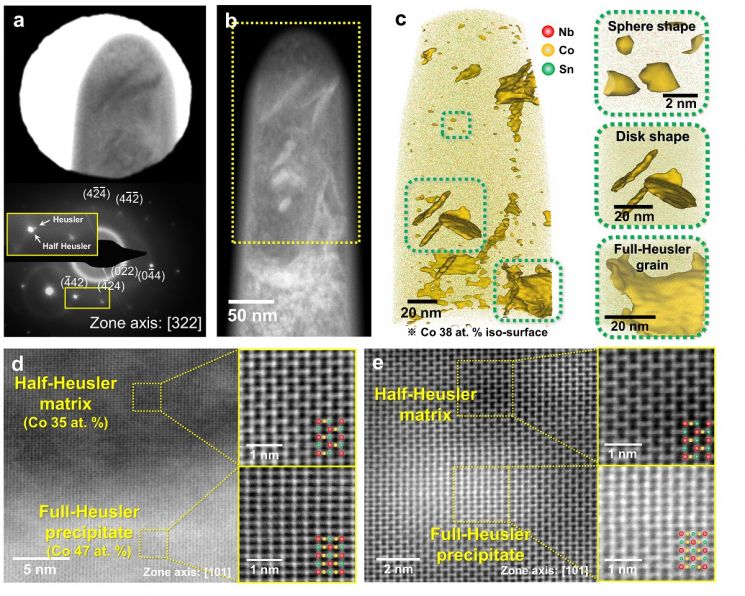 Analysis of Full Hovisler Precipitates Using Three-Dimensional Atom Probe Microscopy and Transmission Electron Microscopy
[Asia Economy Reporter Junho Hwang] A new method to control half-Heusler compounds, which are used as materials for thermoelectric generation that produces electricity through temperature differences, has been developed. By utilizing this method, the thermal conductivity of half-Heusler compounds, considered a drawback, can be reduced to one-third, promising a revolutionary improvement in thermoelectric performance.
The Korea Advanced Institute of Science and Technology (KAIST) announced on the 11th that a research team led by Professor Byeokpa Choi from the Department of Materials Science and Engineering, in collaboration with Professor Heungsun Lee's team from Kyungpook National University's Department of Materials Science and Engineering, developed a new method to control the nanostructure of half-Heusler thermoelectric materials by utilizing a metastable phase. This research achievement was published in the international journal 'Nano Energy.'
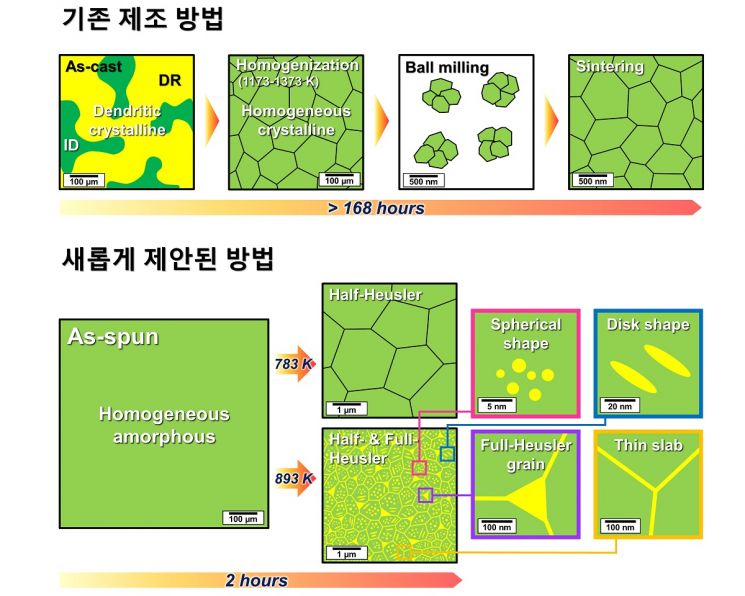
The research team developed a method to lower the thermal conductivity of half-Heusler compounds while increasing their electrical conductivity.
Professor Choi's team utilized the crystallization method of a metastable (amorphous) phase. A metastable phase refers to a phase that is relatively less stable compared to a stable phase and can easily undergo phase transitions to stable phases (solid, liquid, gas, etc.) through heat treatment. Depending on the heat treatment temperature, the crystallization state of the metastable (amorphous) phase varies, allowing control over the size and phase of nanocrystals.
Specifically, the team produced an amorphous (metastable) half-Heusler (NbCo1.1Sn) composition using a rapid cooling process, followed by a short heat treatment at a relatively low temperature. This created a complex nanostructure containing full-Heusler (NbCo2Sn) nanoprecipitates inside the half-Heusler material.
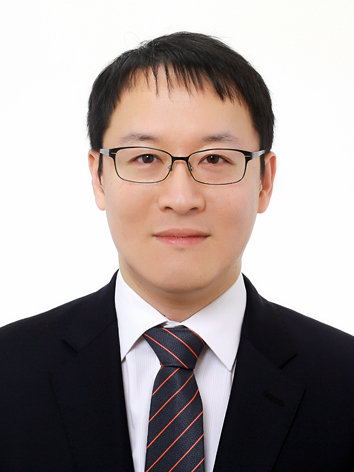 Choi Byeokpa, Professor, Department of Materials Science and Engineering, Korea Advanced Institute of Science and Technology
The method newly developed by Professor Choi's team does not require long-term heat treatment at high temperatures, unlike conventional methods, making it easier, more economical, and capable of forming more complex and detailed nanostructures.
The research team observed the synthesized compound using three-dimensional atom probe microscopy and transmission electron microscopy, confirming the presence of full-Heusler nanoprecipitates a few nanometers in size within the half-Heusler material.
Professor Byeokpa Choi stated, "The thermoelectric materials created using the newly proposed method in this study have more complex nanostructures compared to existing materials, and we expect a reduction in thermal conductivity by more than three times along with a revolutionary increase in thermoelectric generation performance."
Meanwhile, half-Heusler compounds are a type of intermetallic compound (alloy) that are attracting attention as energy materials for thermoelectric generation, solar power generation, magnetic materials, and more.
© The Asia Business Daily(www.asiae.co.kr). All rights reserved.
![Clutching a Stolen Dior Bag, Saying "I Hate Being Poor but Real"... The Grotesque Con of a "Human Knockoff" [Slate]](https://cwcontent.asiae.co.kr/asiaresize/183/2026021902243444107_1771435474.jpg)

















