Dollar Weakness on Potential Aggressive Stimulus... Intraday Record Highs and Sharp Yield Gains
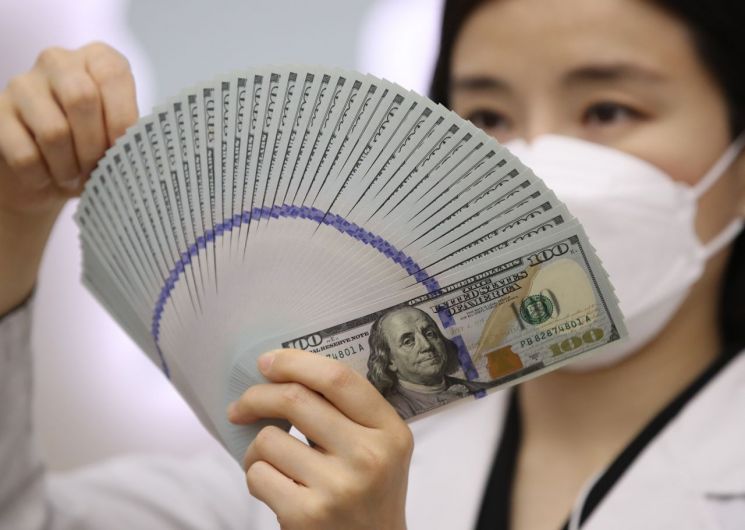
[Asia Economy Reporter Eunmo Koo] The weakness of the US dollar is intensifying. This is due to the increased likelihood of aggressive stimulus measures following the victory of Joe Biden, the Democratic candidate, in the US presidential election. As the dollar weakens, the returns of dollar inverse exchange-traded products (ETPs), which generate profits when the dollar declines, are rapidly rising.
On the 10th, the won-dollar exchange rate in the Seoul foreign exchange market closed at 1,113.9 won, down 6.5 won from the previous trading day's closing price. This not only set a new yearly low based on the closing price but also marked the lowest level in 1 year and 10 months since January 31 of last year (1,112.7 won). Since the US presidential election on the 4th, the rate has fallen for three consecutive trading days, dropping 23.8 won during this period.
As the won-dollar exchange rate hits new lows daily, inverse stocks betting on the dollar's decline are reaching new highs. According to the Korea Exchange, the KODEX US Dollar Futures Inverse 2X closed at 10,160 won, up 1.45% (145 won) from the previous trading day. Notably, it even reached an intraday high of 10,165 won, setting a new record.
Dollar inverse stocks have shown a sharp upward trend since last month, supported by the dollar's weakness. The KODEX US Dollar Futures Inverse 2X rose 10.1% from October to the day before, while KOSEF US Dollar Futures Inverse 2X (Synthetic) (10.0%), TIGER US Dollar Futures Inverse 2X (10.0%), and Shinhan Inverse 2X US Dollar Futures ETN (9.8%) also posted returns around 10%, outperforming the KOSPI's rise of 5.1% during the same period.
With Biden's victory in the US presidential election, the possibility of expanded fiscal debt is interpreted as leading to the dollar's weakness. Although most countries have seen a significant increase in fiscal deficits due to the impact of COVID-19, the US fiscal response is more focused on income preservation and transfer payments rather than loans and guarantees, which increases the likelihood of a heavier government debt burden.
Hyojin Kim, a researcher at KB Securities, explained, "The recent dollar weakness is due to the increased possibility of fiscal debt following Biden's election. Loans and guarantees may be recovered depending on the COVID-19 situation and economic recovery, but income preservation and transfer payments can largely lead to government debt, which is a key difference."
The foreign exchange market also seems to weigh on the dollar's weakness trend next year. As the global economy moves into a recovery phase, large-scale US fiscal policies are expected, and uncertainties are easing with news such as Pfizer's COVID-19 vaccine candidate proving 90% efficacy in the final phase 3 clinical trials, strengthening preference sentiment going forward.
From the perspective of domestic foreign exchange market supply and demand conditions, factors such as increased trade volume expanding the trade surplus and rising foreign investor inflows are acting as factors strengthening the won. However, there is a forecast that 1,050 won could serve as a technical support level. Changseop Oh, a researcher at Hyundai Motor Securities, predicted, "If the won-dollar exchange rate approaches the lower bound of the fluctuation range since 2010, around 1,050 won, the speed of the exchange rate decline will slow due to the exchange rate burden on export companies."
© The Asia Business Daily(www.asiae.co.kr). All rights reserved.
![Clutching a Stolen Dior Bag, Saying "I Hate Being Poor but Real"... The Grotesque Con of a "Human Knockoff" [Slate]](https://cwcontent.asiae.co.kr/asiaresize/183/2026021902243444107_1771435474.jpg)















