40% of Nurses Experience "Taeum"
Poor Working Conditions Behind Taeum
Experts Say "Nurses' Internal Self-Regulation and Hospital Management Awareness Improvement Needed"
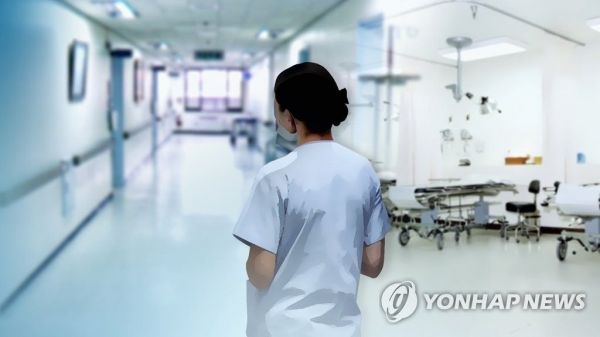 The death of nurse Seo Ji-yoon, who was driven to take her own life after suffering from "Taeum," a harmful practice within hospitals described as "tormenting someone until they break," has been recognized as a work-related injury. Photo by Yonhap News
[Asia Economy Reporter Kim Suwan] The death of the late nurse Seo Ji-yoon of Seoul Medical Center, who suffered from workplace harassment known as 'Taeum' in the medical field and took her own life, has been recognized as a work-related injury, sparking ongoing criticism about the blind spots in nurses' human rights.
According to the Public Transport Workers' Union Medical Solidarity on the 9th, the Seoul Occupational Disease Judgment Committee of the Korea Workers' Compensation and Welfare Service judged on the 29th of last month that there is a significant causal relationship between Nurse Seo's death and her work, recognizing it as an occupational disease.
After reviewing related materials, the committee concluded that Nurse Seo made the extreme choice while her normal cognitive abilities were impaired due to accumulated overwork and stress from her job.
Previously, Nurse Seo, who worked at Seoul Medical Center, was found dead at her home in January last year. Her family raised suspicions that severe workplace harassment known as 'Taeum' was behind it.
According to an investigation by the Truth Countermeasure Committee, composed of Seo's family and union recommendations, Nurse Seo worked continuously without rotation in the team with the highest work intensity from July 2015 to December 16, 2018. Her total annual working days in 2018 were 217, more than the average of 212 days among 19 peers, and her night shifts numbered 83, exceeding the 76 days of her peers.
Consequently, Nurse Seo repeatedly appealed for department transfers or resignation due to frequent schedule changes, unreasonable work shifts, and night shift issues. She also reportedly confided in acquaintances about the distress caused by night shifts. Furthermore, the committee identified circumstances suggesting that some staff members made insulting remarks to the deceased.
Before her extreme decision, Nurse Seo sent messages to her family such as "I can't work because of the scary atmosphere," "I feel so lonely and sorrowful," and "I got scolded while making coffee." In her will, she also wrote that she did not want condolences from hospital staff.
The problematic 'Taeum' culture in the medical field derives from the phrase meaning 'burning the soul to ashes,' referring to mental and physical harassment inflicted by senior nurses on new nurses under the guise of training. Since it mostly involves excessive personal degradation, it is cited as a major cause of nurse turnover.
Social issues regarding Taeum have been continuously raised. Nurse Park Seon-wook, who worked in the intensive care unit at Seoul Asan Medical Center, also suffered from Taeum and took her own life in February 2018.
Before her death, Nurse Park expressed her suffering in her phone memo, stating, "The pressure from work, the critical eyes of the preceptor, and symptoms of becoming discouraged and anxious worsened. With only 3 to 4 hours of sleep a day and frequently skipped meals, I could not recover."
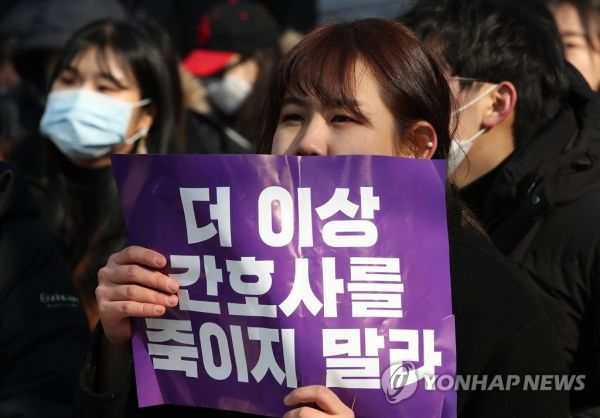 On the afternoon of February 16 last year, participants at a memorial rally for two nurses held by the "Joint Countermeasures Committee for the Truth Investigation, Industrial Accident Recognition, and Prevention of Recurrence of the Death of the Late Nurse Park Seon-wook" and the "Citizen Countermeasures Committee for the Death of the Late Nurse Seo Ji-yoon Due to Workplace Harassment at Seoul Medical Center" at Cheonggye Plaza in Jongno-gu, Seoul, held hand placards reading "Stop Killing Nurses." Photo by Yonhap News
In a 2018 survey conducted by the Korean Nurses Association involving 7,275 nurses, the most common types of Taeum were identified as △ shouting and verbal abuse (62.7%) △ spreading rumors or bad gossip (47%) △ making someone a laughingstock (44.5%, multiple responses allowed).
Notably, 40.9% of responding nurses experienced Taeum, with perpetrators being senior nurses and preceptors (guiding nurses) at 30.2%, fellow nurses at 27.1%, nursing department heads at 13.3%, and doctors at 8.3%.
The background of this Taeum culture also includes poor working conditions. According to data submitted last month to the National Assembly Legislative Research Office by Kang Seon-woo, a member of the National Assembly Health and Welfare Committee from the Democratic Party, the average number of patients per nurse per shift in South Korea is 16.3. This is double the average of 8.8 in 12 European countries and the United States.
Given this situation, calls are growing to strengthen punishment regulations to prevent the Taeum culture. The current revised Labor Standards Act aimed at preventing nurse Taeum lacks punitive provisions, and the reporting and investigation of incidents are handled by the same workplace employer, making proper investigations virtually impossible if the employer is the perpetrator.
Recently, a petition titled "Please strongly punish workplace harassment and nurse Taeum" was posted on the Blue House National Petition Board. The petitioner, identifying as a current nurse, appealed, "Taeum still hasn't changed at all," and "Even if workplace harassment occurs, hospitals only take corrective actions." They added, "If even reporting to the Ministry of Labor results only in corrective actions, the law must definitely be changed," urging, "Please help so that no more nurses suffer or resign due to Taeum."
Experts point out that eradicating Taeum requires not only internal self-purification efforts among nurses but also awareness improvement by hospital management.
Choi Min, an occupational environmental medicine specialist at the Korea Labor and Health Institute, stated at a discussion held at the National Assembly in September last year titled "Changes and Future Tasks Brought by Consecutive Nurse Deaths," "Unsystematic and insufficient training for new nurses and excessive work pressure contributed to harassment," emphasizing, "Proper support for new nurses is crucial."
Dr. Choi stressed, "Efforts to improve nurses' working environments must be accompanied by basic efforts to identify the scale of work-related suicides among nurses," adding, "This is not just a nurse issue but should start with suicide prevention policies that properly estimate and investigate the scale of suicides caused by work-related factors and focus on the 'reasons and causes' that left them no choice but to take their own lives."
© The Asia Business Daily(www.asiae.co.kr). All rights reserved.


















