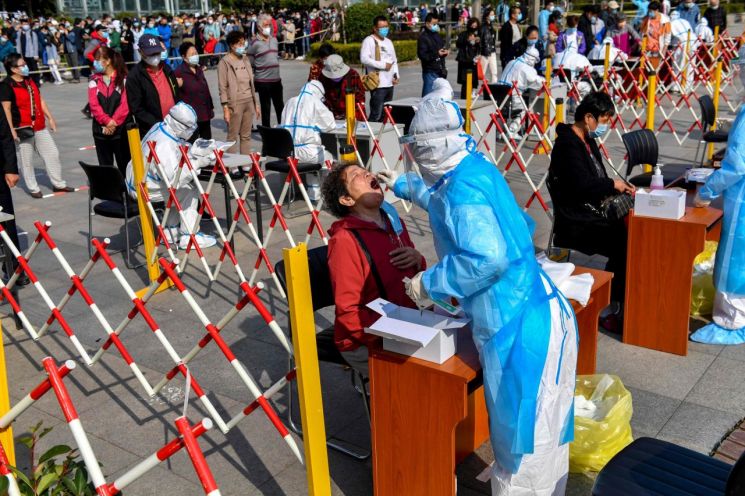
[Asia Economy Reporter Ki Ha-young] Chinese health authorities have raised quarantine measures to require passengers from Korea to undergo nucleic acid testing twice before boarding flights.
According to the Chinese Embassy in Korea on the 8th, Chinese authorities announced that starting from 0:00 on the 11th (Korean time), all passengers of Chinese and foreign nationalities must present two negative nucleic acid test (PCR) certificates for COVID-19 before boarding.
Accordingly, all passengers departing from Korea must undergo nucleic acid tests at two designated medical institutions within 48 hours before boarding, with at least a 3-hour interval between tests. If the test results are negative, passengers must present a standardized test result certificate to the airline to board the aircraft. If it is not possible to receive the second test certificate in time, passengers can present the receipt from the second test hospital and the test result text message to the airline to be allowed to board.
For passengers on temporary flights or charter flights departing from Korea, one test must be conducted at each of two designated medical institutions within 72 hours before boarding, with the second test conducted within 36 hours before boarding to be eligible for boarding.
Passengers transferring through a third country after departing from Korea must meet the same conditions as direct passengers from Korea to China. Additionally, they must submit the HS Health QR code or health declaration issued by the Chinese Embassy or Consulate General in Korea to board the flight.
Earlier, on the 4th, Chinese authorities issued a ban on foreign nationals entering from countries with worsening COVID-19 situations such as the United Kingdom, the Philippines, and Belgium. On the 5th, eight more countries including India, France, Russia, Bangladesh, Ethiopia, Italy, Nigeria, and Ukraine were added to the list of countries banned for foreign nationals.
The ban applies only to foreign nationals who are not Chinese citizens, and entry is prohibited even for foreign nationals holding valid visas or residence permits. However, this measure does not affect special cases such as diplomatic or official visas.
© The Asia Business Daily(www.asiae.co.kr). All rights reserved.
![Clutching a Stolen Dior Bag, Saying "I Hate Being Poor but Real"... The Grotesque Con of a "Human Knockoff" [Slate]](https://cwcontent.asiae.co.kr/asiaresize/183/2026021902243444107_1771435474.jpg)















