UK, Belgium, and Austria Also Resume Lockdown Orders
Protests Against Lockdown Measures Intensify... Nationwide Chaos in Spain and Italy
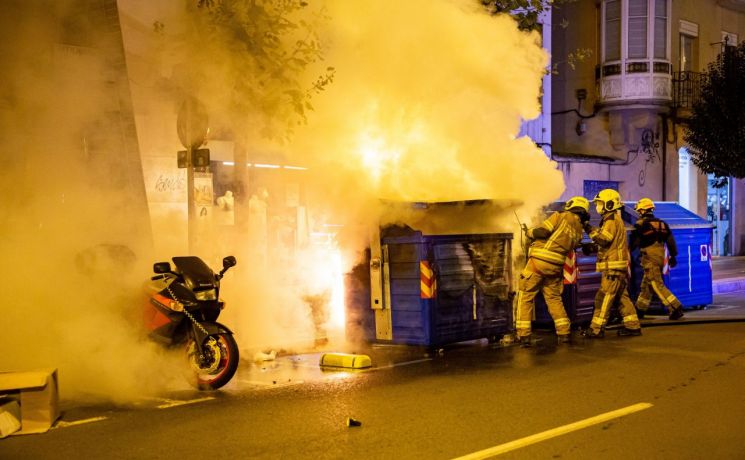 On the 1st (local time), firefighters in Logro?o, La Rioja, in north-central Spain, are extinguishing fires that broke out across the city during protests against the COVID-19 lockdown. On the 29th of last month, the Spanish Parliament announced the extension of the state of emergency, which was enacted to curb the spread of COVID-19, for six months until May next year, sparking large-scale protests nationwide. Logro?o, Spain=Photo by EPA Yonhap News
[Asia Economy Reporter Hyunwoo Lee] As the cumulative number of confirmed cases of the novel coronavirus infection (COVID-19) in Europe surpassed 10 million, expectations are growing that the brief economic recovery in the Eurozone (19 countries using the euro) in the third quarter will falter again. Forecasts suggest that the economic growth rate in the fourth quarter will turn negative again following the second quarter, raising concerns about a "double-dip" recession. Protests against the reimplementation of COVID-19 lockdown orders by authorities are intensifying, adding to the chaos.
According to foreign media including the Associated Press on the 1st (local time), a survey conducted among European economists by major foreign media forecasted that the Eurozone's fourth-quarter gross domestic product (GDP) growth rate will be -2.3% compared to the previous quarter. Earlier, on the 30th of last month, Eurostat announced that the Eurozone's third-quarter GDP growth rate rebounded sharply to 12.7% compared to the previous quarter, following a -11.8% decline in the second quarter. However, the economy is once again plunging into recession.
The concerns about an economic shock stem from the severe COVID-19 situation in Europe and the reimplementation of lockdown measures by various countries. According to global statistics site Worldometer, as of this day, the cumulative confirmed COVID-19 cases in the European region reached 10,170,973, surpassing 10 million. The ranking of cumulative confirmed cases by country is Russia (1,636,781), France (1,413,915), Spain (1,264,517), the United Kingdom (1,034,914), Italy (709,335), and Germany (544,346), among others.
Following France, Germany, and Spain, major European countries including the United Kingdom, Belgium, and Austria have simultaneously begun reimposing lockdown orders. According to the BBC, British Prime Minister Boris Johnson announced the reimplementation of a nationwide lockdown starting November 5 for four weeks, declaring a stay-at-home order across the UK. Belgium announced it will reimpose lockdown from November 1 to December 13, and Austria from November 3 to 30. The Portuguese government will implement strict lockdown measures from the 4th to the 15th, banning all outings except for purchasing essential goods and medical visits, and prohibiting gatherings of five or more people. Italy, which imposed restrictions on nighttime operations of restaurants and pubs from October 26, is reportedly considering high-intensity movement restrictions controlling residents' outings.
Protests against the reimposition of lockdown orders are also erupting fiercely. According to CNN, Spain, which declared a nationwide state of emergency and imposed a six-month nighttime curfew starting October 25, saw large-scale protests yesterday in the capitals Madrid and Barcelona. Thirty-two people were arrested in Madrid and twelve in Barcelona, with dozens injured. In Italy, since the nighttime operation restrictions began on October 26, simultaneous protests against lockdown orders have occurred in major cities nationwide including Rome, Milan, Turin, and Naples. Looting and arson incidents occurred, resulting in 28 arrests.
Economic experts warned that the economic downturn caused by the lockdown orders could last longer than expected. Christian Keller, chief economist at British investment bank Barclays, said, "While manufacturing outlook remains relatively stable, the reimposition of lockdowns will lead to a downturn in the service sector, which is directly affected, pushing the Eurozone economy, which had just begun to recover, back into negative growth." Carsten Brzeski, economist at ING, also said, "A double-dip recession is unavoidable, and this renewed lockdown will create a sense of crisis among consumers that more frequent lockdowns may occur next year, affecting behavior patterns. The Eurozone GDP growth rate next year is expected to be only about 0.7% quarter-on-quarter."
© The Asia Business Daily(www.asiae.co.kr). All rights reserved.

















