Park Neung-hoo "The Best Outcome Is Controlling the COVID-19 Outbreak at Stage 1"
[Asia Economy Reporters Seo So-jeong, Choi Dae-yeol] The government has subdivided the social distancing levels for responding to the novel coronavirus infection (COVID-19) from the existing 3 levels to 5 levels and will apply this from the 7th of this month. The distancing levels have increased from the previous 1, 2, and 3 levels to include levels 1.5 and 2.5, making a total of 5 levels, and the criteria for raising each level have been relaxed compared to before.
As COVID-19 has prolonged, the government aims to control the spread of COVID-19 below a manageable risk level, and instead of uniform measures on facilities and activities, it will limit operating hours and the number of users stepwise according to changes in risk levels. However, to suppress COVID-19 as much as possible, from level 1 of distancing, core quarantine rules such as mandatory mask-wearing will be enforced in 23 types of multi-use facilities.
"Existing 3-level social and economic damage excessive, difficult to operate"
Subdivision of 3-level system and strengthening regional response
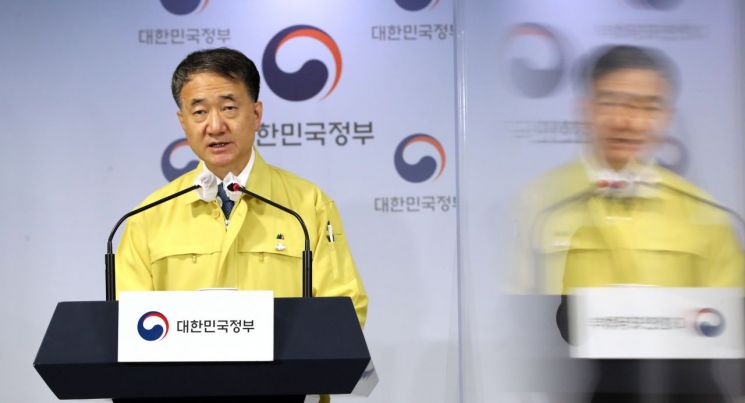
Park Neung-hoo, the first head of the Central Disaster and Safety Countermeasure Headquarters, said at a regular briefing held at the Government Seoul Office on the 1st, "The social distancing levels, which were previously 3 levels, will be subdivided into 5 levels," adding, "When levels were raised, social confusion and resistance were significant, and especially level 3 caused excessive social and economic damage, making it difficult to actually operate, which was reflected in this change."
The government previously maintained a 3-level system, but during actual level adjustments from August to October, it operated effectively as a 5-level system by implementing levels 1.5 and 2.5 considering social acceptability.
In particular, although the capacity for medical response has increased recently due to the expansion of intensive care units and other medical systems, the current criteria for raising levels were set too low based on initial medical capacity, which has been a problem.
Compared to major overseas cases, Korea’s criteria for raising levels were quite conservative. Major foreign countries use the number of confirmed cases per 100,000 population as a standard when strengthening quarantine measures.
The feature of this revision is that the existing 3-level system is further subdivided and regional responses are strengthened. The COVID-19 situation is broadly divided into everyday quarantine (level 1), regional outbreaks (levels 1.5 and 2), and nationwide outbreaks (levels 2.5 and 3), with levels 1.5 and 2.5 newly established by further subdividing regional and nationwide outbreak stages. The application of levels is also differentiated by seven regions: the Seoul metropolitan area, Chungcheong region, Honam region, Gyeongbuk region, Gyeongnam region, Gangwon, and Jeju.
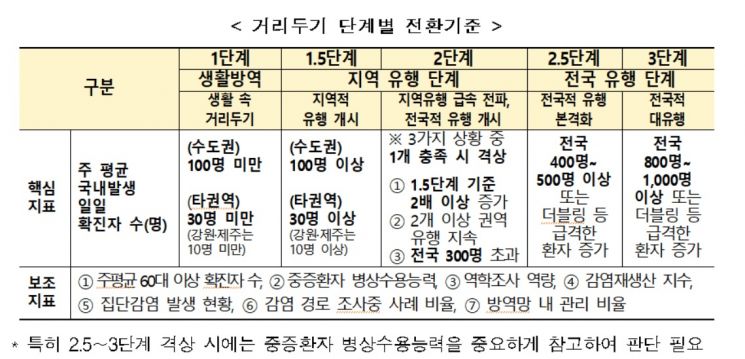
Head Park said, "We added levels 1.5 and 2.5, which the public is familiar with, classifying level 1 as everyday quarantine, levels 1.5 and 2 as regional outbreaks, and levels 2.5 and 3 as nationwide outbreaks," adding, "Among the subdivided levels, quarantine will be strengthened centered on outbreak regions up to the regional outbreak stage, and at the nationwide outbreak stage, which exceeds the usual capacity of our medical system, enhanced quarantine measures will be applied nationwide."
Also, considering the capacity of intensive care beds expanded so far, the criteria for raising levels have been adjusted. The weekly average daily number of patients is used as a core indicator, but various indicators such as the proportion of patients aged 60 and over and patterns of cluster infections are referenced to determine whether to adjust levels. For example, in the Seoul metropolitan area, if more than 100 domestic patients occur daily on average for one week, consideration will be given to raising to level 1.5.
Preparing for a prolonged COVID-19 battle... Strategy for coexistence of quarantine and daily life
Securing about 180 dedicated intensive care beds by year-end
Head Park emphasized the importance of establishing a sustainable response strategy that allows quarantine and daily life to coexist as much as possible in preparation for a prolonged battle with COVID-19. To this end, the goal is to proactively strengthen quarantine response capacity to block patient occurrence early.
Head Park said, "We will additionally recruit epidemiological investigation personnel and rapidly expand epidemiological investigation capacity through support from regional disease response centers," adding, "We will strengthen proactive full-scale testing for facilities such as nursing hospitals where high-risk groups are concentrated or where there is concern about spread."
He also stated that the core goal is to reduce the fatality rate by significantly strengthening medical response capacity and creating an efficient response system.
Head Park said, "We will not uniformly hospitalize all patients but will prioritize assigning mild and asymptomatic patients to residential treatment centers to secure hospital capacity for patient treatment and reduce medical staff fatigue."
Intensive care beds autonomously managed by medical institutions will be converted into government-managed dedicated COVID-19 intensive care beds, and the number of intensive care beds will be greatly expanded. Dedicated personnel will also be newly trained and developed, including recruiting nurses with intensive care unit experience.
Head Park explained, "By securing about 180 dedicated intensive care beds by the end of the year, even if about 250 new patients occur daily on average, appropriate treatment will be possible within the usual response capacity."
Finally, efforts will be made to strengthen social response fields so that quarantine and daily life can harmoniously coexist. Head Park said, "To prevent the burden of care at home from increasing due to COVID-19, we will strengthen tailored care for children, the elderly, and the disabled, and especially develop and diversify non-face-to-face community care methods such as home or visiting care."
The government will adjust current quarantine measures according to the revised content of level 1 distancing under the distancing reorganization plan, but considering the preparation period on site, it will be applied from the 7th.
However, the penalty imposition for mandatory mask-wearing will be applied from November 13, in line with the end of the previously announced guidance period.
Head Park said, "The best outcome is to control the COVID-19 outbreak at level 1 without raising levels," adding, "Currently, most quarantine rules remain recommendations, and the suppressive power of level 1 is insufficient, so existing quarantine rules have been reorganized." He added, "In the future, we will activate penalty imposition and claims for damages and encourage all citizens to participate responsibly in quarantine through various incentives."
© The Asia Business Daily(www.asiae.co.kr). All rights reserved.

![User Who Sold Erroneously Deposited Bitcoins to Repay Debt and Fund Entertainment... What Did the Supreme Court Decide in 2021? [Legal Issue Check]](https://cwcontent.asiae.co.kr/asiaresize/183/2026020910431234020_1770601391.png)















