Suncheon City Council Member Lee Young-ran... Claims No Deliberation, Legal Violation, No Benefit So Demolition Needed
Council Member A... Argues It's Not a Council Report Matter but Mayor's Administrative Discretion, No Problem
Officials... Claim R
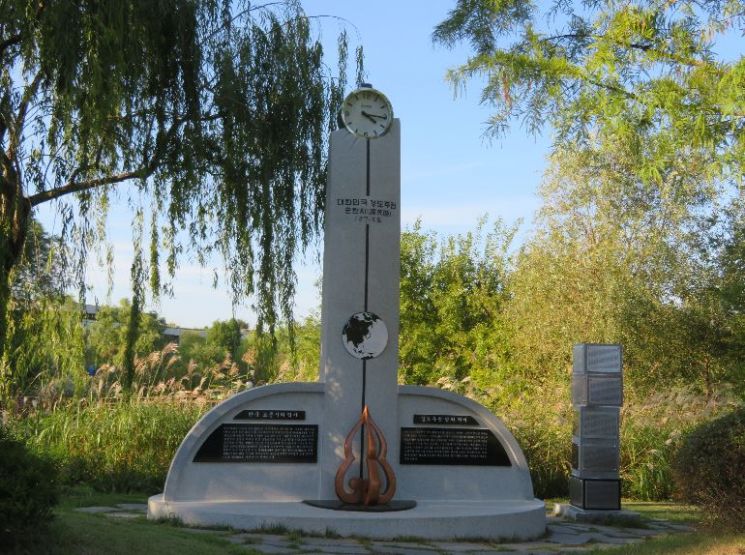
[Asia Economy Honam Reporting Headquarters Reporter Lee Hyung-kwon] On August 15th, the 75th anniversary of Liberation Day, a ‘Longitude Sovereignty Tower’ sculpture was installed at the ‘Suncheonman National Garden’ in Suncheon City, Jeollanam-do. It was created with voluntary donations from the ‘Longitude Sovereignty Recovery Citizens’ Movement Headquarters’ and Suncheon citizens to reclaim the Korean standard time that was taken away during the Japanese colonial period.
The clock installed at the top of the tower runs 30 minutes faster than the time we currently use.
Based on Suncheonman National Garden, located at longitude 127.5 degrees instead of Tokyo’s 135 degrees, our standard time has been changed to ‘Suncheon Time (時)’.
This sculpture is historically significant as a starting point in Suncheon to reopen public discussion and reflection on ‘longitude sovereignty’.
‘Longitude sovereignty’ refers to the story of Emperor Gojong of the Korean Empire, who first established a standard time based on 127.5 degrees longitude, adding 8 hours and 30 minutes to London time, and proclaimed this time to the world, representing Korea’s time. The movement aims to reclaim this Korean standard time.
After the forced annexation by Japan, the Governor-General of Korea unilaterally changed the Korean Empire’s standard time to Japanese standard time based on Tokyo’s 135 degrees longitude. Since then, Korea’s standard time has undergone hardships of restoration and re-change.
The term ‘longitude sovereignty’ emerged as a call to restore Korea’s sovereignty and pride by reclaiming its standard time.
The Syngman Rhee government restored the standard time after the Korean War, arguing that Korea’s longitude could not be the same as Japan’s for international time standards.
Later, the Park Chung-hee regime changed the standard time back to Tokyo time, and Korea has used Tokyo time as its standard time ever since.
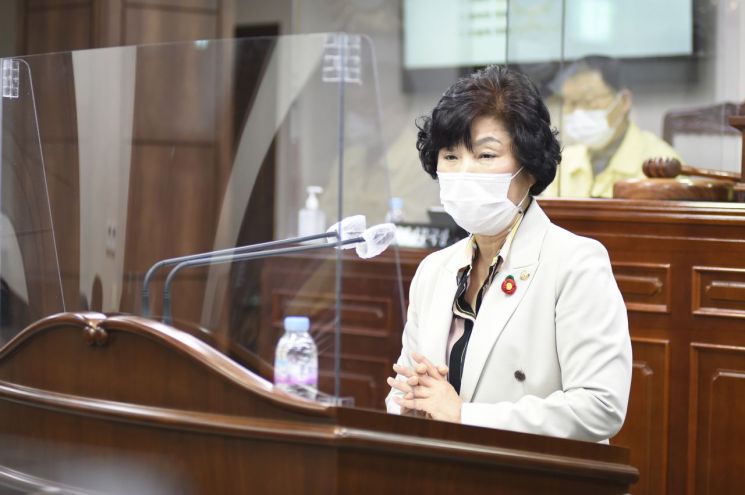
Lee Young-ran, a member of the Suncheon City Council, raised a claim that the ‘Longitude Sovereignty Tower’ sculpture donated by the ‘Longitude Sovereignty Recovery Movement Headquarters,’ led by Suncheon citizens who want to recover the lost Korean standard time and overcome a dark past, should be removed from the National Garden.
Councilor Lee argued that the installation of the Longitude Sovereignty Tower in Suncheonman National Garden did not undergo review by the Public Sculpture Review Committee, as required by the ordinance on the establishment and management of public sculptures in Suncheon City.
She also claimed that since donated property cannot be accepted if it does not benefit local finances, the Longitude Sovereignty Tower does not help Suncheon City’s finances.
Furthermore, according to the Act on the Solicitation and Use of Donations, anyone intending to solicit donations exceeding 10 million won must register with the Minister of the Interior and Safety or the provincial governor. The Longitude Sovereignty Recovery Citizens’ Movement Headquarters, which donated the tower, has never taken any such registration measures, thus violating the law, she pointed out.
She also urged Suncheon City to dismantle the Longitude Sovereignty Tower, stating that even its founding purpose could be politically misunderstood.
A Suncheon City official said, “It is hard to accept the claim that there is no benefit in Suncheon City receiving the Longitude Sovereignty Tower, which has high historical, geographical, and educational value, as a free donation without financial investment, and then exposing it to millions of National Garden visitors annually.”
A member of the Suncheon City Council, Councilor A, said, “Officials or Mayor Heo Seok should have given a proper response regarding the Longitude Sovereignty Tower,” and argued, “If the installation of the Longitude Sovereignty Tower required council approval, it would have been discussed and approved in advance. However, since the scale is small according to the ordinance, it had to be handled as an administrative discretionary act.”
In other words, if something is not subject to council approval, the council cannot make special claims without a report, and if the mayor is asked to report everything that can be done as an administrative discretionary act, it raises the question of how far that should go.
This implies that the mayor, as an elected official, should be able to exercise a certain degree of political discretionary administration, meaning that political obstruction should not be allowed even if the Longitude Sovereignty Tower is viewed politically.
Suncheon City official B said, “If there are procedural errors in administration and officials despite the good intentions of the Longitude Sovereignty Tower, that is a separate issue,” and added, “Discussing the dismantling of the Longitude Sovereignty Tower could be viewed from another perspective.”
Citizen C said, “The Suncheon City Council’s damage to the meaning of the Longitude Sovereignty Tower can only be interpreted as politically motivated,” and asked, “Isn’t the meaning of the Longitude Sovereignty Tower greater than the symbols of various organizations scattered throughout Suncheon City?”
The claim that sculptures donated by private organizations should not be installed in Suncheonman National Garden conflicted with the movement to correct Korea’s standard time and reclaim sovereignty.
Citizens responded that it would not be bad to have meaningful symbols in the National Garden, not just flowers and trees, and argued that the National Garden should be strictly managed by revising or reestablishing related ordinances and operational guidelines.
© The Asia Business Daily(www.asiae.co.kr). All rights reserved.


















