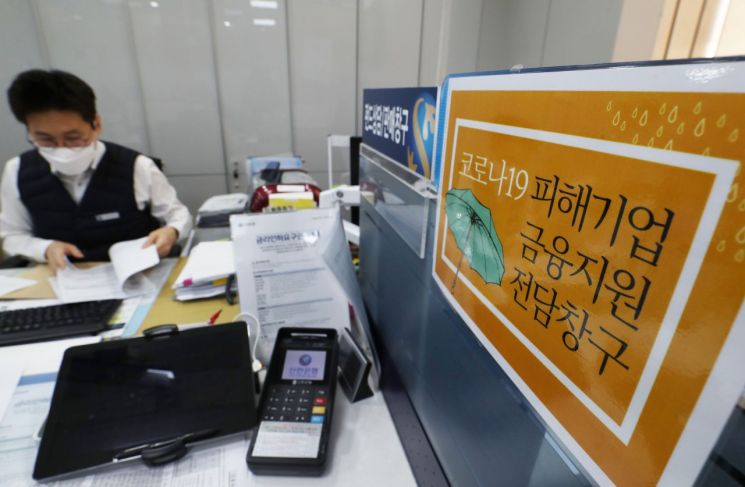
[Asia Economy Reporter Kim Min-young] The banking sector has established a model code that exempts responsible employees from liability in cases where loans to companies and small business owners affected by disasters such as the novel coronavirus infection (COVID-19) become non-performing, or when investments in startups and venture companies result in losses.
The Korea Federation of Banks announced on the 27th that its board of directors had enacted the "Model Code for Exemption from Liability in Banks' Innovative Financial Operations" at a meeting held the previous day.
This is part of follow-up measures to the "Comprehensive Reform Plan for the Financial Sector's Exemption System" announced by the Financial Services Commission and the Financial Supervisory Service on April 6. Each bank plans to incorporate the established model code into its internal regulations and implement it by the end of this year.
Previously, the need to reform the exemption system was raised as a prerequisite to further activate support for companies affected by COVID-19 and innovative finance. Currently, banks operate their own exemption systems, but there have been opinions that the criteria for intentional or gross negligence, which are exclusion conditions for exemption, are ambiguous, and that the interpretation by bank inspection departments is strict, making it difficult to actually receive exemption.
The Federation first clarified the scope of exemption. It limited it to five categories: financial support for companies and small business owners affected by disasters such as COVID-19; secured loans using movable property and intellectual property (IP); loans to small and medium-sized enterprises based on technological capability and future growth potential; direct and indirect investments and mergers and acquisitions (M&A) involving startups and venture companies; innovative financial services; and tasks related to designated agents.
The exemption requirements were also rationalized. For tasks subject to exemption, exemption will be granted unless there is intentional or gross negligence, improper solicitation, or violations of financial transaction targets and limits. In particular, when determining intentional or gross negligence, the absence of "private interests or significant defects under laws and internal regulations" will be considered as no intentional or gross negligence.
A Liability Exemption Review Committee will be newly established and operated within banks. The committee will include six members from related departments within the bank, external experts, and the inspection department. The committee reviews cases where the inspection department has dismissed exemption requests, judging that the reasons for exemption do not apply despite the applicant's request.
The results of the committee's review will be submitted along with the inspection report to the Personnel Committee (the final disciplinary decision body), which is instructed to respect the committee's review results as much as possible.
The newly established model code will also apply when reviewing sanctions related to exemption-targeted tasks (such as financial support during disasters like COVID-19) that have already been handled this year.
The Federation stated, "As the scale of funding for companies affected by COVID-19 and innovative finance expands, minimizing uncertainty regarding sanctions against bank employees is expected to enable faster and smoother financial support."
© The Asia Business Daily(www.asiae.co.kr). All rights reserved.
![Clutching a Stolen Dior Bag, Saying "I Hate Being Poor but Real"... The Grotesque Con of a "Human Knockoff" [Slate]](https://cwcontent.asiae.co.kr/asiaresize/183/2026021902243444107_1771435474.jpg)















