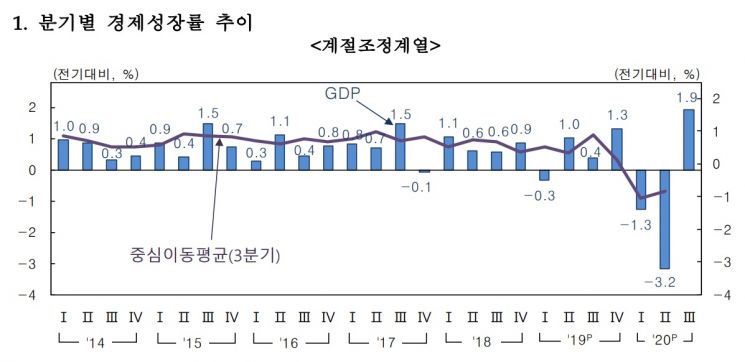
[Asia Economy Reporter Kim Eun-byeol] Overcoming two consecutive quarters of negative growth due to the shock of the novel coronavirus infection (COVID-19), the South Korean economy rebounded by nearly 2% in the third quarter. However, the third-quarter economic growth rate was largely influenced by the base effect from the easing of lockdown measures in the U.S. and Europe, making it difficult to view this as a 'V-shaped recovery.'
On the 27th, the Bank of Korea announced that the preliminary real Gross Domestic Product (GDP) for the third quarter was 456.8635 trillion won, an increase of 1.93% compared to the previous quarter. This is the highest quarterly GDP growth rate since the first quarter of this year (2.0%). However, compared to a year ago, it still shows a contraction of -1.3%, continuing the negative growth trend.
The rapid recovery in exports, driven by the lifting of lockdown measures in the U.S. and Europe, was a key factor in quickly boosting the growth rate. Exports, which had plummeted to -16.1% in the second quarter?the worst shock since 1970?increased by 15.6% in the third quarter. In particular, exports, a mainstay of the South Korean economy, grew centered on automobiles and semiconductors. Imports also increased by 4.9%, mainly in crude oil and chemical products, turning positive from -6.7% in the second quarter.
Private consumption, which grew by 1.5% in the first quarter, turned negative again (-0.1%). This was due to strengthened social distancing measures following the resurgence of COVID-19 starting in mid-August. The record-breaking monsoon rains and heavy rainfall this summer also appear to have reduced private consumption. Government consumption increased by 0.1%, mainly due to health insurance benefit payments.
Construction investment decreased by 7.8%, mainly in civil engineering, due to the impact of the monsoon and a reduction in the government's social overhead capital (SOC) budget. The decline in construction investment was the largest on a quarterly basis since the first quarter of 1998 (-9.6%). The government significantly cut the SOC budget as it spent money on transfer payments such as emergency disaster relief funds and consumption coupons to respond to the COVID-19 crisis. A positive aspect is that facility investment increased significantly. Facility investment rose by 6.7% as machinery such as semiconductors and displays, as well as transportation equipment, all increased.
Meanwhile, real Gross Domestic Income (GDI) in the third quarter increased by 2.5% due to improved terms of trade. Real GDI outpaced real GDP growth. An increase in GDI can improve corporate profitability, enabling consumption and investment, and is expected to have a positive impact on employment.
© The Asia Business Daily(www.asiae.co.kr). All rights reserved.
![Clutching a Stolen Dior Bag, Saying "I Hate Being Poor but Real"... The Grotesque Con of a "Human Knockoff" [Slate]](https://cwcontent.asiae.co.kr/asiaresize/183/2026021902243444107_1771435474.jpg)















