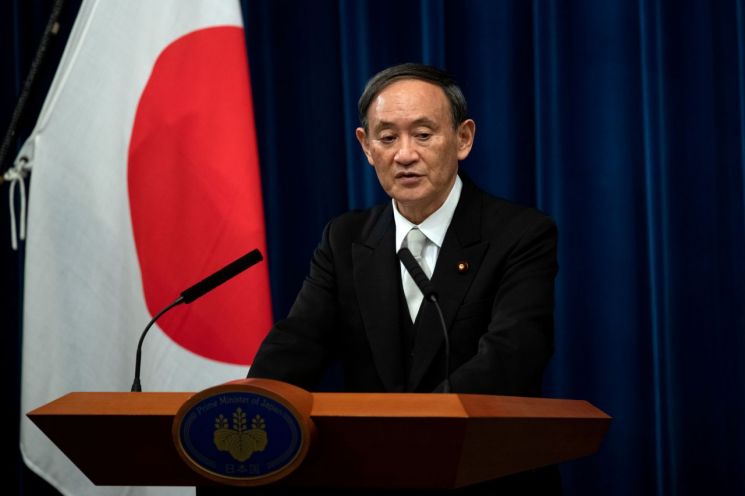
[Asia Economy Reporter Jeong Hyunjin] Japanese Prime Minister Yoshihide Suga has set the resolution of the forced labor compensation issue, the biggest pending matter between Korea and Japan, as a condition for attending the upcoming Korea-China-Japan summit to be held in Korea. Meanwhile, Japan's Tokyo Shimbun criticized Prime Minister Suga for showing 'self-contradictory' behavior and argued that he should attend without conditions and engage in open dialogue.
On the 26th, Tokyo Shimbun expressed this stance in an editorial titled "Attend the Korea-China-Japan Summit and Engage in Open Dialogue." Tokyo Shimbun stated, "Regarding the Korea-China-Japan summit scheduled to be held in Korea, the Japanese government reportedly conveyed to the Korean side that measures on the former forced laborers (Korean forced laborers under Japanese rule) issue are necessary as a prerequisite for attendance," and pointed out that "attaching conditions to attendance is inappropriate."
The Korea-China-Japan summit is held annually on a rotating basis among the three countries, and this year, Korea, as the chair country, is coordinating the schedule to host the summit. Prime Minister Suga had previously expressed the position that he could visit Korea only if the Korean government presents measures to resolve the issue of compensation for forced labor under Japanese rule.
In response, Tokyo Shimbun mentioned that the sale process of Japanese company assets seized due to compensation lawsuits in Korea is underway, saying, "From Prime Minister Suga's standpoint, he is likely concerned about domestic criticism if the cash conversion occurs immediately after his year-end visit to Korea," but emphasized, "However, precisely because there is an issue, they must meet directly to find a point of agreement."
It continued, "The Korea-China-Japan summit was originally a place to discuss common challenges," and pointed out, "If bilateral issues are raised there as conditions for attendance, it will become difficult to hold regular summits in the future." Tokyo Shimbun also referred to the case when the Korea-China-Japan summit was held after three and a half years, noting that former President Park Geun-hye showed the perception that Japan's proactive response to the comfort women issue was a condition for holding the summit.
Tokyo Shimbun criticized the current situation as self-contradictory by mentioning that then Chief Cabinet Secretary Suga said at a regular press conference, "We should not attach preconditions when meeting leaders of neighboring countries." Tokyo Shimbun added, "Recently, there have been movements where lawmakers from both Korea and Japan visit the other country to seek solutions," and urged, "As we enter next year, both countries will face important election schedules and will have less time for summits. This opportunity must be seized."
© The Asia Business Daily(www.asiae.co.kr). All rights reserved.
![Clutching a Stolen Dior Bag, Saying "I Hate Being Poor but Real"... The Grotesque Con of a "Human Knockoff" [Slate]](https://cwcontent.asiae.co.kr/asiaresize/183/2026021902243444107_1771435474.jpg)















