Ministry of Health and Welfare and Korea Health Promotion Institute Establish 'Walking Guidelines for Koreans'
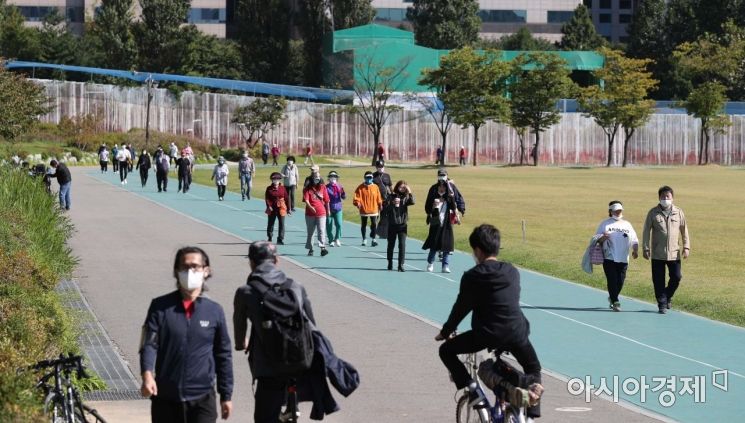
[Asia Economy Reporter Seo So-jeong] Recently, as physical activity has decreased due to the novel coronavirus infection (COVID-19), increasing the risk of obesity, the government has established walking guidelines specifically for Koreans to help maintain health in daily life.
The Ministry of Health and Welfare and the Korea Health Promotion Institute announced on the 25th that they have prepared the "Walking Guidelines for Koreans" to promote public health through the activation of walking.
According to a "Health Investment Awareness Survey" conducted this year by the Korea Health Promotion Institute on 1,031 citizens, 32.9% of respondents answered that "before COVID-19, they engaged in sufficient physical activity, but currently they do not." Additionally, 32.1% of respondents reported "weight gain" as a lifestyle change after COVID-19.
The adult obesity rate increased from 30.9% in 2014 to 34.6% in 2018, while during the same period, the rate of aerobic physical activity practice decreased from 58.3% to 47.6%.
Walking is a physical activity that can be practiced in daily life while maintaining social distancing and adhering to quarantine guidelines.
Regular walking reduces the risk of death and obesity, lowers the risk of developing eight major cancers (breast, colon, bladder, endometrial, esophageal, kidney, lung, and stomach cancer), as well as heart disease, stroke, dementia, and diabetes. It also decreases the risk of depression, improves sleep quality, contributes to mental health promotion, and helps enhance cognitive function.
The walking guidelines were developed by gathering opinions from walking experts and through deliberation by the Ministry of Health and Welfare’s Nutrition and Obesity Expert Committee (Chair: Professor Kang Jae-heon, Department of Family Medicine, Kangbuk Samsung Hospital, Sungkyunkwan University School of Medicine).
To experience the benefits of walking, it is recommended to walk briskly for at least 150 minutes per week (walking while able to talk but not sing) or walk very briskly for 75 minutes per week (walking while unable to talk). When mixing brisk walking and very brisk walking, note that 1 minute of very brisk walking equals 2 minutes of brisk walking.
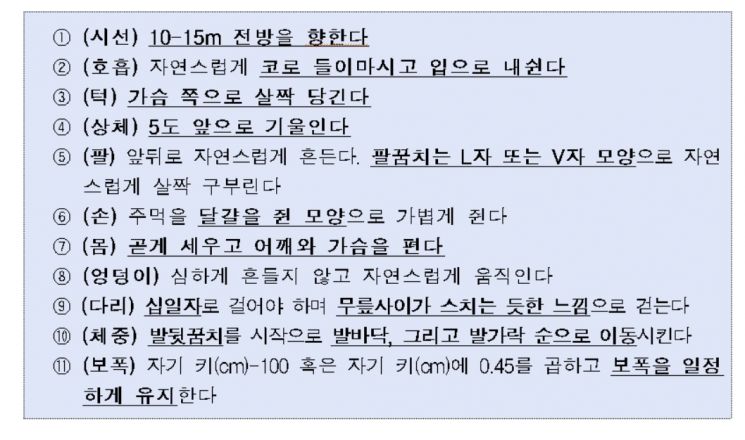
When walking, gaze should be directed 10 to 15 meters ahead, breathing naturally by inhaling through the nose and exhaling through the mouth. The chin should be slightly pulled toward the chest, and the upper body should lean forward about 5 degrees. Arms should swing naturally back and forth, with elbows slightly bent in an L or V shape. Fists should be lightly clenched as if holding an egg, and the hips should move naturally without excessive swaying.
Legs should walk in a straight line, with the knees brushing lightly against each other. Weight should shift from the heel to the sole and then to the toes. Warm-up and cool-down exercises should be performed before and after walking. When starting to walk, begin slowly for about 5 minutes, then increase speed, and gradually slow down when finishing.
In daily life, office workers using buses or subways can increase walking activity by getting off earlier to walk, using stairs instead of elevators, and making walking companions.
Additionally, to prevent COVID-19, masks should be worn and a distance of 2 meters between people should be maintained. If breathing becomes difficult, move to a place without people, briefly remove the mask, and rest.
Lee Yoon-shin, Director of the Health Promotion Division at the Ministry of Health and Welfare, said, "In a situation where citizens’ lifestyles have greatly changed due to COVID-19, we expect the walking guidelines to serve as a health lifestyle manual."
© The Asia Business Daily(www.asiae.co.kr). All rights reserved.


















