2030 Stock Investment Boom
Frowns Over New Listing 'BigHit' Decline
Chat Rooms Like 'Refund Applicants Group'
"Ultimately, Retail Investors Are Thoroughly the Weak
Regret Beating the Ground Trying to Make Easy Money"
2030 Investment Failure 'Wails'
[Asia Economy Reporters Donghoon Jeong, Intern Journalists Juni Park, Suhwan Kim, Seungseop Song] "People around me kept urging me to buy because the stock price was 'Tteoksang' (rapid surge), and I was blinded by the desire to make easy money, leading to an irreversible mistake."
Kim Jincheol (pseudonym), a self-employed man in his 30s, recently bought 60 million KRW worth of Big Hit Entertainment stocks and now regrets it deeply. On the first day of Big Hit's IPO on the 15th, he invested in stocks for the first time in his life, only to suffer losses as Big Hit's stock price plummeted day after day. He even created an anonymous chatroom on social networking service (SNS) called 'Big Hit Refund Applicants Group,' but refunds were impossible. Kim said, "I lost tens of millions of won in an instant and feel a great sense of loss, but I am 'Jonbeo' (enduring with respect) with hope that the stock price will rise again."
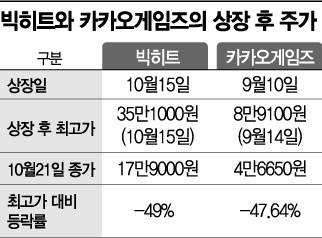
The stock investment frenzy among the 20s and 30s generation is facing a backlash. Since young people's stock investment funds are often not surplus assets or constitute a large portion of their total assets, stock price fluctuations cause anxiety and can lead to significant losses. In fact, many young investors who made 'blind investments' in Big Hit, considered the biggest IPO of the year, suffered huge losses right after the listing. On SNS, there are many young people mocking themselves with the term 'Bithit' (debt + Big Hit). There is concern that excessive expectations of risky assets among young people, without accurate corporate analysis or consideration of macroeconomic conditions, can lead to substantial investment losses.
Lee (27, Bupyeong-gu, Incheon), an office worker, invested in Kakao Games, which was listed last month, and based on his experience of 'Ttasangsang' (IPO price doubled + two consecutive days of upper limit price), he also bought Big Hit stocks. Currently, 5 million KRW has dropped to 3 million KRW. Lee, who has been investing in stocks for three months, has mostly traded blue-chip stocks like Naver, Kakao, LG Chem, Apple, and Tesla, enjoying decent returns so far. However, with a 40% loss in Big Hit stocks, his overall stock investment performance has fallen to -20%. Lee said, "My girlfriend is a fan of BTS, so I knew a lot about Big Hit and judged that it was worth investing after seeing BTS songs dominate the Billboard charts."
Hong (28, Dongjak-gu, Seoul), an office worker, bought 10 shares of Big Hit on the first day of listing but sold them within 20 minutes. The stock price, which was 320,000 KRW per share, dropped to 290,000 KRW, prompting a hurried sale. Hong said, "I didn't expect the price to fall right after buying," adding, "Looking at the current price, it's dizzying. If I hadn't sold then, I might have quit stocks altogether."
As cases of Big Hit stock investment failures continue, a 'Big Hit Shareholders Countermeasure Committee' was created on KakaoTalk open chat on the 16th. In this chatroom with about 140 participants, one investor wrote, "I didn't know a thing about stocks and even borrowed money from my parents to buy 20 million KRW worth at 305,000 KRW per share, but I got screwed." An investor with the ID 'Bithit' wrote, "The bad news for Big Hit was BTS's military service issue, but wasn't the controversy over military service exemption already planned? I learned again from 'Bithit' that retail investors are thoroughly the weak in the stock market." Professor Sung Tae-yoon of Yonsei University's Department of Economics advised, "Stocks are assets with high price volatility and thus carry significant risk compared to other assets. For healthy investing, one needs to study economic conditions and policies independently. It is advisable to avoid investing in stocks with assets that need to be liquidated in the short term rather than assets that can be tied up long-term."
© The Asia Business Daily(www.asiae.co.kr). All rights reserved.
![Clutching a Stolen Dior Bag, Saying "I Hate Being Poor but Real"... The Grotesque Con of a "Human Knockoff" [Slate]](https://cwcontent.asiae.co.kr/asiaresize/183/2026021902243444107_1771435474.jpg)















