As of September this year, 4,189 contracts compared to 2,717 last year
New Lease Law causes Jeonse crisis... Sharp rise in new Jeonse contract prices
Increase in landlords' actual residence deepens supply-demand imbalance
Expansion of high-priced Jeonse from Gangnam to Gangbuk areas
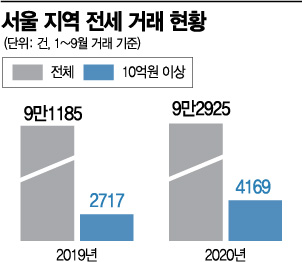
[Asia Economy Reporter Onyu Lim] This year, the volume of apartment jeonse (long-term lease) transactions in Seoul priced at 1 billion KRW or more has surged by over 65% compared to the same period last year. This is the result of a sharp price increase caused by the new Housing Lease Protection Act amid strengthened owner-occupancy requirements related to reconstruction and capital gains tax. In particular, as the imbalance between jeonse supply and demand worsened, high-priced jeonse transactions, which were concentrated in the Gangnam area, have rapidly expanded to the Gangbuk area.
On the 19th, Asia Economy analyzed the actual transaction prices disclosed by the Ministry of Land, Infrastructure and Transport and found that from the beginning of this year to September, there were a total of 4,169 jeonse contracts in Seoul priced at 1 billion KRW or more. This represents a 65.2% increase compared to 2,717 transactions during the same period last year. The proportion of jeonse transactions priced at 1 billion KRW or more among all jeonse transactions in Seoul also rose from 3.0% to 4.5%. The total number of jeonse transactions in Seoul from January to September was 91,185 last year and 92,925 this year.
The sharp increase in jeonse transactions priced at 1 billion KRW or more appears to be significantly influenced by government policies. The shortage of jeonse supply began in earnest as long-term holding special deductions on capital gains tax and owner-occupancy requirements related to reconstruction were strengthened through real estate measures on December 16 last year, June 17 this year, and July 10 this year. Furthermore, the implementation of the new Housing Lease Protection Act at the end of July, which includes the rent ceiling system and the right to request contract renewal, has further fueled instability in the jeonse market. This is because the number of landlords choosing to live in their properties instead of signing jeonse contracts has rapidly increased, and landlords have sharply raised jeonse prices by considering four years’ worth of rent increases when signing new contracts.
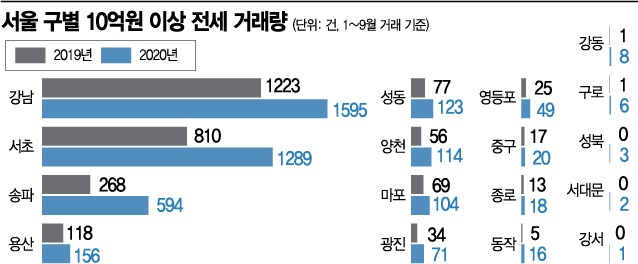
The district with the highest number of jeonse transactions priced at 1 billion KRW or more within Seoul was Gangnam-gu. There were a total of 1,595 transactions, an increase of 372 (30%) compared to 1,223 transactions in the same period last year. In particular, Daechi-dong, known as the "No. 1 school district" with high jeonse demand, recorded 430 transactions priced at 1 billion KRW or more. Adjacent Dogok-dong had 365 such transactions. Seocho-gu also had many high-priced jeonse transactions, with 1,289 transactions priced over 1 billion KRW, up by 479 from 810 last year. Following this, Songpa-gu increased from 268 to 594 transactions, highlighting a notable rise in high-priced jeonse transactions in the three Gangnam districts.
Jeonse transactions priced at 1 billion KRW or more have rapidly expanded to the Gangbuk area as well. Not only popular areas such as Yongsan-gu (118 → 156), Seongdong-gu (77 → 123), Yangcheon-gu (56 → 114), and Mapo-gu (69 → 104), but also mid-to-low-priced apartment areas like Seongbuk (3 transactions), Seodaemun (2 transactions), and Gangseo (1 transaction) have seen a series of high-priced jeonse deals. For example, on the 5th of last month, a 198㎡ (exclusive area) apartment in Star Palace, Jangwi-dong, Seongbuk-gu, was leased for 1 billion KRW, and earlier, a 175㎡ unit in Hillstate Sinchon, Bukahyeon-dong, Seodaemun-gu, was transacted for 1.1 billion KRW.
Kyunghee Yeo, Senior Researcher at Real Estate 114, said, "With the new Housing Lease Protection Act causing a severe shortage of jeonse listings and the demand continuing during the autumn moving season, the rate of jeonse price increases is expanding. Although the government has announced plans to implement additional measures, it is difficult to immediately resolve the supply-demand imbalance, so there is a possibility that jeonse price increases will spread throughout the metropolitan area."
© The Asia Business Daily(www.asiae.co.kr). All rights reserved.
![Clutching a Stolen Dior Bag, Saying "I Hate Being Poor but Real"... The Grotesque Con of a "Human Knockoff" [Slate]](https://cwcontent.asiae.co.kr/asiaresize/183/2026021902243444107_1771435474.jpg)

















