Large-scale pressure expected like in Korea
US negotiation representative is the same as Korean negotiation representative
Negotiations planned for 5 years but may end in 1 year
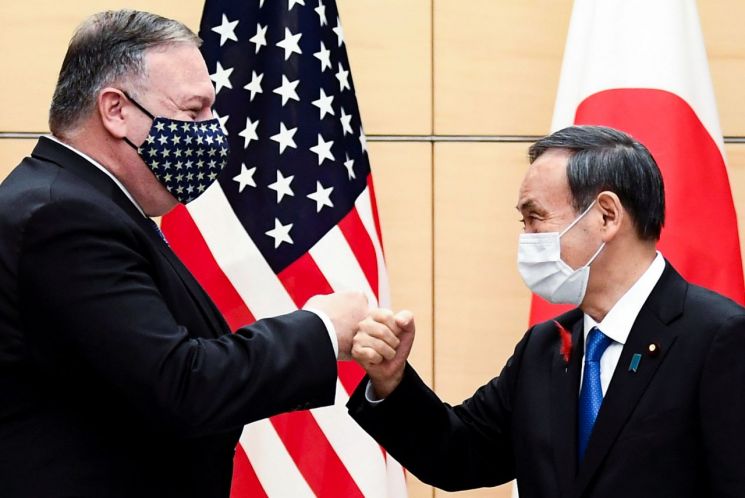 U.S. Secretary of State Mike Pompeo and Japanese Prime Minister Yoshihide Suga are shaking hands with a fist bump.
 [Image source=Reuters Yonhap News]
[Asia Economy New York=Correspondent Baek Jong-min] The U.S. Department of State announced on the 16th (local time) that the United States and Japan have begun negotiations on defense cost-sharing related to the U.S. Forces Japan deployment.
Amid stalled defense cost-sharing negotiations between South Korea and the U.S., attention is focused on how the U.S. will proceed with negotiations with Japan.
The U.S. Department of State stated in a press release that "the Japanese government and the U.S. government held preliminary consultations on 'Host Nation Support' via video conference on the 15th and 16th."
It added, "The chief representatives shared their views on mutual contributions to the (U.S.-Japan) alliance and agreed to continue coordinating the framework and timing of formal negotiations."
From the U.S. side, newly appointed defense cost-sharing negotiator Donna Welton participated. Welton was appointed in early August and is responsible for defense cost negotiations with South Korea and Japan.
The special agreement on defense cost-sharing between the U.S. and Japan, which has a validity period of five years, will expire in March next year. This year, Japan's burden amounts to 197.4 billion yen (approximately 2.15 trillion KRW).
In this regard, former White House National Security Advisor John Bolton revealed in his memoir that President Donald Trump demanded an increase to 8 billion dollars (approximately 9.2 trillion KRW) from Japan.
Kyodo News, citing sources, reported that the U.S. and Japan might reach a provisional one-year agreement instead of a five-year deal.
Previously, South Korea also reached a short-term one-year agreement in the 10th defense cost-sharing agreement instead of five years. Since then, the U.S. and South Korea have failed to reach an agreement on the 11th agreement even after the validity period expired.
© The Asia Business Daily(www.asiae.co.kr). All rights reserved.

















