First Visit to the U.S. After Appointment as National Security Advisor
Interest in Whether Hanmi Will Find Common Ground on Current Issues
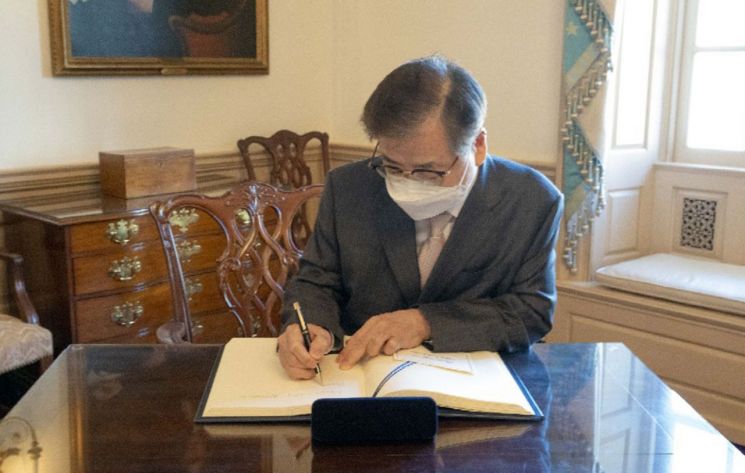 National Security Office Director Suh Hoon is writing in the guestbook on the afternoon of the 15th (local time) at the U.S. Department of State in Washington DC before meeting with Secretary of State Mike Pompeo.
 Seo Hoon, Director of the National Security Office at the Blue House, visited the United States for the first time since his appointment and held a series of meetings with high-level officials. The main focus is on whether he will coordinate a consensus on the recently contentious issues surrounding the timing of the transfer of wartime operational control and the scale of U.S. troop deployment in South Korea amid defense cost-sharing negotiations, as well as the "Declaration of the End of War" proposed by President Moon Jae-in.
First, it is believed that Director Seo has taken steps to coordinate at a high level regarding the various disagreements that have recently surfaced between South Korea and the U.S. Recently, the two countries have revealed differing views not only on the transfer of wartime operational control but also on defense cost-sharing and the maintenance of U.S. forces in South Korea. U.S. Secretary of Defense Mark Esper pressed strongly for a significant increase in South Korea's defense cost-sharing during the 52nd Security Consultative Meeting (SCM) held in Washington, D.C. Since the defense cost-sharing negotiation representatives from both countries hold separate meetings, this issue was not a major agenda item at the SCM. However, the timing of the transfer of wartime operational control was publicly exposed as a point of disagreement. This is interpreted as a blatant use of the operational control issue to pressure for increased defense contributions. Notably, the phrase "maintaining the current level of U.S. forces in South Korea" was omitted for the first time in 12 years, sparking controversy. In the aftermath of the U.S.-China hegemonic competition, the U.S. side is also demanding that South Korea exclude Chinese IT products such as Huawei. This represents a comprehensive U.S. pressure campaign.
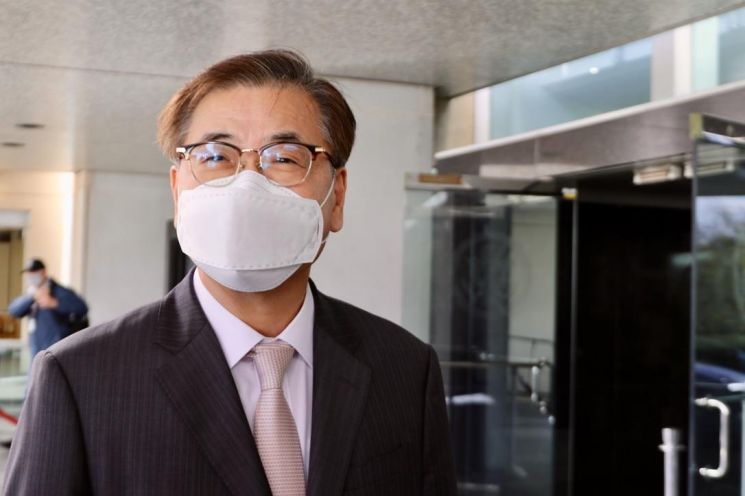 Seo Hoon, Director of the National Security Office at the Blue House, is answering questions from correspondents after meeting with Secretary of State Mike Pompeo at the U.S. Department of State building in Washington, D.C., on the 15th (local time).
 The Korean Peninsula issue, including the Declaration of the End of War, is also a key agenda item. President Moon reiterated the Declaration of the End of War card in his speech at the United Nations (UN) General Assembly on the 23rd of last month. The diplomatic and security teams have been moving urgently around this time. Choi Jong-geun, First Vice Minister of Foreign Affairs, visited the U.S. on the 9th of last month, and Lee Do-hoon, Director-General for Korean Peninsula Peace and Security Affairs at the Ministry of Foreign Affairs, visited on the 27th. Kim Hyun-chong, Second Deputy Director of the National Security Office at the Blue House, also visited the U.S. from the 16th to the 20th of last month, holding a series of contacts with White House and U.S. government officials. Despite the international community's cold response and criticism from opposition parties, President Moon expressed his urgent will for thawing relations on the Korean Peninsula by mentioning the Declaration of the End of War again in his speech at the Korea Society on the 8th.
The government is defending against claims that there are differences of opinion with the U.S. regarding the Declaration of the End of War. Ambassador Lee Soo-hyuk to the U.S. stated on the 11th (local time), "The U.S. government also shows a positive response regarding the Declaration of the End of War," adding, "It is possible if North Korea agrees." He emphasized, "This is based on contacts with senior U.S. officials," and said, "The U.S. response is that the Declaration of the End of War has enough value to be considered."
Therefore, if U.S. Secretary of State Mike Pompeo's visit to South Korea took place, it is highly likely that this issue was discussed in detail. There is speculation that Director Seo personally traveled to the U.S. to meet with Secretary Pompeo for follow-up coordination.
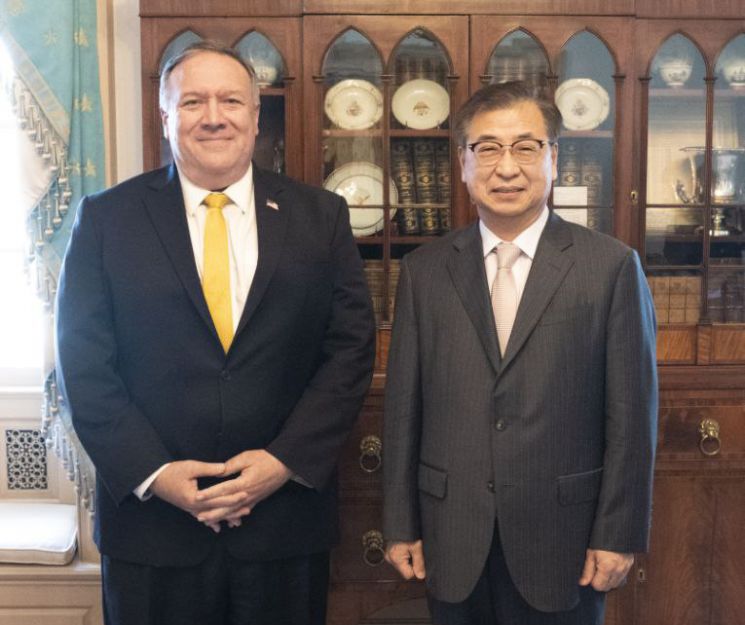 National Security Advisor Suh Hoon and U.S. Secretary of State Mike Pompeo are taking a commemorative photo before their meeting at the U.S. Department of State in Washington DC on the afternoon of the 15th (local time).
 On the 15th (local time), Director Seo met with U.S. Secretary of State Mike Pompeo at the State Department building in Washington, D.C., and told reporters, "The issue of the Declaration of the End of War is not a new matter," adding, "It has always been on the negotiation table, and there can be no differing views between South Korea and the U.S. on that part."
He said, "The issue is only about the sequence in the denuclearization process or the degree of linkage with denuclearization," and added, "It is better not to make overly different or excessive interpretations." However, Director Seo added that during his visit to the U.S., "We did not have particularly deep discussions about the Declaration of the End of War."
Regarding the deadlock over defense cost-sharing, he said, "We did not have very deep conversations," and added, "It is desirable to reach a reasonable and mutually acceptable agreement as soon as possible."
When asked about the controversy sparked by Ambassador Lee Soo-hyuk's remark at the National Assembly audit on the 12th that "South Korea chose the U.S. 70 years ago, but that does not mean it will choose the U.S. for the next 70 years," Director Seo refrained from commenting, saying, "It would be better to confirm directly with the ambassador." However, he added, "The correspondents probably know better what kind of thoughts the ambassador usually has about South Korea-U.S. relations," and said, "I think there might have been some misunderstanding."
Director Seo's visit to the U.S. is also seen as a move to prepare for the new U.S. administration beyond coordinating opinions on current issues. In particular, the U.S. policy toward North Korea is a decisive variable for resolving Korean Peninsula issues, including the Declaration of the End of War.
Lee Ki-dong, Senior Research Fellow at the National Security Strategy Institute, said, "Once the U.S. foreign and security policy is decided, it does not change easily," adding, "How to manage the adjustment period of the new U.S. administration's foreign and security policy in the first half of next year is very important." He emphasized, "Before the U.S. policy toward North Korea is finalized, South and North Korea need to advance the peace process first," and added, "Such progress and a peaceful atmosphere should be reflected in the establishment of the U.S. policy toward North Korea, including the denuclearization process."
© The Asia Business Daily(www.asiae.co.kr). All rights reserved.
![Clutching a Stolen Dior Bag, Saying "I Hate Being Poor but Real"... The Grotesque Con of a "Human Knockoff" [Slate]](https://cwcontent.asiae.co.kr/asiaresize/183/2026021902243444107_1771435474.jpg)

















