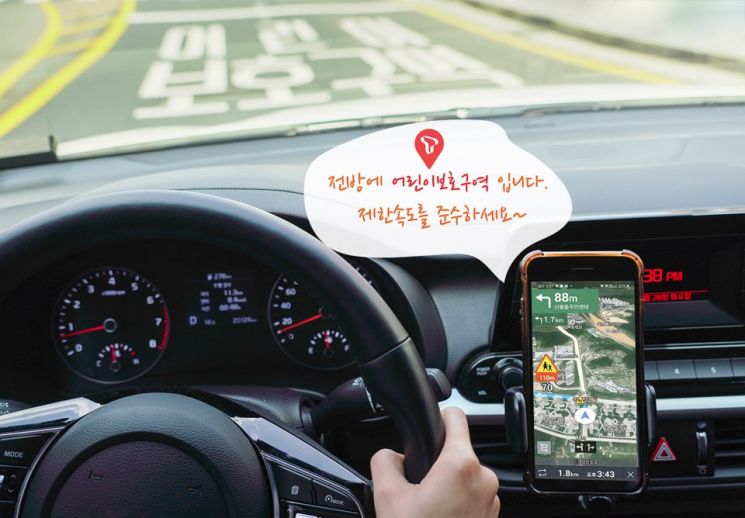
[Asia Economy Reporter Seulgina Cho] SK Telecom has officially announced the spin-off of its mobility business centered around T map. Through an extraordinary general meeting of shareholders next month, the newly established company tentatively named 'T map Mobility Co., Ltd.' will take its first step. The mobility alliance will also be in full swing, with global ride-sharing company Uber investing in the new corporation and establishing a joint venture.
Through this, they plan to launch an 'All-in-One MaaS' service that offers discount benefits by bundling taxi, ride-sharing, rental cars, and public transportation, and aim to challenge future mobility such as flying cars.
◆No SK in the company name... Intent to dominate the platform led by 'T map'
According to SK Telecom on the 16th, the company resolved at the board meeting held the previous afternoon to establish a 'mobility specialized company' to swiftly respond to the rapidly changing global mobility industry. The mobility industry, which refers to services that enhance people's movement and logistics convenience through ICT, is gaining attention as a key sector for future society.
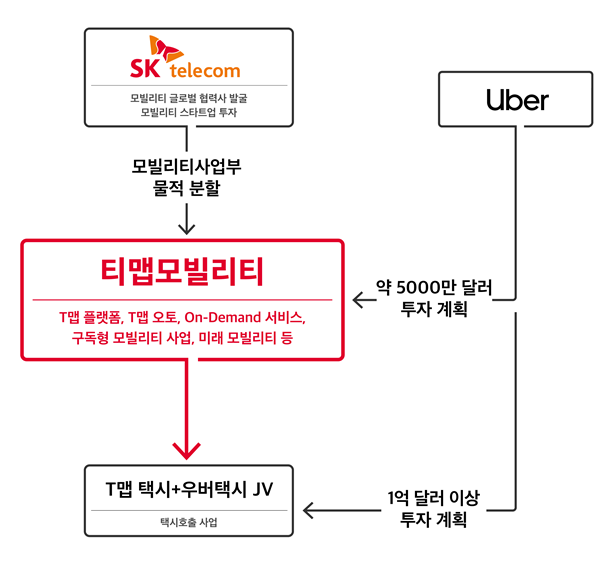
SK Telecom will spin off the 'Mobility Business Unit,' which has been promoting the T map platform and T map Taxi business, and establish 'T map Mobility Co., Ltd.' (tentative name) within this year. The extraordinary general meeting of shareholders is scheduled for November 26, and the spin-off date is December 29.
While the new company's name does not reveal SK, it prominently features 'T map,' the largest domestic navigation service with 18.5 million subscribers. This reflects the intention to grow T map, which encompasses mobility, artificial intelligence (AI), big data, and 5G mobile communications?future growth engines?into a super mobility platform for the Fourth Industrial Revolution era.
SK Telecom stated, "The specialized company will have a flexible structure that can deliver strong drive and execution through independent management," and explained, "We plan to quickly develop and provide next-generation services, collaborate with various leading domestic and international companies, and attract investments to secure market leadership."
◆Alliance with ‘Uber’... Establishing a taxi joint venture to bring a fresh breeze
‘T map Mobility’ plans to grow its ecosystem through close cooperation with various domestic and international companies.
First, in the first half of next year, it will establish a joint venture with Uber for e-hailing joint business such as taxi calls. Through this, they aim to bring a fresh breeze to the stagnant domestic taxi-hailing market and provide innovative services to customers. The joint venture is expected to combine T map Mobility’s T map Taxi drivers, map and vehicle traffic analysis technology with Uber’s global operational experience and platform technology to develop an innovative taxi-hailing business that enhances consumer convenience.
Additionally, Uber plans to invest more than $100 million (approximately 115 billion KRW) in the joint venture and about $50 million (approximately 57.5 billion KRW) in ‘T map Mobility’ to strengthen the strategic partnership between the two companies. Uber’s total investment will exceed $150 million (approximately 172.5 billion KRW).
◆"Discounts on all transportation modes with a monthly subscription" Launching the ‘All-in-One MaaS’ business
The core assets of ‘T map Mobility’ are the mobility platform T map, which holds a 70% market share domestically, and the taxi-hailing service T map Taxi. T map Taxi is the second-largest taxi-hailing service in Korea with 200,000 registered drivers and 750,000 monthly users. There are also growth businesses such as T map Auto for automakers, T map Public Transportation, and T map Parking. The new company plans to focus on launching various innovative services centered on customer convenience and safety based on these assets.
The four core mobility businesses are ▲platform business based on Korea’s No.1 ‘T map’ including parking, advertising, and UBI (usage-based insurance) products ▲‘T map Auto’ for automakers including IVI (in-vehicle infotainment system) and in-car payments ▲‘Mobility On-Demand’ including taxi-hailing and designated driver services ▲‘All-in-One MaaS (Mobility as a Service)’ offering subscription-based discounts on various transportation modes.
In particular, ‘T map Mobility’ plans to differentiate itself by launching the ‘All-in-One MaaS’ service as a subscription model that bundles rental cars, car-sharing, taxis, short-distance mobility (electric kickboards, bicycles, etc.), designated drivers, and parking with discount benefits.
SK Telecom explained, "The average monthly transportation cost per household in Korea is 350,000 KRW, totaling 84 trillion KRW annually. Just as the past introduction of the ‘public transportation transfer system’ improved passenger convenience, the establishment of a ‘mobility subscription discount system’ will enable users to use various transportation modes affordably and conveniently on their way to their destinations."
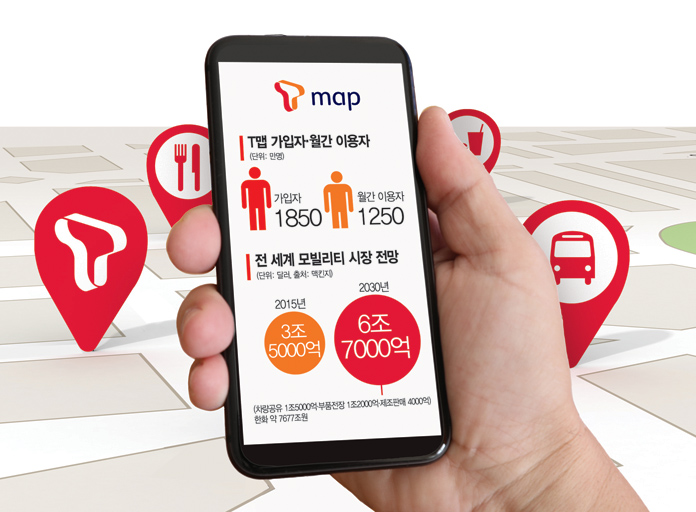
Furthermore, ‘T map Mobility’ aims to embed the ‘T map’ platform in all vehicles domestically. This can be done through in-vehicle integration by automakers, IVI, or smartphone navigation. Based on this, they plan to expand platform-based businesses such as advertising and data.
Following services that provide real-time congestion information by subway car to overcome COVID-19 early, they will expand ‘customer safety’ contactless mobility services that provide vehicle status and floating population information around destinations. They also plan to strengthen services that notify drivers of unexpected situations on driving routes and offer special benefits to safe drivers.
◆Challenging future mobility such as ‘flying cars’
SK Telecom possesses various future technologies including 5G, AI, V2X (Vehicle to Everything), ADAS (Advanced Driver Assistance Systems), quantum-based LiDAR, high-definition maps (HD maps), and next-generation 5G intelligent transportation systems.
‘T map Mobility’ aims to ultimately spread future mobility in Korea, such as the ‘flying car’ that humanity has dreamed of for a century, by utilizing these technologies. The challenge areas include ▲‘Flying car navigation’ that sets optimal aerial routes using 5G, AI, and T map functions ▲3D HD maps considering high-altitude terrain and landmarks ▲intelligent air traffic control systems for flying cars.
SK Telecom focuses on establishing a healthy competitive system in the domestic mobility industry and plans to actively invest in expanding the ecosystem qualitatively and quantitatively so that various stakeholders can benefit from active competition and cooperation.
◆The fifth core business toward becoming a ‘Big Tech’ company... Targeting a corporate value of 4.5 trillion KRW by 2025
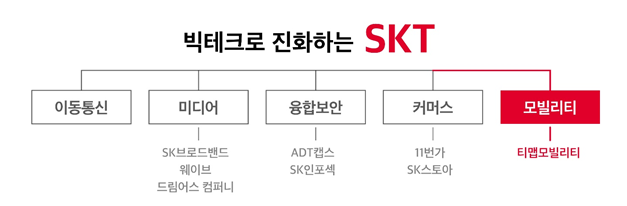
Over the past several years, SK Telecom has reorganized its business into ▲mobile communications ▲media ▲security ▲commerce, preparing to leap forward as a ‘Big Tech’ company. It is accelerating innovation in OTT (Wavve), K App Store (One Store), music (Flo), and e-sports (T1) as well.
The ‘mobility’ business is considered the fifth core business that will lead the growth of the SK ICT family. SK Telecom stated that it will grow ‘T map Mobility,’ which was recognized with a corporate value of 1 trillion KRW at its launch, into a company valued at 4.5 trillion KRW by 2025.
Nelson Chai, Uber’s Chief Financial Officer (CFO), said, “Korea is one of the first countries Uber entered, and through a close partnership with SK Telecom, we will strive to realize the market potential in Korea,” adding, “We will improve accessibility to mobility services and provide better services to both passengers and drivers.”
SK Telecom CEO Park Jung-ho said, “Together with Uber, a global top company, we will transform the costs and time spent on mobility into time for a happy life for customers and promote mobility innovation so that any mode of transportation can be used safely.” He continued, “Through close cooperation with companies with diverse capabilities, we will solve transportation challenges and ultimately work to bring forward an era where flying cars enable travel between Seoul and the Gyeonggi region within 30 minutes.”
© The Asia Business Daily(www.asiae.co.kr). All rights reserved.
![Clutching a Stolen Dior Bag, Saying "I Hate Being Poor but Real"... The Grotesque Con of a "Human Knockoff" [Slate]](https://cwcontent.asiae.co.kr/asiaresize/183/2026021902243444107_1771435474.jpg)

















