Request for US Congress Approval to Sell Anti-Ship and Surface-to-Air Missiles
[Asia Economy Reporter Hyunwoo Lee] The U.S. government is pushing forward with a plan to sell seven types of advanced weapons to Taiwan despite strong opposition from China, marking the full-scale implementation of the "Fortress Taiwan" strategy. As the U.S. is expected to position Taiwan as a key partner in the Indo-Pacific region to counter China in the South China Sea, cross-strait relations are anticipated to deteriorate significantly.
According to foreign media including the Associated Press on the 13th (local time), the U.S. government is advancing a plan to sell seven types of advanced weapons to Taiwan amid China's protests. The U.S. government has reportedly requested congressional approval to sell five types of weapons including the High Mobility Artillery Rocket System (HIMARS), the long-range air-to-ground missile SLAM-ER, data links for F-16 fighter jets, the MQ-9 Reaper, and Harpoon anti-ship missiles. Requests for approval to sell underwater mines and anti-tank missiles are also expected to follow soon.
This move by the U.S. government is interpreted as being linked to the "Fortress Taiwan" strategy promoted by the Department of Defense since the Trump administration took office. It is known that the total value of weapons sales to Taiwan decided over the past year exceeded $10 billion (approximately 11.4 trillion KRW). Since the establishment of diplomatic relations between the U.S. and China in 1979, the U.S. accepted China's "One China" principle and severed diplomatic ties with Taiwan. Since then, the U.S. has intermittently sold weapons to Taiwan under the Taiwan Relations Act but has done so at a cautious level considering relations with China.
The scale of weapons Taiwan has decided to procure from the U.S. over the past two years is evaluated to surpass the total amount of weapons Taiwan acquired from the U.S. from 1979 to 2018. Despite strong opposition from China last year, the U.S. government approved the sale of F-16V fighter jets and the Taiwan-specific version of the M1A2 Abrams tank, the M1A2T, to Taiwan.
China strongly opposes the U.S. arming Taiwan, which it considers a "non-recovered territory," arguing that it blatantly violates the One China principle agreed upon at the time of establishing diplomatic relations. Zhao Lijian, spokesperson for the Chinese Ministry of Foreign Affairs, warned at a regular briefing the day before, saying, "The U.S. actions seriously interfere in China's internal affairs and undermine China's sovereignty and security interests," and added, "China will take just and necessary measures depending on the situation."
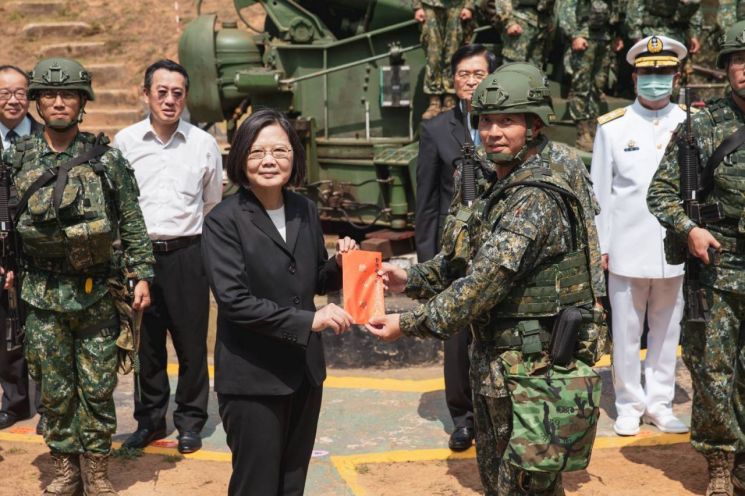
Amid rising tensions across the Taiwan Strait, Taiwanese President Tsai Ing-wen visited a radar base and emphasized that Taiwan is fully capable of defending against China's threats. According to local media including Taiwan's Apple Daily on the 14th, President Tsai stated during her visit to the Lushan radar base the previous day, "I have confidence in the military's ability to defend against China's airspace threats." President Tsai toured the Air Force Surveillance and Warning Center within the base and encouraged military personnel, noting that they quickly identify missile trajectories and respond promptly within a short time.
© The Asia Business Daily(www.asiae.co.kr). All rights reserved.