Government and Ruling Party Announce Strengthened Corporate Regulations by Amending Commercial and Fair Trade Laws
Companies Bewildered by Toxic Provisions Ignoring Market Principles, Including Separate Election of Audit Committee Members and 3% Voting Rights Cap for Major Shareholders
Significant Concerns Over Becoming Prey to Foreign Speculative Capital
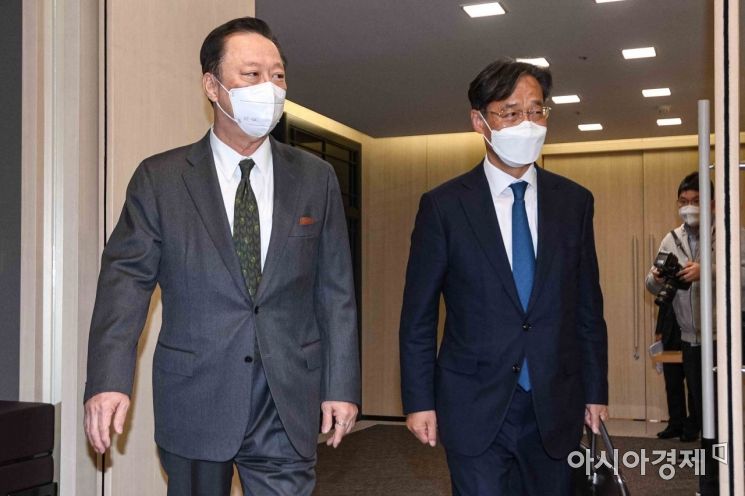 Park Yong-man, Chairman of the Korea Chamber of Commerce and Industry, and Yoo Dong-su, Senior Deputy Chairman of the Policy Committee of the Democratic Party, are entering the meeting room to attend the 'KCCI-Democratic Party Fair Economy TF Policy Meeting' held on the 14th at the Korea Chamber of Commerce and Industry in Jung-gu, Seoul. Photo by Kang Jin-hyung aymsdream@
[Asia Economy Reporters Changhwan Lee and Dongwoo Lee] On the morning of the 14th, the 20th-floor conference room of the Korea Chamber of Commerce and Industry (KCCI) located in Jung-gu, Seoul, was filled with great tension. This day marked the first time that members of the Democratic Party of Korea visited KCCI among economic organizations to hear opinions from the business community regarding various corporate regulatory laws, including amendments to the Commercial Act and the Fair Trade Act.
During the meeting, there was a sharp confrontation between ruling party lawmakers who aimed to push through the corporate regulatory laws in the current regular session of the National Assembly and economic organizations and businesspeople who sought to block them.
A senior executive of KCCI who attended the meeting said, "Since the government and the ruling party have planned to pass the three corporate regulatory laws in this regular session, there is little time left to persuade them," adding, "We are meeting with lawmakers in a truly desperate state."
In the afternoon, other economic organizations such as the Korea Employers Federation, the Korea Federation of Small and Medium Business, and the Federation of Korean Mid-sized Enterprises also planned to meet with Democratic Party lawmakers to request the withdrawal of the corporate regulatory laws. A representative from the Korea Employers Federation emphasized, "The corporate regulatory laws are truly fatal to companies," and added, "We will continue to visit the National Assembly to persuade lawmakers about the problems of the bills."
The reason the business community is meeting with politicians day after day to demand the repeal or revision of the corporate regulatory laws is that the management environment for Korean companies is already difficult. Due to the novel coronavirus disease (COVID-19), business conditions have worsened, and the push for excessive corporate regulations raises concerns that the number of companies forced to close could significantly increase.
The biggest concern among companies regarding the government and ruling party’s corporate regulatory laws is the '3% rule' in the amendment to the Commercial Act. The 3% rule requires the separate election of audit committee members from other directors and limits the voting rights of major shareholders to 3% during this election.
While some economic organizations have differing opinions on certain provisions, they unanimously demand the repeal of the 3% rule. KCCI, which organized the meeting, initially requested revisions to the 3% rule but recently shifted its stance toward repeal or market self-regulation. Although some within the Democratic Party are trying to enforce the 3% rule through an agreement with KCCI, the atmosphere at KCCI is that it is difficult to comply with the 3% rule.
KCCI stated, "Limiting voting rights to 3% could undermine the principles and fundamentals of the stock market and market economy," adding, "It is an excessive regulation to the extent that no similar cases can be found overseas."
The separate election system for audit committee members is similarly problematic. Audit committee members are key personnel of the board of directors, the highest decision-making body of a company, and can be involved not only in audits but also in corporate management. Currently, audit committee members are selected from among directors appointed by major shareholders, but under the government’s amendment to the Commercial Act, companies will have to separately elect at least one audit committee member from other directors at the shareholders' meeting.
This means that in the future, audit committee members must be elected separately at the shareholders' meeting, not from directors appointed by major shareholders. At this time, the voting rights of major shareholders are limited to 3%. With voting rights restricted, it becomes easier for forces with hostile M&A (mergers and acquisitions) intentions to elect audit committee members.
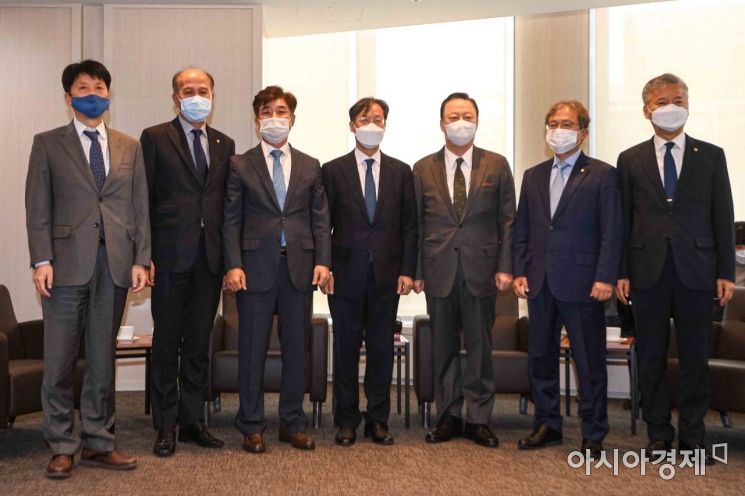 Park Yong-man, Chairman of the Korea Chamber of Commerce and Industry, along with members of the Democratic Party's Fair Economy Task Force, are attending the 'KCCI-Democratic Party Fair Economy Task Force Policy Meeting' held on the 14th at the Korea Chamber of Commerce and Industry in Jung-gu, Seoul, posing for a photo. Photo by Kang Jin-hyung aymsdream@
◆If the Law is Amended, Our Companies Could Become Prey to Foreign Capital
If the law is amended, there is a high possibility that Korean companies will be exploited in money games by foreign speculative funds. Speculative funds could split their shares into 3% portions and unite to attack companies, then enter the board of directors and obstruct various board agendas (such as venture investments and business restructuring), potentially engaging in greenmail (demanding high-priced buyouts of attacker shares).
In fact, Korean companies have been exposed to management rights threats from speculative capital several times in the past. The activist fund Elliott’s threats to Samsung and Hyundai Motor are representative cases. Around 2004, Sovereign Asset Management, which fought a management rights battle with SK, split its 14.99% stake in SK into five funds, each exercising 2.99% voting rights. Sovereign threatened management by demanding the resignation of SK executives, opposing support for troubled affiliates (SK Global), and calling for improvements in corporate governance based on its high voting rights.
An executive from a major domestic conglomerate said, "If the 3% rule is introduced, virtually most of our companies will become prey to foreign speculative capital," adding, "Companies will face enormous difficulties defending their management rights."
There is also an analysis that if major shareholders’ voting rights are limited to 3% and audit committee members are separately appointed, 87% of listed companies in Korea will appoint hedge fund-recommended personnel.
The Korea Industrial Alliance Forum (KIAF) analyzed the foreign shareholding ratio of 15 major listed companies in Korea, the shareholding ratio of major shareholders and related parties, and the voting tendencies of foreign shareholders during Elliott’s appointment of outside directors at Hyundai Motor. The analysis concluded that if major shareholders’ voting rights are limited to 3% and audit committee members are separately appointed, up to 13 companies (87%) among listed companies would appoint hedge fund-recommended personnel as audit committee members and directors.
Jung Manki, chairman of the Korea Industrial Alliance Forum, said, "If the amendment to the Commercial Act is implemented, foreign speculative capital and outside directors recommended by foreign competitors could be appointed as audit committee members and directors," adding, "This could result in the enemy participating in our military’s strategy meetings."
© The Asia Business Daily(www.asiae.co.kr). All rights reserved.