Electronic Cigarette Association: "Despite the World's Highest Tax Rate on E-liquids, Increase Unjustified"
Scientific Reports Highlight Less Harmful Nature of Heated Tobacco, Demand for Tax Discrimination Changes
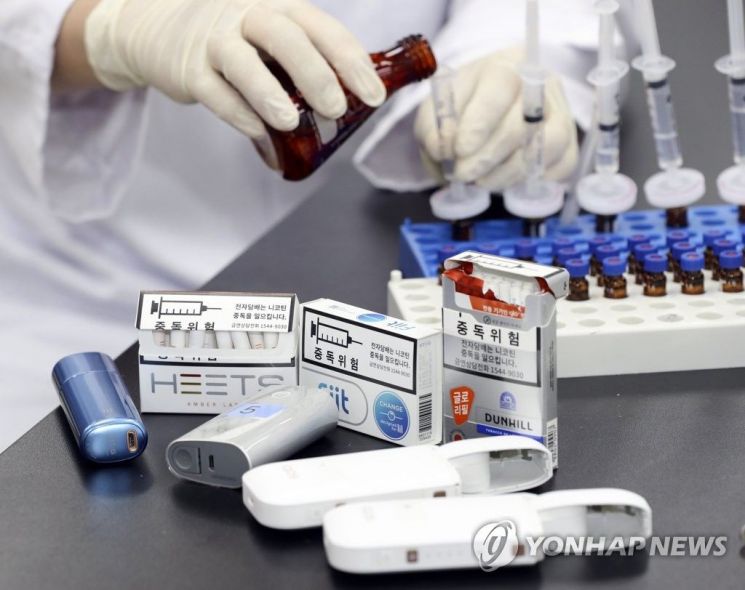
[Asia Economy Reporter Lee Seon-ae] The liquid-type and heated tobacco product (HTP) electronic cigarette industries are engaged in intense disputes with the government over harmfulness and taxation. As the government pushes to raise taxes on liquid-type electronic cigarettes to ensure fairness with conventional cigarettes and HTPs, the liquid-type e-cigarette industry is protesting. Meanwhile, the HTP industry has expressed dissatisfaction, claiming that excessive taxes are being imposed on HTPs, which are fundamentally different from conventional cigarettes. Both industries are united in their call for differential taxation based on the degree of harmfulness.
According to related industries on the 12th, the government is pursuing increased taxation in two main directions: expanding the definition of liquid-type electronic cigarettes to eliminate tax blind spots through legislation and tax law amendments, and raising the tax itself on liquid-type e-cigarettes. Currently, the liquid solution used in liquid-type e-cigarettes is traded at 30ml for 30,000 to 35,000 KRW. Approximately 1ml is considered equivalent to one pack of cigarettes (20ml).
A representative from the Electronic Cigarette Association Federation stated, "If the definition of tobacco is expanded, a tax of about 54,000 KRW will be imposed on 30ml of liquid, causing prices to rise sharply," and warned, "If the government enforces taxation, the related industry will face collapse."
Especially as the liquid-type e-cigarette industry raises its voice that taxes should be lower if these products are less harmful than conventional cigarettes, the government has issued research results on harmfulness to justify taxation. On the 4th, the Ministry of Health and Welfare announced the progress of safety management measures for liquid-type e-cigarettes, revealing that toxic substances were detected in some products of liquid-type e-cigarettes sold domestically.
The HTP industry demands changes in taxation, arguing that although the government raised taxes based on the Ministry of Food and Drug Safety’s research on the harmfulness of HTPs, scientific evidence continues to show that they are less harmful.
Philip Morris’s HTP brand, IQOS, recently received the first-ever ‘Modified Risk Tobacco Product (MRTP)’ marketing authorization from the U.S. Food and Drug Administration (FDA). This was based on extensive scientific evidence, including eight preclinical studies and ten clinical studies. MRTP refers to products that, when smokers switch to them, reduce or have the potential to reduce harm. Notably, the FDA judged that IQOS has a reasonable likelihood of significantly reducing disease incidence or mortality among individual smokers. This confirms that the generation and exposure frequency of harmful substances are lower compared to conventional cigarettes.
Baek Young-jae, CEO of Korea Philip Morris, emphasized, "The FDA decision proves that IQOS vapor contains fewer harmful substances and reduces exposure to harmful substances," adding, "This is fundamentally different from conventional cigarettes, so regulating it in the same way is inappropriate."
A research team from Hansung University’s Global Economic Research Institute (Professors Park Young-beom, Hong Woo-hyung, and Lee Dong-gyu) also released a report titled ‘Estimation of External Costs of Smoking and Rational Tobacco Taxation Measures (2020),’ which concluded that assuming all tobacco products have the same harmfulness, the appropriate tax amount for HTPs should be 2,510.7 KRW, about 493.7 KRW lower than the current rate.
Meanwhile, the liquid-type and HTP industries emphasize the need to compare taxation with other countries. For liquid-type e-cigarettes, the tax rate is the highest in the world. The Electronic Cigarette Association Federation pointed out, "The domestic tax rate for liquid-type e-cigarettes is the highest globally (30ml, 53,970 KRW), which is 365% higher than the second-highest country, yet the government plans to double the tax rate."
The tax burden ratio of HTPs compared to conventional cigarettes is 90.4% (conventional cigarettes : HTP = 1 : 0.90), the highest among major countries. Japan has the highest tax burden ratio among major countries at 78.0%, followed by Russia at 63.1%, Greece at 52.9%, with other countries having even lower rates of 20-40%. Professor Park Young-beom of Hansung University’s Department of Economics stated, "Looking at cases in major advanced countries, tobacco regulations and tax rates are applied proportionally to the harmfulness of each tobacco product type," and emphasized, "The Korean government should seriously consider introducing tobacco regulation policies proportional to tobacco harmfulness, such as strengthening regulations on more harmful tobacco and relaxing regulations on less harmful tobacco."
© The Asia Business Daily(www.asiae.co.kr). All rights reserved.

















