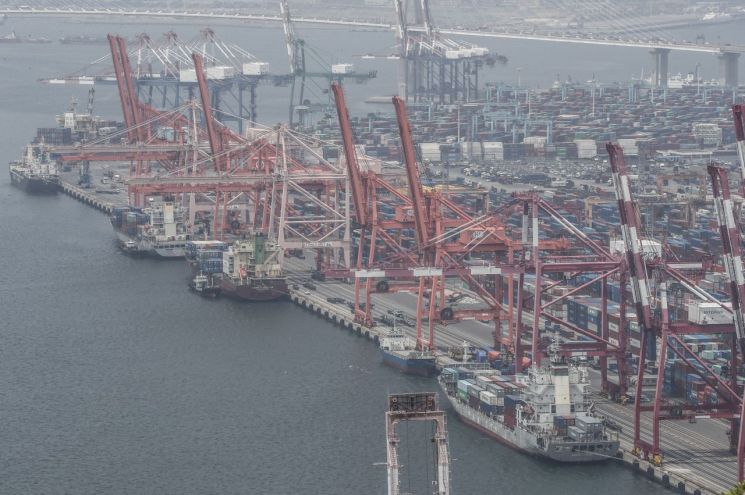
[Asia Economy Reporter Moon Chaeseok] Although South Korea's export performance turned positive last month for the first time in seven months, there is uncertainty about whether this trend will continue into the fourth quarter. This is due to the fact that the number of working days from this month through December is 1.5 days fewer than the same period last year, as well as the uncertainty surrounding the global spread of the novel coronavirus disease (COVID-19) and the subsequent resumption of economic activities.
According to the 'September Export-Import Trends' announced by the Ministry of Trade, Industry and Energy on the 1st, last month's export value was $48.05 billion, an increase of 7.7% compared to the same month last year. The 7.7% growth rate is the highest in 1 year and 11 months since October 2018. The average daily export value was $2.089 billion, a 4% decrease compared to the same month last year. This is the highest this year and the first time in eight months that the daily average export value has recovered to the $2 billion level since January's $2.016 billion.
The Ministry of Trade, Industry and Energy emphasizes 'average daily performance' considering the number of working days, 'performance by industry' such as semiconductors and automobiles, and 'performance by market' such as China, the United States, the European Union (EU), and ASEAN (Association of Southeast Asian Nations) when evaluating export performance. In particular, for last month's performance, significance was placed on the fact that automobile (rebounded after 6 months), auto parts (6 months), general machinery (7 months), textiles (7 months), and steel (9 months) sectors turned positive for the first time since COVID-19.
However, the number of working days, which was high in September, naturally decreases in October. The total number of working days from October to December is 68 days, which is 1.5 days fewer than 69.5 days during the same period last year.
Semiconductors and others are influenced by the expansion of non-face-to-face industries due to the COVID-19 pandemic, global companies' delivery situations, and petroleum products are affected by international oil prices, but industries such as shipbuilding and wireless communication devices are influenced by overseas buyer orders and shipment volumes, so the number of working days cannot be ignored. Even last month, when the number of working days was 2.5 days more than the previous year, sectors such as ships (-3%), petrochemicals (-5.3%), and petroleum products (-44.2%) were negative.
The most important variable is how much each country opens its market and the direction of U.S.-China conflicts and economic policies after the U.S. presidential election on November 3 (local time). The key question is whether the increased demand last month can continue into the fourth quarter.
Professor Jung In-gyo of Inha University's Department of International Trade said, "Last month, pent-up overseas demand rebounded, and export performance exceeded expectations, but the fourth quarter will be greatly influenced by the severity of COVID-19 and the U.S. presidential election. If the world improves to the extent that it returns to pre-COVID-19 conditions after the U.S. election, opportunities will come to South Korea, but if not, last month's export performance may be recorded as an exceptional phenomenon."
Professor Ha Jun-kyung of Hanyang University's Department of Economics said, "Our exports have at least escaped the worst phase, but uncertainty about whether the rebound will continue remains high. The global COVID-19 pandemic is a more important variable than 1-2 working days, and the export performance may fluctuate at a certain level for a considerable period."
© The Asia Business Daily(www.asiae.co.kr). All rights reserved.
![Clutching a Stolen Dior Bag, Saying "I Hate Being Poor but Real"... The Grotesque Con of a "Human Knockoff" [Slate]](https://cwcontent.asiae.co.kr/asiaresize/183/2026021902243444107_1771435474.jpg)















