Chinese Ministry of Commerce Implements 'Blacklist' System for Foreign Companies and Individuals
Foreign Companies or Individuals on List Face Restrictions or Bans on Trade and Investment with China
[Asia Economy Reporter Kim Hyewon] China has officially introduced a 'blacklist' system for foreign companies. Initially, this move is largely a countermeasure against the U.S. sanctions on Huawei, but other countries cannot feel secure either. Companies or individuals placed on the blacklist will effectively be unable to conduct normal market transactions with China.
According to the KOTRA Beijing Trade Office on the 30th, China's Ministry of Commerce announced the "Regulations on the List of Unreliable Entities" (hereinafter referred to as the Regulations) on the 19th and implemented them immediately. The Ministry of Commerce stated that the regulations target foreign companies and individuals that harm national sovereignty, security, and development interests.
Why Has China Introduced a Blacklist System for Foreign Companies? What Sanctions Are Imposed?
The Regulations consist of a total of 14 articles. According to the Regulations, if a company or individual seriously infringes on legitimate rights and interests by suspending normal transactions with Chinese companies, organizations, or individuals and implementing discriminatory measures, they will be designated as "unreliable companies and individuals."
The Ministry of Commerce, a department under the State Council of China, has formed a dedicated task force and can initiate investigations based on recommendations or complaints from related agencies and stakeholders. Based on the investigation results, the entities will be placed on the blacklist.
The Ministry of Commerce announced six corresponding measures against foreign companies and individuals on the blacklist. First, it will restrict or prohibit trade activities with China. Investment within China will also be restricted or prohibited. This is an economic retaliation akin to "an eye for an eye," mirroring the sanctions the U.S. imposed on Huawei.
Additionally, entry restrictions or bans will be imposed on related personnel or transportation means, and employment permits, residence, and stay qualifications within China will be restricted or revoked. This is interpreted as an intention to completely block activities involving China, similar to the retaliation Korea faced with visa issuance restrictions during the THAAD (Terminal High Altitude Area Defense) deployment conflict.
The Ministry of Commerce also indicated that it will impose corresponding fines depending on the situation and may take any other necessary measures.
Before implementing these measures, the targeted entities will be given a "correction period." If they cease activities harming China's interests and resolve the issues within this period, they will be excluded from the list. However, if no corrective action is taken, penalties will be imposed. An exception clause is also established for companies or individuals on the blacklist who need to conduct trade or transactions with China, allowing them to apply to the task force.
Part of Response to U.S. Sanctions Offensive... Who Is on the First Blacklist?
The KOTRA Beijing Trade Office views China's introduction of the foreign company blacklist system as a legal and institutional countermeasure against the U.S.'s sanctions offensive targeting Chinese companies. Amid the deepening decoupling between the U.S. and China and multifaceted conflicts in trade, finance, technology, and industry, this is a measure to protect Chinese companies. Since the additional tariffs between the U.S. and China were implemented in July 2018, trade disputes between the two countries have intensified. Last year, when the U.S. government significantly increased the number of sanctioned Chinese companies to 150, the Chinese government began drafting and implementing related systems in response.
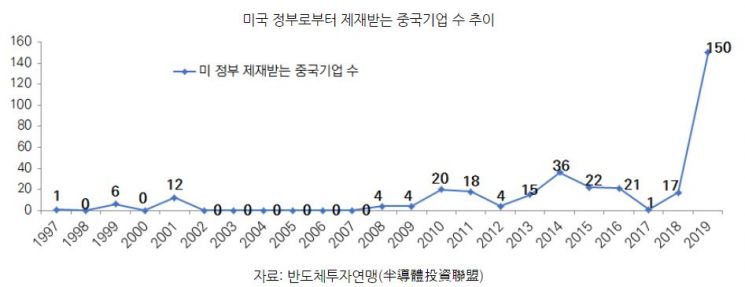
The industries most affected by U.S. sanctions in China are integrated circuits and telecommunications. As of the end of last year, among the 239 sanctioned companies, 46 are in integrated circuits and 35 in telecommunications. These are industries that the Chinese government has vigorously nurtured and supported in recent years. Experts believe the U.S. government is using sanctions on Chinese tech companies to curb China's rise as a manufacturing powerhouse.
The Chinese government is widely expected not to place a large number of foreign companies on the blacklist to maintain foreign investment stability. Since China has a high participation rate in the global value chain (GVC), sanctioning foreign companies could directly damage China's industrial development. Although specific company lists have not yet been released, experts anticipate that China will consider the impact on supply chains and industrial networks when taking measures.
Chinese authorities are reportedly targeting American companies in the first blacklist. Major U.S. IT companies such as Apple, Qualcomm, and Cisco are mentioned as potential retaliation targets. The Wall Street Journal recently reported that Cisco appears to be included on the blacklist based on its termination of a long-standing contract with a Chinese state-owned telecommunications company. It was also reported that the Chinese government issued instructions to break contracts with U.S. companies even if penalties must be paid. Considering political repercussions, it is expected that the blacklist will be made public after the U.S. presidential election on November 3.
It is pointed out that Korean companies also need to prepare for the deepening U.S.-China decoupling and the resulting GVC restructuring. A KOTRA Beijing Trade Office official advised, "Companies should thoroughly review various factors such as China's foreign investment policies, the current status of U.S.-China trade disputes, and movements to reorganize component supply chains around manufacturing, and formulate and adjust their trade and market entry strategies toward China accordingly."
© The Asia Business Daily(www.asiae.co.kr). All rights reserved.
![Clutching a Stolen Dior Bag, Saying "I Hate Being Poor but Real"... The Grotesque Con of a "Human Knockoff" [Slate]](https://cwcontent.asiae.co.kr/asiaresize/183/2026021902243444107_1771435474.jpg)
















