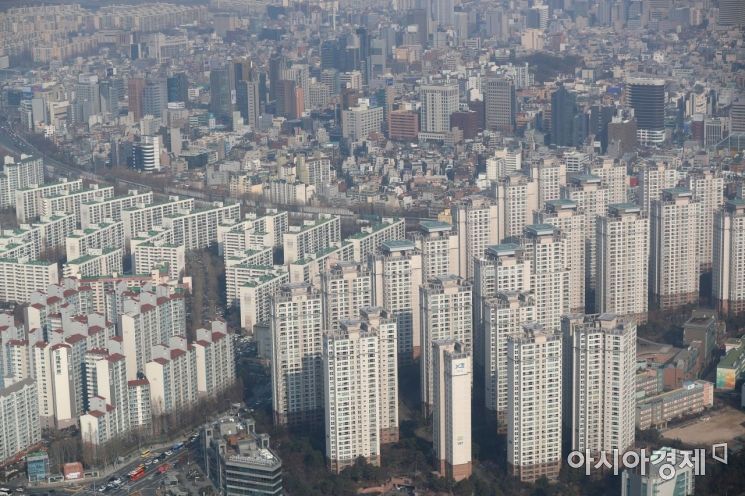
[Asia Economy Reporter Yuri Kim] Voices have emerged calling for the need to link the two projects following controversy over the exclusion of urban regeneration projects when promoting public redevelopment projects. It is argued that redevelopment and reconstruction should be incorporated within the framework of urban regeneration and guided to contribute to local regeneration through appropriate urban planning measures.
As the government launched a public contest for pilot projects of public redevelopment in Seoul and the metropolitan area through the August 4 housing supply plan, controversy arose over the exclusion of areas already selected as urban regeneration project sites. The Ministry of Land, Infrastructure and Transport and the Seoul Metropolitan Government have been accepting applications for public redevelopment pilot project candidates from the 21st of last month until November 4. Areas currently undergoing urban regeneration were excluded from the contest. The reasons cited included prohibition of budget duplication and maintaining policy consistency.
The Korea Research Institute for Construction Industry recently emphasized in a report the need for efficient linkage between urban regeneration projects and public redevelopment projects. It stated that in the future, priorities between urban regeneration and public redevelopment projects will inevitably vary depending on local governments and residents’ perspectives, and that direction setting for efficient promotion is required.
Public redevelopment is a project in which the public sector participates in maintenance projects to improve the residential environment of deteriorated areas and promote housing supply within urban centers, with many associations expressing willingness to participate. Areas wishing for public redevelopment are designated as 'Housing Supply Activation Districts' and receive various supports such as increased floor area ratio, simplified permits and approvals, exemption from the price ceiling system, and project cost loans. Some 'Urban Regeneration Activation Areas' such as Changsin and Sungin sought to promote public redevelopment. Since 2015, 13 'Urban Regeneration Activation Areas' have been designated in Seoul and projects have been promoted. However, some residents in certain areas still perceive that clear results will not be achieved in terms of residential regeneration.
Researcher Lee Seung-woo said, "The original purpose of urban regeneration is to strengthen the public role in areas where private profit-based urban maintenance like conventional redevelopment is impossible, improving the residential environment and revitalizing the economy to regenerate the area," adding, "If residential maintenance projects are possible through appropriate public support, the effectiveness of residential improvement-type urban regeneration projects inevitably decreases." He explained that it is necessary to efficiently link urban regeneration projects, which are premised on gradual improvement, and public redevelopment projects, which pursue demolition and redevelopment, by considering the project conditions of the target area and the level of public role sharing.
Both methods are means to achieve the goal of urban regeneration, and redevelopment is included as a project type under the actual 'Special Act on Urban Regeneration.' He said, "Public funds are essential in urban regeneration projects," and "Considering efficient allocation of resources, in areas where public redevelopment is possible, that project type will be the most efficient means of urban regeneration." He added, "The recently amended enforcement decree of the 'Special Act on Urban Regeneration' includes public redevelopment projects as recognized urban regeneration projects," and "When promoting public redevelopment, recognized projects can be pursued in combination to enhance project efficiency."
In areas where redevelopment can be promoted through institutional support rather than direct public funding, it is necessary to actively utilize redevelopment and reconstruction as means of urban regeneration. Researcher Lee emphasized, "Not only at the level of the Urban Regeneration New Deal project but also in the broader sense of urban regeneration aimed at restoring urban functions and strengthening competitiveness, the effectiveness of redevelopment and reconstruction remains significant," and "Redevelopment and reconstruction should be incorporated within the framework of urban regeneration and guided through appropriate urban planning measures to contribute to the socioeconomic regeneration of the area."
© The Asia Business Daily(www.asiae.co.kr). All rights reserved.
![Clutching a Stolen Dior Bag, Saying "I Hate Being Poor but Real"... The Grotesque Con of a "Human Knockoff" [Slate]](https://cwcontent.asiae.co.kr/asiaresize/183/2026021902243444107_1771435474.jpg)
















