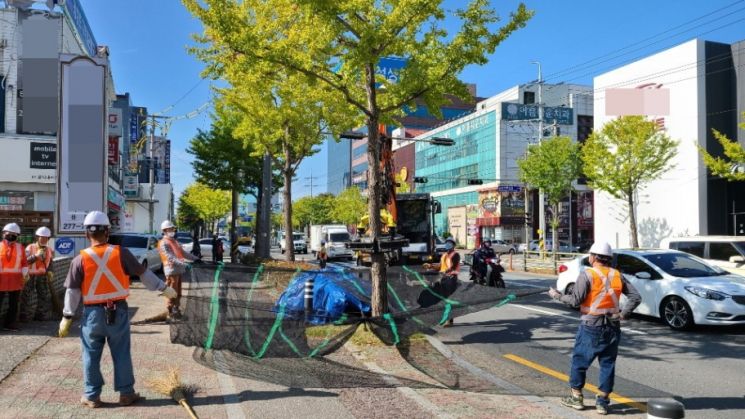
[Asia Economy Yeongnam Reporting Headquarters Reporter Park Dong-wook] Pohang City, Gyeongbuk announced on the 30th that starting from the end of September, it is harvesting ginkgo nuts using a vibration harvester for the first time this year to minimize pedestrian inconvenience and damage to small business owners caused by the odor of ginkgo nuts.
The total number of street trees in Pohang City is 54,015, with ginkgo trees accounting for about 15%. The number of female ginkgo trees bearing nuts is 2,910.
Ginkgo trees have many advantages as street trees, as they are highly resistant to car exhaust, have excellent air purification abilities, and require no maintenance costs other than pruning. The wood is hard, acting as a shield if a vehicle crashes onto the sidewalk, and the trees are resistant to cold and heat, emit a large amount of oxygen, and have excellent sulfur dioxide absorption capabilities.
However, complaints related to the odor of nuts falling from female trees and pedestrian inconvenience increase every year from September to October. Feeling the limitations of manual harvesting, Pohang City introduced a machine this year that harvests by applying vibrations to the trees.
Geum Chang-seok, head of the Greenery Division of Pohang City, explained, "In the short term, we plan to minimize the odor from falling nuts through proactive harvesting, and in the mid to long term, we plan to gradually reduce the number of female trees by replacing trees under 30 years old with male trees."
He added, "In the mid to long term, the replaced female trees will be planted in the Tree Bank being established in Jangryang-dong to provide enjoyable experiences such as ginkgo harvesting, as well as to create a ginkgo tree cluster dyed yellow in autumn to offer scenic views."
© The Asia Business Daily(www.asiae.co.kr). All rights reserved.
![Clutching a Stolen Dior Bag, Saying "I Hate Being Poor but Real"... The Grotesque Con of a "Human Knockoff" [Slate]](https://cwcontent.asiae.co.kr/asiaresize/183/2026021902243444107_1771435474.jpg)















