Transaction Volume Exceeding 17 Trillion Won
Falls to 8-9 Trillion Won Range by End of September... Growing Cautious Sentiment
November US Presidential Election, Increasing Uncertainty
"With Its End and Limits Defined, Prefer Holding Over Selling, Buying Over Watching"
[Asia Economy Reporter Oh Ju-yeon] The KOSPI closed higher, rising above the 2300 level ahead of the Chuseok holiday, but market sentiment is said to have become more cautious compared to early September. This is because significant events and economic data releases are scheduled during the holiday period, including the first U.S. presidential debate and U.S. employment data announcements, which are increasing uncertainty. However, these issues are being viewed as limited risks with a defined end, drawing attention.
According to the Korea Exchange on the 30th, trading volume, which exceeded 17 trillion won until the 22nd, dropped to the 13 trillion won range on September 23rd, and further declined to 8.971 trillion won and 9.487 trillion won on the 28th and 29th, respectively, falling below 10 trillion won. This is interpreted as a result of increased cautiousness ahead of the Chuseok holiday.
In this atmosphere, investors' attention is gradually shifting toward October and beyond, as volatility may increase with the U.S. presidential election just a month away.
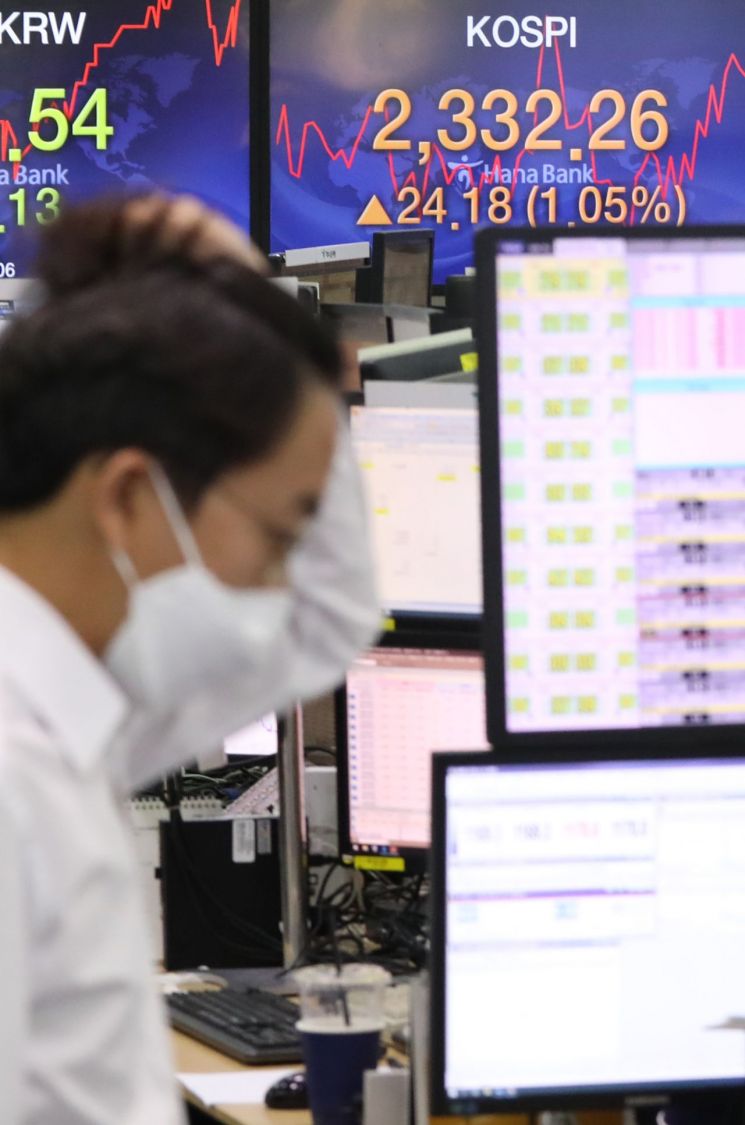
Samsung Securities expects the KOSPI to fluctuate between 2250 and 2400 in October. They explained that the expansion of global political uncertainty related to the U.S. presidential election and the deepening cracks in Nasdaq tech stocks will act as disruptive factors for domestic and international stock markets. Considering the unpredictable current election landscape, they noted that an increase in market volatility, as represented by the VIX, is inevitable for the time being, but emphasized that expectations for the normalization of Korea’s export and earnings fundamentals remain strong. They also suggested that the recent market correction is more sentimental (investor sentiment) than fundamental (corporate earnings) in nature, and that a gradual period adjustment until early November before the U.S. election is more likely than further price corrections.
Kim Yong-gu, a researcher at Samsung Securities, said, "According to past case studies, there is a clear inverse correlation between the polling gap between leading presidential candidates and the VIX index, a barometer of market volatility. The closer the election race, the more political uncertainty and market volatility intensify, while when one side gains a clear advantage, related uncertainty and volatility gradually ease."
Researcher Kim added, "Currently, Biden maintains a limited lead of around 7%, but considering the unpredictable final outcome, political uncertainty and market volatility are likely to further intensify with the full-scale battle entering the late October period."
NH Investment & Securities also forecast that the KOSPI may fluctuate within a box range of 2200 to 2450 in October, recommending a strategy to adjust portfolio weights toward value stocks near the upper bound of the range and toward growth stocks near the lower bound.
Oh Tae-dong, head of the investment strategy team at NH Investment & Securities, said, "Given that the market capitalization relative to Korea’s GDP reached near an all-time high in September, it will not be easy to break the highs of August and September immediately. However, since low discount rates are maintained and abundant domestic stock purchasing funds are waiting, the downside is expected to be limited. The KOSPI will digest the U.S. election event and continue to fluctuate within the 2200 to 2450 box range while waiting for clearer signs of economic recovery."
However, it is important to note that the U.S. election risk is ultimately temporary.
Researcher Kim said, "Looking at the changes in domestic and international stock indices and the VIX index 60 days before and after the U.S. presidential elections in 2004, 2008, 2012, and 2016, there was a double burden of stock price weakness and increased market volatility before the election day, but after the election, the trend reversed, fully offsetting the previous impact. Since the essence of this risk is time-limited with a defined end and boundary, the strategy should always favor holding over selling and buying over waiting."
© The Asia Business Daily(www.asiae.co.kr). All rights reserved.
![Clutching a Stolen Dior Bag, Saying "I Hate Being Poor but Real"... The Grotesque Con of a "Human Knockoff" [Slate]](https://cwcontent.asiae.co.kr/asiaresize/183/2026021902243444107_1771435474.jpg)
















