Publication of the 2021 and Mid-term Economic Outlook Report
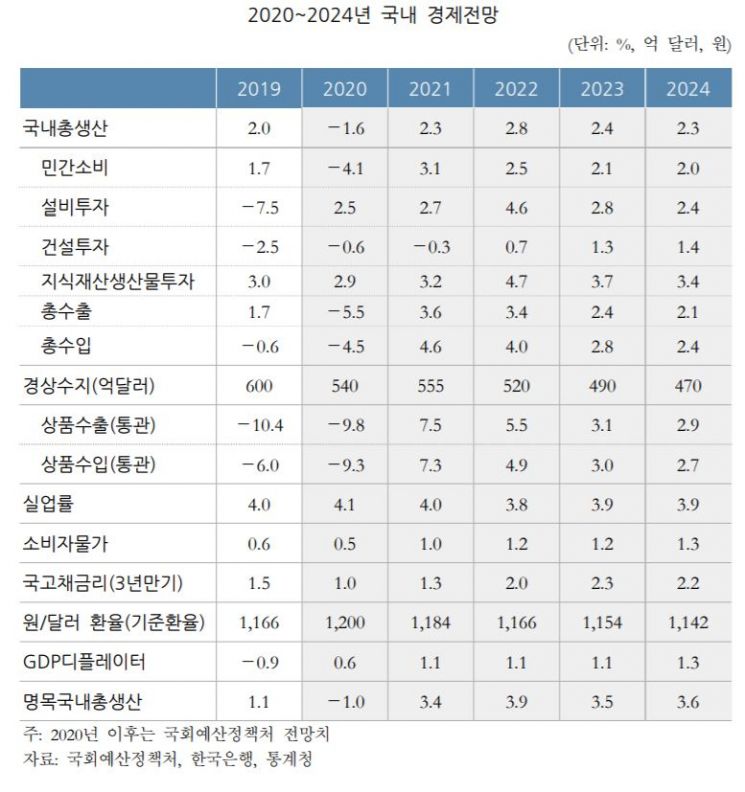
[Sejong=Asia Economy Reporter Kim Hyunjung] The National Assembly Budget Office forecasted that this year's economic growth rate will record -1.6% and then rebound to around 2.3% next year. It predicted that the sluggishness in service consumption caused by the COVID-19 pandemic would ease next year, but it assessed that a rapid recovery surpassing last year's level would be difficult.
In its recently published '2021 and Medium-Term Economic Outlook' report, the Budget Office stated, "Real Gross Domestic Product (GDP) in 2021 will grow by 2.3% as it gradually recovers from the shock of COVID-19," adding, "Private consumption, which sharply declined in 2020 due to the COVID-19 shock, will rebound in 2021 supported by the easing of sluggish service consumption and improvements in consumption activities and consumer sentiment." However, it also noted, "Improvement in household income and employment conditions will be delayed, making a rapid recovery exceeding the pre-COVID-19 level of 2019 unlikely."
Regarding construction and facility investment, the report said, "Construction investment will see a mitigation of its slump due to improvements in leading indicators and an expansion of the government's SOC budget in 2021, but housing investment will continue to decline slightly on an annual basis." It also observed, "Facility investment will expand mainly in the semiconductor and IT sectors, but in the non-IT sectors, investment expansion will be limited due to overall sluggish business conditions and economic uncertainties."
The nominal GDP growth rate, reflecting price changes, is expected to rise from a negative growth of -1.0% in 2020 to 3.4% in 2021, supported by economic recovery and an increase in the GDP deflator. The Budget Office predicted, "The rise in the GDP deflator in 2021 will be driven by an increase in the private consumption deflator due to economic recovery and improvements in terms of trade."
Furthermore, it projected that real GDP will grow at an average annual rate of 1.6% during the 2020?2024 period, a significant decline compared to the 2.8% average annual growth rate from 2015 to 2019. The Budget Office explained, "The real GDP growth trend over the next five years will show a contraction in 2020 due to the economic recession caused by the COVID-19 outbreak, followed by a recovery starting in 2021, reaching a peak growth rate of 2.8% in 2022, and then slowing down thereafter."
Next year, South Korea's per capita GDP is expected to be $32,023, continuing a decline following the peak of $33,429 in 2018 and last year's $31,838 (affected by the depreciation of the Korean won).
Regarding the trade balance next year, the report explained, "Since recording a record high surplus of $95.2 billion in 2017, the surplus has shrunk due to continued export sluggishness, and in 2021, it is expected to show a surplus of $35.1 billion, about 37% of the peak level." It also forecasted a current account surplus of $55.5 billion for the year, driven by an expanded goods trade surplus due to increased exports and a widening deficit in the service trade balance.
The total number of employed persons is expected to increase by about 180,000 compared to the previous year, influenced by a gradual economic recovery and slow improvement in major face-to-face service sectors. The Budget Office stated, "Even if economic conditions improve, the unemployment rate may not decline rapidly and could remain at a relatively high level for a considerable period due to increased job-seeking activities among the non-economically active population," adding, "The unemployment rate is expected to slightly decrease from 4.1% in 2020 to 4.0% in 2021."
Consumer prices are forecasted to rise by 1.0% year-on-year, higher than last year, due to the base effect from low inflation in the previous two years, rising international oil prices, and easing downward pressure on demand.
Lee Jonghoo, head of the Budget Office, emphasized, "The global spread of COVID-19 has dealt a significant shock to the world economy and our economy," adding, "The potential growth rate of our economy over the next five years is estimated to be 2.0% annually, down 0.6 percentage points compared to the previous five years. The contribution of capital to potential growth is expected to decline sharply, indicating that expanding investment is crucial to enhancing our economy's growth potential."
© The Asia Business Daily(www.asiae.co.kr). All rights reserved.
![Clutching a Stolen Dior Bag, Saying "I Hate Being Poor but Real"... The Grotesque Con of a "Human Knockoff" [Slate]](https://cwcontent.asiae.co.kr/asiaresize/183/2026021902243444107_1771435474.jpg)
















