Development of Torque-Based Chemical Synthesis System
Proven by Synthesis of Pharmaceutical Compounds like Painkillers
Paper Published in International Journal Nature
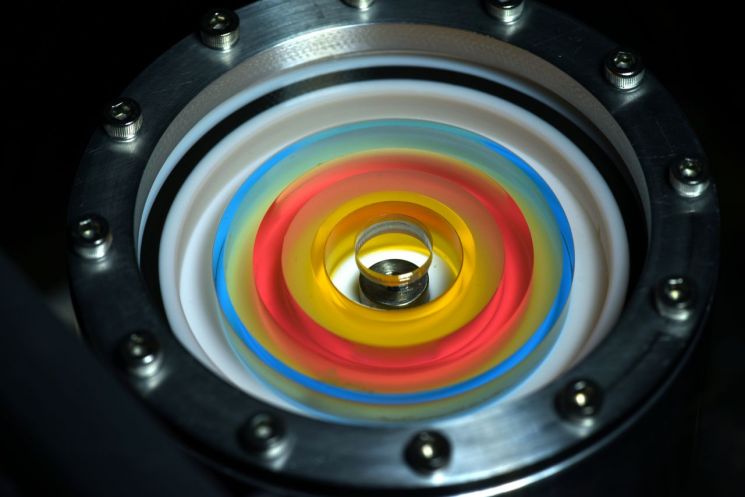
[Asia Economy Reporter Junho Hwang] A technology has been developed that allows chemical substances to be placed inside a cylinder and synthesized or separated through rotational force. It is expected to resolve the difficulties of creating complex processes composed of flasks and valves or controlling the continuous flow of liquids to obtain chemical syntheses. The research team anticipated that the time and cost required for extracting rare metals and synthesizing various compounds could be significantly reduced.
The research team led by Bartosz Grzybowski, group leader of the Advanced Soft Materials Research Division at the Institute for Basic Science and distinguished professor at Ulsan National Institute of Science and Technology, announced that they developed a new chemical synthesis system capable of easily handling multiple chemical processes within a single reaction vessel. The related research results were published on the 1st (Korean time) in Nature, an international journal in the natural sciences field.
Put it in a cylinder, rotate it, and obtain the desired compound
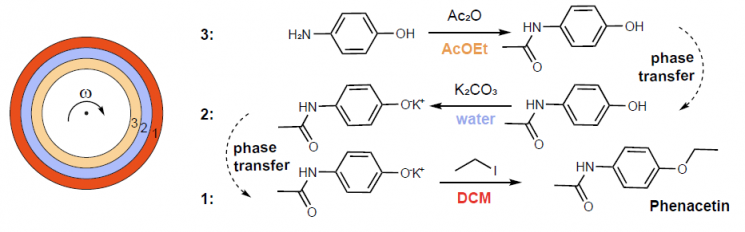
The research team created a cylindrical system that can control chemical synthesis layer by layer based on the idea that immiscible solutions like water and oil stack in order according to their density.
In this system, solvents with higher density form the outer layer, while solvents with lower density remain inside and rotate, according to the rotational force (centrifugal force) of the rotating cylinder. Due to the rotational force, each solvent forms a circular band, which is used like a test tube to control the chemical reactions of reactants. When reactants are added, they diffuse and move to adjacent solvents. Increasing the rotation speed of the cylinder can increase the diffusion rate. Conversely, depending on the properties of the solvents, the reactants and adjacent solvents can also be separated.
The research team used this system to stepwise synthesize actual pharmaceutical compounds such as phenacetin and diloxanide. They also extracted specific organics (p-nitrobenzoate sodium, phenylalanine) from mixtures. The team controlled bacteria or nanoparticles larger than molecules in the rotating solvents as well.
Application in rare metal extraction and more
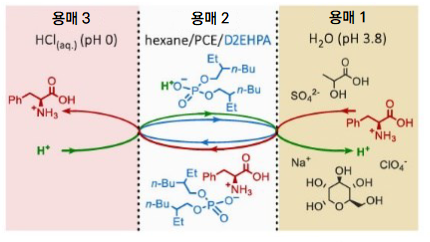
The research team evaluated that the significance lies in proposing a new idea that can reduce the time and cost of small- to medium-scale chemical synthesis and demonstrating its practical applicability.
Co-first author Research Fellow Olger Cybulski stated, "The system developed this time can freely control key variables affecting the synthesis process and regulate interactions between solvent layers, enabling the extraction of compounds that were previously difficult to extract, thus offering limitless potential for application."
© The Asia Business Daily(www.asiae.co.kr). All rights reserved.
![Clutching a Stolen Dior Bag, Saying "I Hate Being Poor but Real"... The Grotesque Con of a "Human Knockoff" [Slate]](https://cwcontent.asiae.co.kr/asiaresize/183/2026021902243444107_1771435474.jpg)

















