Landlords as the Strong, Tenants as the Weak Frame
'Tenant Protection' Intent is Good but Lacks Discussion
Policy Enforcement Causes Market Distortion and Side Effects↑
Disputes and Lawsuits Increase Everywhere, Effectiveness in Doubt
[Asia Economy Reporter Moon Jiwon] Criticism is mounting that the government's biased policy approach of 'tenant = the weaker party' is spreading disputes over housing and commercial lease contracts. This is the result of unconditionally introducing regulations unfavorable to landlords under the pretext of 'protecting tenants' during the amendment process of the Housing Lease Protection Act (hereinafter referred to as the Housing Lease Act) and the Commercial Building Lease Protection Act (hereinafter referred to as the Commercial Lease Act).
It is analyzed that the government is causing unnecessary conflicts and side effects by pushing policies unilaterally without sufficient discussion. In the frontline real estate brokerage industry, there are also criticisms that "the government's excessive intervention in private contracts is only increasing distrust between landlords and tenants."
Immediately Favorable to Tenants but Significant Side Effects
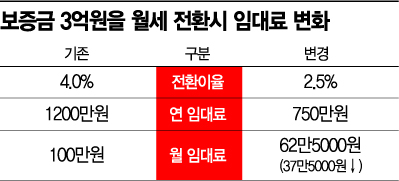
According to the real estate industry on the 29th, the rent-to-deposit conversion rate, which applies when converting a jeonse (lump-sum deposit lease) to a monthly rent, has been lowered from the existing 4% to 2.5%, raising concerns that side effects such as rent increases will intensify in the market.
If the rent-to-deposit conversion rate decreases, tenants can immediately reduce their monthly rent burden. For example, a tenant living in a house with a jeonse deposit of 300 million KRW who lowers the deposit to 100 million KRW upon contract renewal would have previously paid about 670,000 KRW in monthly rent, but from this day forward, only about 420,000 KRW is required.
However, in the long term, there is a high possibility that side effects will arise in the form of rent increases. This is because the rent-to-deposit conversion rate applies only when converting an existing jeonse contract to monthly rent and does not apply to new contracts.
Due to the implementation of the rent ceiling system, landlords dissatisfied with not being able to raise rents to market levels may evict existing tenants and accept new tenants, sharply increasing rent and deposit prices. The market has already seen a strong trend of decreasing jeonse listings and soaring deposits since the implementation of the Lease Protection Laws 2 at the end of July, and the lowering of the rent-to-deposit conversion rate is expected to further accelerate this trend.
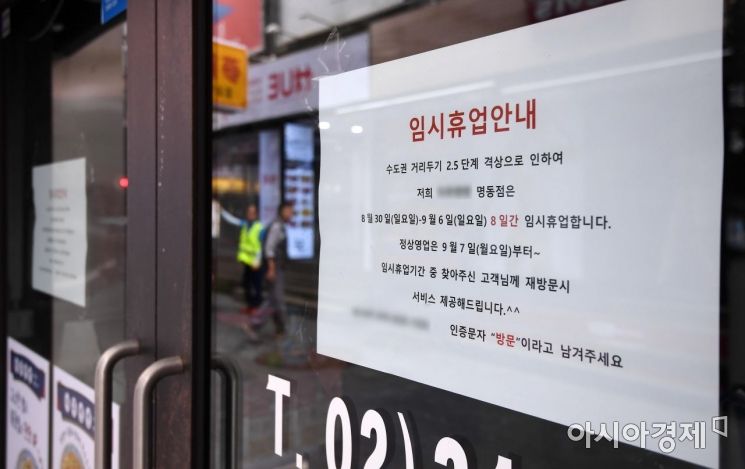 A notice of temporary closure is posted at a store in Myeongdong, Jung-gu, Seoul, an area densely packed with restaurants and various shops. Photo by Kim Hyunmin kimhyun81@
Disputes Everywhere... Encouraging Litigation?
Since the government pushed policies without sufficiently gathering opinions from landlords and experts, disputes among stakeholders are expected to increase. Because the rent-to-deposit conversion rate is stipulated by civil law, landlords cannot be punished even if they violate it. Tenants can claim contract invalidity and demand the return of unjust enrichment, but depending on the case, they may have to go through dispute mediation committees or civil lawsuits.
The government has also announced plans to increase the number of lease dispute mediation committees from the current six to eighteen by next year in preparation for an increase in disputes between landlords and tenants. An industry insider said, "As the conflict structure between landlords and tenants has become clearer, disputes are expected to increase significantly," adding, "Since restrictions on landlords have increased, the quality of tenants' housing may also decline."
According to Seoul City, 5,090 lease-related consultations were received at the Jeonse and Monthly Rent Deposit Support Center within one month after the implementation of the Lease Protection Laws 2, more than three times the 1,539 cases during the same period last year.
The government's amendment of the Commercial Lease Act, which prevents landlords from terminating contracts or refusing renewals even if tenants delay rent payments for up to six months, is also analyzed as a potential spark for disputes between landlords and tenants.
Although many tenants suffered due to the economic downturn caused by the spread of COVID-19, critics argue that shifting all losses onto landlords is unfair. Small-scale commercial landlords, who have little income besides monthly rent, are facing immediate livelihood difficulties due to this law amendment but have no choice but to bear the burden under the government's 'tenant protection' framework.
The 'Good Tenant' Frame Distorts the Market
Lee Eunhyung, a research fellow at the Korea Institute of Construction Policy, said, "Not all landlords are wealthy, and not all tenants are poor, but recent lease-related laws unconditionally benefit tenants and infringe on landlords' interests," adding, "This is a highly contentious issue, yet the government is pushing too hard."
The problem is that contrary to the government's good intentions, the amendments to the Housing Lease Act and Commercial Lease Act are distorting the market in ways that harm not only landlords but also tenants. Commercial building landlords, burdened with fixed costs such as taxes, loan interest, insurance, and repair expenses, may raise rents on new contracts or take strong measures to evict existing tenants after six months.
In fact, among landlords, there is growing backlash with statements like "We have frozen rents for years, but now we will raise them as much as possible" or "If rent is overdue, we will evict according to the law."
The provision allowing tenants to request rent reductions from landlords due to first-class legally designated infectious diseases such as COVID-19 also lacks clarity regarding the reduction amount and period, which is expected to cause unnecessary disputes.
Since there are no specific detailed regulations and landlords are not obligated to comply, many cases are likely to go to court. An industry insider said, "If it goes to litigation, both landlords and tenants may suffer losses in terms of time and cost," adding, "Especially tenants may bear a heavier burden in lawsuits, so the effectiveness of the system may be low."
© The Asia Business Daily(www.asiae.co.kr). All rights reserved.
![Clutching a Stolen Dior Bag, Saying "I Hate Being Poor but Real"... The Grotesque Con of a "Human Knockoff" [Slate]](https://cwcontent.asiae.co.kr/asiaresize/183/2026021902243444107_1771435474.jpg)
















