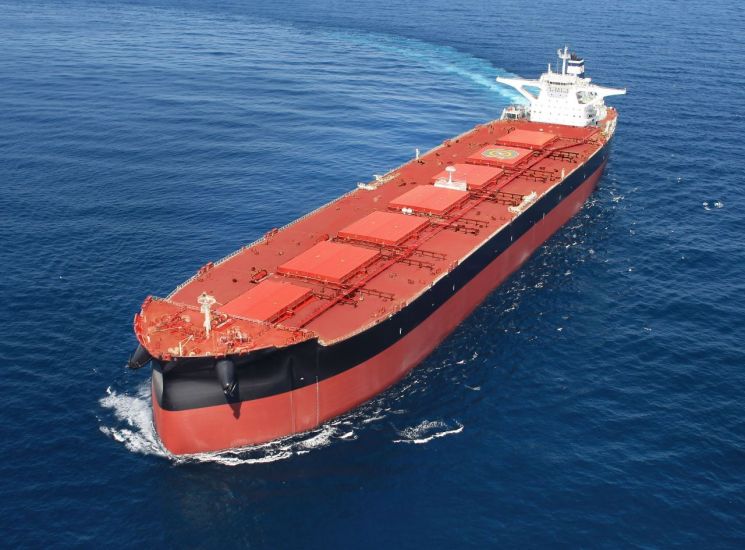
 KCC has developed a solvent-free coating for ships, securing differentiated eco-friendly competitiveness. The photo shows a Polaris Shipping ore carrier of the same type as the ship scheduled to apply the eco-friendly solvent-free coating. Photo by KCC
[Asia Economy Reporter Kim Jong-hwa] Amid the heated development of eco-friendly technologies in the paint sector, a technology enabling the commercialization of solvent-free coatings has been developed, invigorating the ship coating industry.
Shipbuilders are accelerating research and development to secure future competitiveness through various eco-friendly technology developments aimed at dominating the eco-friendly ship market. In this context, the development of technology for commercializing eco-friendly solvent-free coatings has stirred the market.
The ship coating industry estimates the domestic ship coating market size to be about 500 billion KRW this year. The industry expects the market size to grow further as solvent-free coatings, which are eco-friendly and high-quality products but have not been widely used due to technical difficulties, gain momentum.
Solvent-Free Coatings: No Fire Risk During Ship Painting and Significantly Reduced Environmental Pollutant Emissions
Solvent-free coatings are eco-friendly products that eliminate the risk of fire accidents during ship painting work and reduce air and environmental pollution. However, due to technical challenges in achieving uniform quality under various painting environments and shipbuilding conditions, they have not been commercialized and remained overshadowed by hazardous organic solvent-based coatings.
The protagonist who overcame these technical difficulties of solvent-free coatings and ushered in a new era is KCC. Recently, KCC, in collaboration with Korea Shipbuilding & Offshore Engineering and Hyundai Heavy Industries, succeeded in developing eco-friendly solvent-free coating technology by overcoming technical limitations through long-term R&D. Accordingly, KCC, Korea Shipbuilding & Offshore Engineering, and Hyundai Heavy Industries have standardized various new ship solvent-free coating specifications and secured differentiated eco-friendly competitiveness.
With the global demand for eco-friendly products and technologies increasing, the shipbuilding industry of Korea, China, and Japan?which accounts for over 85% of global ship production?means that eco-friendly coating technology originating in Korea will have an international impact.
Accordingly, the government began enforcing the 'Amendment to the Enforcement Rules of the Air Quality Preservation Act' from April 3, mandating eco-friendly applications for ship painting facilities. The amendment introduces regulations requiring the use of eco-friendly coatings in ship painting facilities. Additionally, painting operations must install air pollution prevention facilities or use coatings with a combined concentration of regulated substances below 5 wt% (weight percent).
By 2024, Over 60% of Ship Painting Must Use 'Solvent-Free Coatings'
At shipyards, when using conventional solvent-based coatings, pollution prevention facilities must be installed or eco-friendly coatings that do not cause air pollution must be used. The application of solvent-free coatings must expand to 2% this year, 10% next year, and over 60% by 2024.
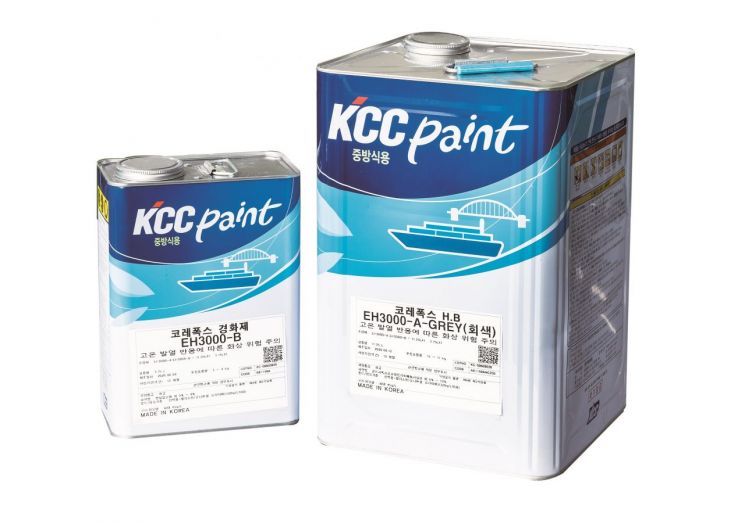
Solvent-free coatings are characterized by viscosity control. Maintaining appropriate viscosity improves painting workability. After painting, the solvent evaporates and does not remain in the coating film. The key to solvent-free coating technology is securing the target physical properties while eliminating the solvent, which is one of the four main components of coatings?resin, pigment, additives, and solvent.
Especially in domestic shipyards where four distinct seasons cause significant differences in painting environment conditions, securing the 'pot life'?the time during which the coating maintains viscosity suitable for subsequent painting?is crucial for smooth painting operations. Some shipyards still use organic solvent coatings despite the risks of explosion and suffocation because of the need to secure this pot life.
KCC Conducting 3-4 Projects Per Shipyard with Solvent-Free Coatings at Major Domestic Shipyards
Solvent-free coatings drastically reduce the emission of volatile organic compounds (VOCs) into the atmosphere and significantly lower the risks of suffocation, explosion, and fire accidents during painting work in enclosed spaces.
In the ship coating industry, KCC is moving a step ahead. KCC is collaborating with shipyards to develop solvent-free coatings with excellent physical properties and field workability, applying them to actual ships. Although the shipowners cannot be disclosed, KCC is currently conducting 3-4 projects each at Hyundai Heavy Industries and Hyundai Samho Heavy Industries.
A KCC official stated, "We plan to further expand solvent-free coating technology as the next-generation standard product for ships, providing not only compliance with eco-friendly regulatory products under the Air Quality Preservation Act but also excellent physical properties, workability, and stability of the solvent-free coating itself." He added, "We will devote ourselves to developing eco-friendly technology products to secure the competitiveness of Korean shipyards and protect the environment."
© The Asia Business Daily(www.asiae.co.kr). All rights reserved.
![Clutching a Stolen Dior Bag, Saying "I Hate Being Poor but Real"... The Grotesque Con of a "Human Knockoff" [Slate]](https://cwcontent.asiae.co.kr/asiaresize/183/2026021902243444107_1771435474.jpg)

















