One Year of 탈일본... Examining the 'Mabuwichim' of Research Institutes
667 R&D Projects Carried Out, 1250 Patent Applications and Registrations
So-Bu-Jang Strategy Must Shift from 탈일본 to Post-Corona
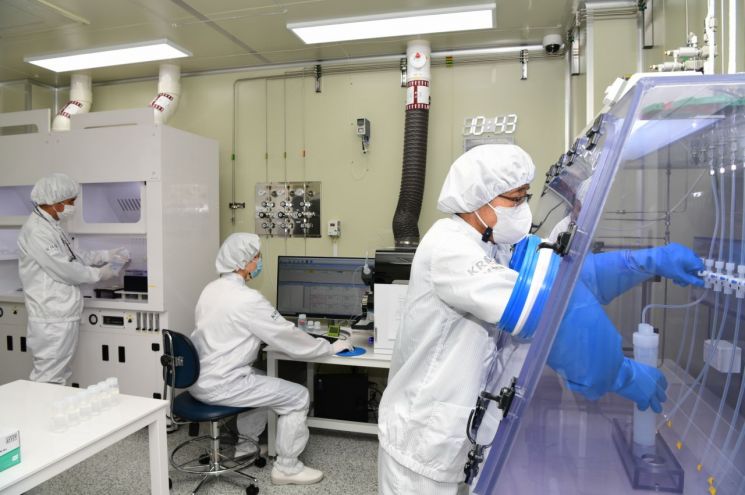
[Asia Economy Reporter Junho Hwang] Mabuwichim (磨斧爲針).
This is the title of the one-year performance report released on the 30th by the National Research Council of Science & Technology, which has been fully committed to securing the competitiveness of Korea's materials, parts, and equipment industry since the Japanese government imposed export restrictions on Korea in July last year. The phrase means "grinding an axe to make a needle," signifying that no matter how difficult a task is, it can be achieved through persistent effort. It reflects the hardships endured so far and the firm determination to achieve technological independence from Japan in the future.
1,250 Patents
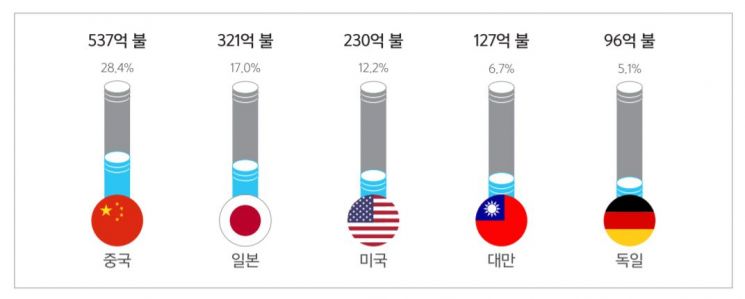 Top 5 Countries by External Dependence Ratio in the Domestic Materials, Parts, and Equipment Industry (As of 2019)
After Japan's export restrictions, government-funded research institutes pursued 677 research and development (R&D) projects. With an investment of 1 trillion won, 15 institutes including the Korea Research Institute of Chemical Technology, Korea Institute of Industrial Technology, and Korea Institute of Materials Science carried out R&D projects. This was a response to Japan removing Korea from its list of security allies last year, requiring individual permits for 1,194 monitored items on their strategic materials list.
Korea has made every effort to achieve technological independence in materials, parts, and equipment, with government-funded research institutes at the forefront. Research in basic chemistry, machinery and metals, and electrical and electronics fields accounted for the majority (524 projects) of the efforts to secure technology in materials, parts, and equipment.
One year later, these R&D efforts have resulted in 1,250 patent applications (720) and registrations (530). The number of technology transfers is about 292. Except for 10 cases, the rest were transferred to small and medium-sized enterprises and mid-sized companies. Technology support projects assisting individual companies' R&D were also carried out for 7,842 companies with 7,562 projects.
From De-Japanization to Post-Corona
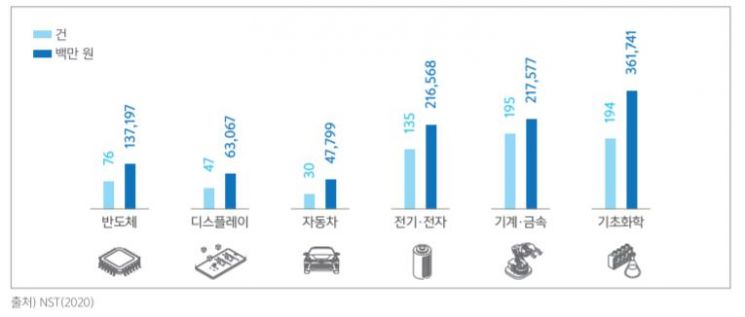 Status of Patent Applications and Registrations by Public Research Institutes Since Japan's Export Restrictions
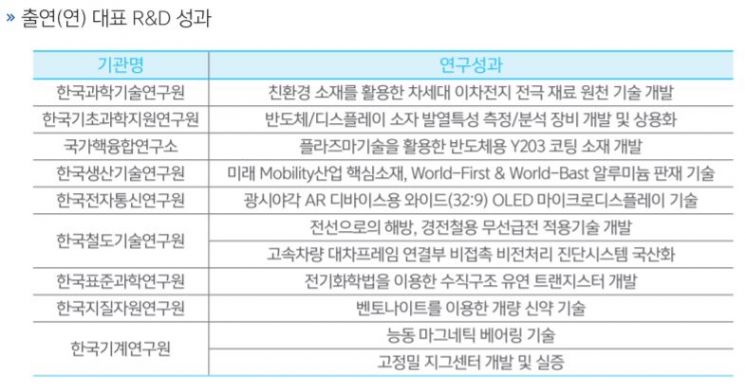
Individual research institutes have also secured notable technological capabilities. The Korea Institute of Machinery & Materials developed a jig center, a high-precision cutting machine tool for core machinery parts processing. This product was previously entirely imported from Japan. The institute jointly developed the core technology and produced prototypes with Doosan Machine Tools. The institute expects annual sales of around 10 billion won three years after the demonstration phase ends.
The Korea Electrotechnology Research Institute developed the world's first copper-graphene composite ink to replace silver-based conductive metal ink. This product aims to break the high dependence on Japan for high-quality silver ink used in precision parts. Although priced at about one-tenth of silver ink, it has similar electrical conductivity to silver. The institute targets a 3% market share replacing imports in the domestic market this year and expects to increase it to 36% by 2025.
The Korea Research Institute of Chemical Technology localized polyvinylidene fluoride (PVDF), which had a 31% import ratio from Japan. This technology was previously unavailable domestically, and the institute collaborated with small and medium enterprises to secure technology for producing PVDF and VDF monomers.
The council stated, "With the expansion of protectionism and changes in the international industrial environment due to the novel coronavirus (COVID-19), rapid yet cautious institutional adjustments that can flexibly respond are necessary," adding, "It is necessary to adjust materials, parts, and equipment items considering the collapse of the global value chain (GVC) after the post-corona era, moving beyond last year's focus on responding to Japan's export restrictions."
© The Asia Business Daily(www.asiae.co.kr). All rights reserved.



















