Three Major Large Mart Operators' Local Governments
Demand to Change Mandatory Closure Days
Conversion Rate Only 28.6%
10-20% Sales Impact if Closed on Weekend Before Holidays
Consumers Inconvenienced... Effectiveness of Regulation 'Questionable'
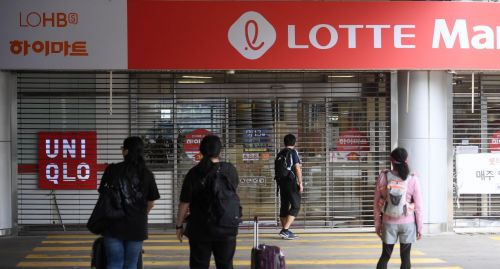 Emart, Homeplus, and Lotte Mart, three major large-scale retailers, will all close their stores in Seoul on the weekend of the Chuseok peak season, the 8th. The three large retailers requested a change in their mandatory closure days (twice a month) from the local governments where their stores are located, but were notified that it was not allowed. Previously, the three large retailers asked to change the mandatory closure day, which coincided with the weekend just before Chuseok, to the day of Chuseok on the 13th, but the request was not accepted. The photo shows a large-scale retailer store in Seoul closed on that day. Photo by Kim Hyunmin kimhyun81@
[Asia Economy Reporter Minyoung Cha] "I need to buy Chuseok gifts today, but where should I go?" Eun-ah Kim (pseudonym), a working mom in her 40s, forgot that the nearby large supermarket was closed for a mandatory holiday on the 27th and ended up making a wasted trip. She had planned to buy Chuseok gifts for both sets of parents, but most large supermarkets in Seoul were closed. Since the gift was meant to convey her heartfelt feelings, she deliberately left home to carefully select the items in person. Eventually, Kim turned to a nearby department store after about an hour, but sighed at the amount exceeding her planned budget.
This Chuseok, 3 out of 10 local governments switched mandatory supermarket closure days
According to the distribution industry on the 28th, the Korea Chain Store Association requested 147 local governments with large supermarkets to change the mandatory closure day from the usual Sunday, October 11, to the earlier Chuseok day, Thursday, October 1. As a result, 42 places (conversion rate 28.6%) agreed to the change, a figure similar to last year. Since changing to the previous weekend, September 27, was deemed difficult under current law, they proposed changing to a later date instead. However, even this was not easy to get local governments’ consent for.
In fact, on the 27th, among the three major domestic large supermarkets in Seoul (E-Mart, Homeplus, Lotte Mart), only one store, the E-Mart affiliated specialty store No Brand at Dongdaemun Doota Mall, was open. These stores are regulated by local ordinances under the Distribution Industry Development Act to have mandatory closure on the second and fourth Sundays of each month. The weekend just before the Seollal and Chuseok holidays accounts for 10-20% of the total holiday season sales for large supermarkets. This means that closing for one day causes a significant sales impact.
The purpose of the Distribution Industry Development Act, which enforces mandatory closures of large supermarkets, is to promote coexistence with traditional markets and small businesses in local shopping districts. The intent was to lock large supermarkets and voluntarily guide citizens to disperse and visit traditional markets and individual stores. However, research conducted over the past decade since the distribution regulations were strengthened in 2012 has shown results contrary to this rationale regarding large supermarkets and surrounding commercial areas.
19.8% stay home when large supermarkets close
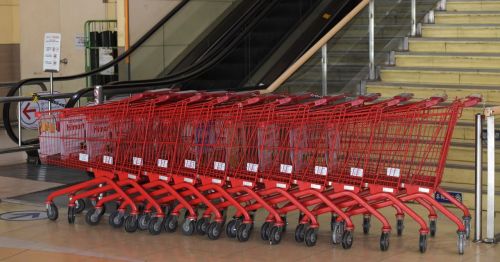 On the 23rd, one day before Chuseok, about two-thirds of major large marts will not be open. This is because the mandatory closure day for large marts, the fourth Sunday of the month, coincided with the day before Chuseok.
Since the introduction of the mandatory closure system for large marts under the 2012 amendment to the Distribution Industry Development Act, this is the first time it has applied on a Sunday before Chuseok. The photo shows Lotte Mart Seoul Station branch on that day. Photo by Moon Honam munonam@
According to the research analysis titled "Evaluation of 10 Years of Distribution Regulation and Coexistence Measures" submitted to Assemblywoman Mookyung Han of the People Power Party by the Korea Distribution Science Association, in a survey on "Consumer Behavior Changes on Mandatory Closure Days of Large Supermarkets," out of 465 respondents, only 29.47% said they visit individual supermarkets (23.66%) or traditional markets (5.81%). Among the rest, online shopping (11.83%), large supermarkets in other regions (11.61%), food material marts (10.11%), leisure activities (7.10%), complex shopping malls (5.16%), convenience stores (4.09%), and others (0.88%) were higher. Staying home and resting (19.78%) resulted in a negative effect where consumption completely disappeared.
The study also analyzed the sales impact on surrounding commercial areas by day of the week after large supermarkets closed. Within 1 km of the large supermarket, supermarkets saw sales decline on five days except Monday and Tuesday, with Sunday sales dropping by 5.01%. Restaurants also experienced sales decreases on five days except Monday and Tuesday, with Sunday sales down by 2.09%. This paradoxically indicates a high correlation in sales between large supermarkets and nearby supermarkets and restaurants on the currently designated mandatory closure day, Sunday.
Political voices to 'rest on Chuseok day'... Labor unions counter with 'trick'
There were moves to improve the fixed mandatory closure day on Sunday in the 21st National Assembly, but labor unions strongly opposed it. On the 22nd, Assemblywoman Heo Eun-ah of the People Power Party introduced a partial amendment bill to the Distribution Industry Development Act to allow workers at large supermarkets and semi-large stores (SSM) to rest with their families on Chuseok or Seollal holidays. The proposal is for workers to rest on Chuseok day, October 1, and work normally on either October 11 or 25, a day designated by the head of the local government.
In response, the Mart Industry Labor Union of the Korean Confederation of Trade Unions’ Service Industry Labor Union Federation demanded that Assemblywoman Heo Eun-ah withdraw the amendment bill. The Mart Union stated, "This completely misrepresents the intentions of supermarket workers and goes against their interests, so it must be withdrawn immediately," and countered, "Workers’ demand is to keep the mandatory closure as is and also rest on the holiday itself." Changing the mandatory closure day to allow workers to rest on Chuseok day is seen as a trick to increase sales, benefiting only the employer companies.
A representative from Assemblywoman Heo Eun-ah’s office explained, "According to last year’s survey by the Gyeonggi Institute of Science and Technology Distribution Research Center, 524 out of 673 supermarket workers (79.9%) responded that they want to rest on the holiday, so this claim is hard to accept." They also argued that since the amendment bill’s passage would allow changing the mandatory closure day for Seollal in January next year, a social consensus should be reached quickly.
© The Asia Business Daily(www.asiae.co.kr). All rights reserved.
![Clutching a Stolen Dior Bag, Saying "I Hate Being Poor but Real"... The Grotesque Con of a "Human Knockoff" [Slate]](https://cwcontent.asiae.co.kr/asiaresize/183/2026021902243444107_1771435474.jpg)
















