[Feature] Four Key Words Deciding the Presidential Election ① Region... DJ and YS Both Confident of Victory, Conclusion is No Tae-woo's Unexpected Gain
[Asia Economy Reporter Ryu Jeong-min]
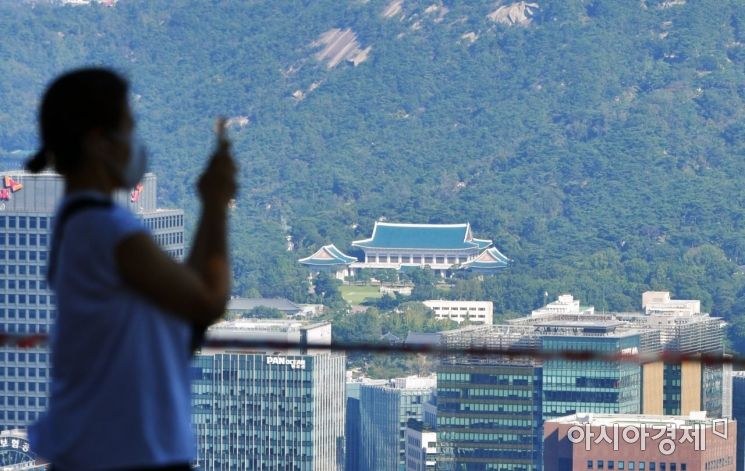 On the 20th, when the weather was fully autumnal, citizens who visited Namsan in Seoul were looking out over the open cityscape. Photo by Dongju Yoon doso7@
If asked to name the hottest presidential election in South Korean political history, the 1987 election cannot be overlooked. A total of five candidates ran, but except for Shin Jeong-il who received 0.20%, the other four were political heavyweights.
The so-called ‘Era of the Three Kims’ was led by three political leaders who all ran in the 1987 presidential election, competing fiercely. Kim Dae-jung of the Peace Democratic Party, Kim Young-sam of the Reunification Democratic Party, and Kim Jong-pil of the New Democratic Republican Party faced off. Opposing them was Roh Tae-woo, the candidate from the then-ruling Democratic Justice Party.
After the so-called gymnasium election ended and the people gained the opportunity to elect the president, the opposition parties were highly confident. They believed that if they ran, they would surely win. Had Kim Dae-jung and Kim Young-sam unified their candidacies, the 1987 election might have been a straightforward contest.
When discussing the 1987 election, regional voting cannot be ignored. Kim Dae-jung represented Honam, Kim Jong-pil represented Chungcheong, Roh Tae-woo represented Daegu and Gyeongbuk in Yeongnam, and Kim Young-sam represented Busan and Gyeongnam. It was an election where regional representation was clear.
In fact, each had the power to secure overwhelming votes in their political strongholds. This gave rise to the so-called ‘Four-way winning theory’ or ‘Four-way losing theory.’ Kim Dae-jung expected to win the presidency based on the overwhelming support from Honam and strong performance in the Seoul metropolitan area, especially Seoul.
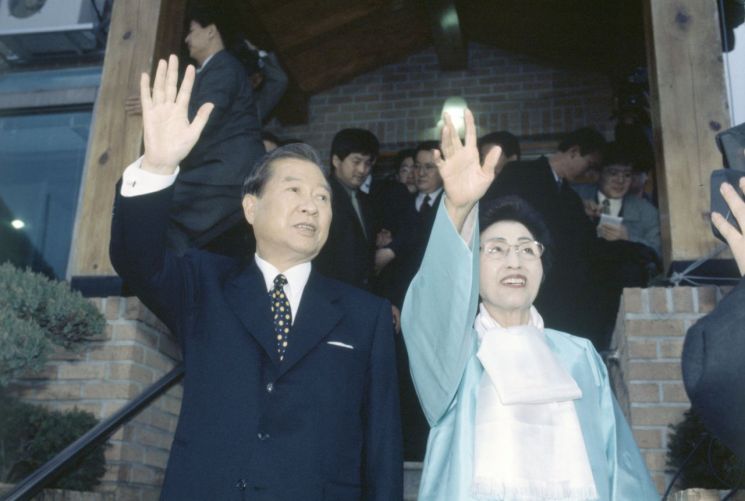
The background of the four-way winning theory was that if the four regional candidates competed, Kim Dae-jung would have the advantage. In Yeongnam, votes would be split between Roh Tae-woo and Kim Young-sam, so the decisive factor would be the Seoul metropolitan area, which favored Kim Dae-jung.
On the other hand, the four-way losing theory argued that if the four-way race continued, Roh Tae-woo, with the ruling party premium, would win. This was also a plausible claim.
The 1987 election saw intense regionalism as expected. Negative campaigning was also rampant. Kim Dae-jung won a landslide in Gwangju with 94.41% of the vote, Kim Jong-pil secured first place in Chungnam with 45.03%, Roh Tae-woo comfortably won Daegu with 70.69%, and Kim Young-sam took first place in Busan with 55.98%.
Comparing only regional vote percentages, Kim Dae-jung’s momentum was tremendous, but considering the number of voters, the regional strongholds’ overwhelming votes ultimately worked against Kim Dae-jung.
At that time, Gwangju had only about 520,000 voters. In contrast, Daegu had about 1.27 million, and Busan had about 2.29 million voters. Daegu and Busan each had more than twice and four times the number of voters compared to Gwangju.
Kim Dae-jung’s camp believed that winning in Seoul, which had about 6.48 million voters, would offset losses in other regions, but the results in Seoul fell short of expectations.
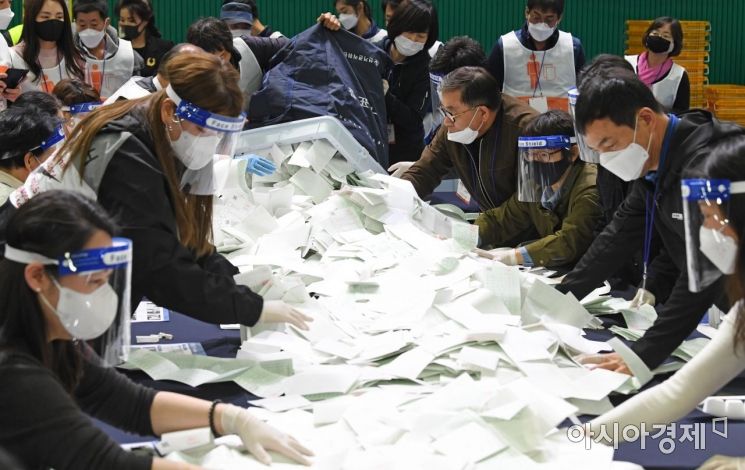 On the 15th, the 21st National Assembly election was held, and officials are conducting vote counting at the counting center set up in the multipurpose badminton gymnasium in Yeongdeungpo-gu, Seoul. Photo by Hyunmin Kim kimhyun81@
Kim Dae-jung received 1,833,010 votes (32.62%) in Seoul, placing first. However, the gap between him and the second and third place candidates was not large. Roh Tae-woo received 1,682,824 votes (29.95%) and placed second, while Kim Young-sam also performed well with 1,637,347 votes (29.14%).
Kim Dae-jung led Roh Tae-woo by about 150,000 votes and Kim Young-sam by about 200,000 votes in Seoul. However, Kim Dae-jung trailed Roh Tae-woo by about 770,000 votes in Daegu and Kim Young-sam by about 930,000 votes in Busan.
This proved that the four-way losing theory, not the four-way winning theory, was correct. The results of the 1987 election, which unfolded amid intense regionalism, confirmed this. Roh Tae-woo won first place with a low vote share of 36.64% by a fortunate margin.
Kim Dae-jung remained in third place with 27.04% of the vote, and Kim Young-sam took second place with 28.03%. The difference in vote share between Kim Young-sam and Kim Dae-jung was not large. Kim Jong-pil was weak outside Chungcheong and finished fourth with 8.06%.
The regional variable remained a key factor in determining election outcomes even after 1987. However, due to changes in the political environment, the phenomenon of overwhelming regional victories has eased compared to the past. While region remains important for politicians running for president, winning is no longer guaranteed solely by regional dominance.
© The Asia Business Daily(www.asiae.co.kr). All rights reserved.
![Clutching a Stolen Dior Bag, Saying "I Hate Being Poor but Real"... The Grotesque Con of a "Human Knockoff" [Slate]](https://cwcontent.asiae.co.kr/asiaresize/183/2026021902243444107_1771435474.jpg)

















