Analysis of FKI Over the Past 3 Years... The Largest Among All Governments
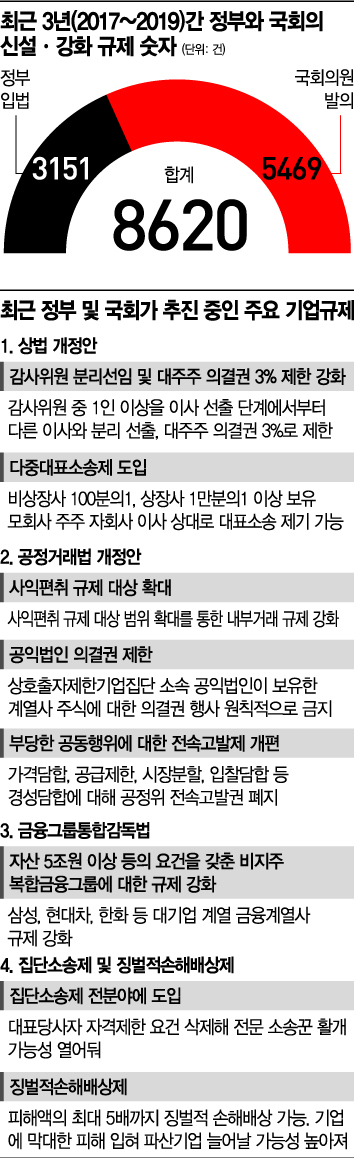
[Asia Economy Reporter Changhwan Lee] It has been revealed that over 8,600 new or strengthened regulations have been created by the government and the National Assembly in the past three years. On average, about 2,800 regulations per year, or roughly 8 per day, were newly established or reinforced.
According to the Federation of Korean Industries on the 28th, from 2017 to last year, 3,151 regulations were newly established or strengthened through government legislation. During the same period, 5,469 regulations were newly established or strengthened through bills proposed by lawmakers, totaling 8,620 regulations combined.
This amounts to an average of 2,873 regulations per year, or about 7.9 per day, being newly established or strengthened. These figures are based on bills reported to the Regulatory Reform Committee over the past three years, representing the highest level compared to previous governments or National Assemblies.
Although about eight regulations are newly established daily, most are considered low-priority regulations, which is also problematic. Among the 3,151 government legislative regulations disclosed to the Regulatory Reform Committee, 97.5% of newly established regulations and 95.2% of strengthened regulations were classified as non-important during the preliminary review and passed without undergoing the Committee’s main review.
When the government intends to establish or strengthen regulations, it must undergo review by the Regulatory Reform Committee; however, if classified as non-important, no review is required. According to the Framework Act on Administrative Regulations, important regulations include those where the burden on the regulated group and the public exceeds 10 billion KRW annually, or where the number of people regulated exceeds 1 million annually, or where the regulation is excessive or unreasonable compared to international standards.
Representative important regulations recently legislated by the government include the Chemical Substances Registration and Evaluation Act (Chemicals Control Act), which imposes significant burdens on companies, and financial supervisory regulations limiting Loan-to-Value (LTV) and Debt-to-Income (DTI) ratios on mortgage loans.
However, such important regulations are a very small minority, with over 95% being minor regulations. It is pointed out that the government’s excessive issuance of unnecessary regulations is damaging corporate competitiveness and hindering the development of new industries.
Kwon Tae-shin, Vice Chairman of the Federation of Korean Industries, stated, "In an era of borderless global competition, to win against advanced foreign countries, the regulatory burden on our companies must be lower than or at least equal to that of companies in other countries, but Korea is moving in the opposite direction. Due to unreasonable regulations, open hospitals that could create many jobs, foreign school establishments, and complex leisure facilities have all been blocked. Our early initiatives such as the Northeast Asia financial hub and logistics hub were all overtaken by Shanghai and Singapore, which started later."
© The Asia Business Daily(www.asiae.co.kr). All rights reserved.
![Clutching a Stolen Dior Bag, Saying "I Hate Being Poor but Real"... The Grotesque Con of a "Human Knockoff" [Slate]](https://cwcontent.asiae.co.kr/asiaresize/183/2026021902243444107_1771435474.jpg)
















