Record High in Zombie Companies
Emergency Measures Including Bank Loan Loss Provisions
Four Major Banks' Subordinated Bonds Near 3 Trillion This Year
[Asia Economy Reporter Jo Gang-wook] Amid the aftermath of the novel coronavirus infection (COVID-19), the number of 'zombie companies' surviving on debt has reached an all-time high, prompting major commercial banks to consecutively issue subordinated bonds to stockpile ammunition for potential emergencies. However, there is growing concern that the large-scale issuance of subordinated bonds by banks to bolster capital could backfire by undermining profitability. The Bank for International Settlements (BIS) has also expressed worries that the financial soundness of the Korean market may deteriorate due to these 'zombie companies.'
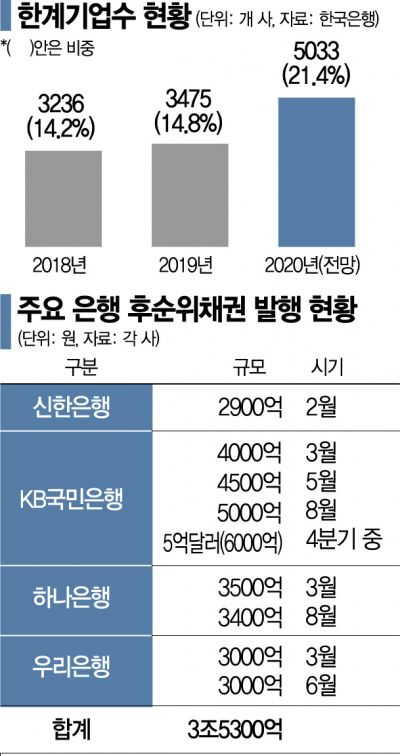
According to the financial sector on the 28th, the total amount of subordinated bonds issued this year by Korea's four major commercial banks?KB Kookmin, Shinhan, Hana, and Woori?approaches 3 trillion won. Including the $500 million (approximately 600 billion won) foreign currency amortizing contingent capital securities (subordinated bonds) that KB Kookmin Bank announced on the 24th through a revised disclosure to be issued in the fourth quarter, the total exceeds 3.5 trillion won. This amount already surpasses last year's annual issuance volume of 2.2 trillion won by more than 1 trillion won.
By bank, Shinhan Bank started with 290 billion won in February, followed by KB Kookmin Bank issuing subordinated bonds worth 400 billion won in March, 450 billion won in May, and 500 billion won in August. Originally, Kookmin Bank planned to issue $500 million in the second quarter of this year, but postponed the issuance schedule considering the deteriorating overseas bond market conditions due to the spread of COVID-19. Hana Bank also issued subordinated bonds worth 350 billion won in March and 340 billion won last month, while Woori Bank issued 300 billion won worth in both March and June.
The rush by commercial banks to issue subordinated bonds stems from an emergency in managing capital soundness due to provisions for loan losses. Subordinated bonds are used as a means for banks to increase capital. International organizations such as the BIS recognize long-term subordinated bonds with maturities of five years or more issued by banks as capital. As of the end of June, Kookmin Bank's BIS total capital ratio stood at 14.38%, down 1.47 percentage points from the end of last year, marking the lowest level among major banks.
Growing Concerns Over Defaults from Zombie Companies
The problem is that concerns over defaults caused by zombie companies are snowballing. According to the Bank of Korea, the number of zombie companies this year is estimated to exceed 5,000. This is 1,500 more than last year’s 3,475, which was the highest since related statistics began in 2010. In the worst-case scenario, the Bank of Korea forecasts that 2 out of every 10 companies this year could be zombie companies.
Another burden is that subordinated bonds, which have a lower repayment priority and thus must offer high interest rates to be sold, could become a future financial pressure for banks. In a situation where it is difficult to generate profits due to COVID-19 financial support, issuing subordinated bonds could increase funding costs and act as a burden on banks. Yet, banks face a dilemma as they cannot stop securing ammunition to support companies financially.
In a recent report, the BIS predicted that if the number of insolvent companies surges, the 'shock absorption capacity' of banks could become a critical issue. It pointed out that zombie companies, which had low profitability even before COVID-19, are surviving due to low interest rates and government public support.
Jang Woo-ae, a research fellow at IBK Economic Research Institute, explained, "The BIS warned that while countries like Luxembourg, Norway, Finland, and Mexico have a high proportion of direct financing, Hong Kong, China, and Korea rely heavily on commercial banks to meet most of the COVID-19 financial demand, necessitating greater caution in managing soundness."
© The Asia Business Daily(www.asiae.co.kr). All rights reserved.
![Clutching a Stolen Dior Bag, Saying "I Hate Being Poor but Real"... The Grotesque Con of a "Human Knockoff" [Slate]](https://cwcontent.asiae.co.kr/asiaresize/183/2026021902243444107_1771435474.jpg)















