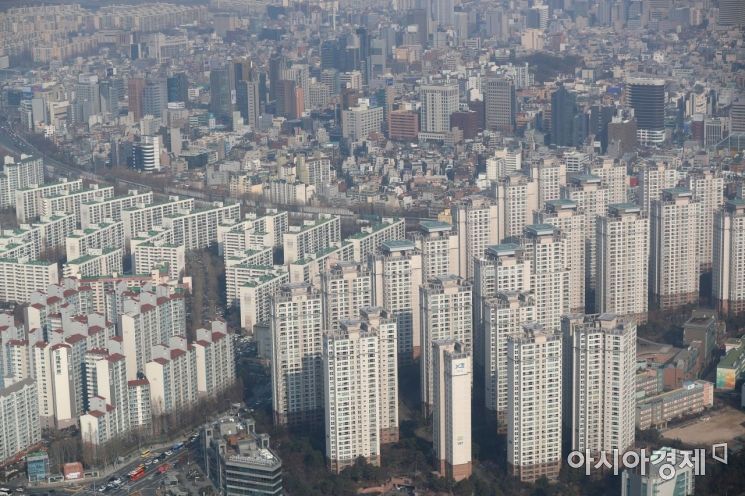
[Asia Economy Reporter Yuri Kim] An analysis has emerged suggesting that to stabilize the Seoul apartment market, where housing prices and rental fees continue to fluctuate, a new balance must be sought among supply volume, supply speed, location, and the recovery of development profits.
The Korea Research Institute for Construction Industry recently stated this in a report. The actual transaction prices of Seoul apartments have shown a prolonged high growth rate, generating various social issues. While the volatility of the Seoul apartment market has decreased from a long-term perspective, during periods of stable sale prices, jeonse (long-term deposit lease) prices have risen, causing repeated instability in housing prices and rental fees.
Researcher Yoon-kyung Heo of the institute diagnosed, "It is essential to secure trust that housing will be supplied steadily when buyers want to purchase, preventing future demand from being brought forward to the present." She added, "Reviewing demand and supply situations indicates the need for quantitative expansion of housing supply, especially for the middle class and those in their 30s aiming to own homes." She also pointed out that although policies to strengthen one household one house ownership are in place, homeownership and owner-occupancy rates have stagnated, raising concerns about policy effectiveness.
While the number of registered households has increased due to net inflow growth in the metropolitan area, leading to increased quantitative housing demand, Seoul’s homeownership rate remains below 50%, indicating persistent potential sales demand. The metropolitan population experienced net outflow from 2011 to 2016 but shifted to net inflow after 2017, exceeding 80,000 net inflows in 2019. Seoul follows a similar pattern to the metropolitan area.
Since the 2010s, the decrease in apartment supply in the metropolitan area and Seoul has also reduced the stock of newly built apartments in Seoul. According to the institute, compared to the 2000s (2000?2009), the average annual apartment move-in volume in the metropolitan area decreased by 17.1% in the 2010s (2010?2019), and Seoul saw a 45.0% reduction. As of 2005, the stock of Seoul apartments within 5 years of age was 354,000 units, but by 2018, it had decreased to 173,000 units, about half.
Notably, price increases were higher for newly built apartments and those with exclusive areas of 85㎡ or less, with increases in purchases by people in their 30s, multi-homeowners, gifts, and corporations. Researcher Heo said, "Compared to the metropolitan area, Seoul apartments show less variation in price growth rates by age and size, but apartments under 10 years old and those sized 20?30 pyeong (approximately 66?99㎡) had the highest price increases." She added, "According to the Korea Real Estate Board, over the past three years, Seoul apartment prices increased by 15.2% for those under 5 years old and 15.5% for those between 5 and 10 years old, showing the highest growth." Regarding exclusive area, apartments between 40㎡ and 60㎡ increased by 15.2%, and those between 60㎡ and 85㎡ rose by 14.9%, indicating high growth rates. The share of apartment purchases by people in their 30s in Seoul increased from 25.3% in the first half of 2019 to 29.8% in the second half, and 31.1% in the first half of 2020.
Researcher Heo emphasized, "Securing buyer trust that they can enter the housing market at any time is paramount," and added, "It is necessary to seek a new policy balance among supply volume, supply speed, location, and development profit recovery to establish a stable housing policy system from a long-term perspective."
© The Asia Business Daily(www.asiae.co.kr). All rights reserved.
![Clutching a Stolen Dior Bag, Saying "I Hate Being Poor but Real"... The Grotesque Con of a "Human Knockoff" [Slate]](https://cwcontent.asiae.co.kr/asiaresize/183/2026021902243444107_1771435474.jpg)















