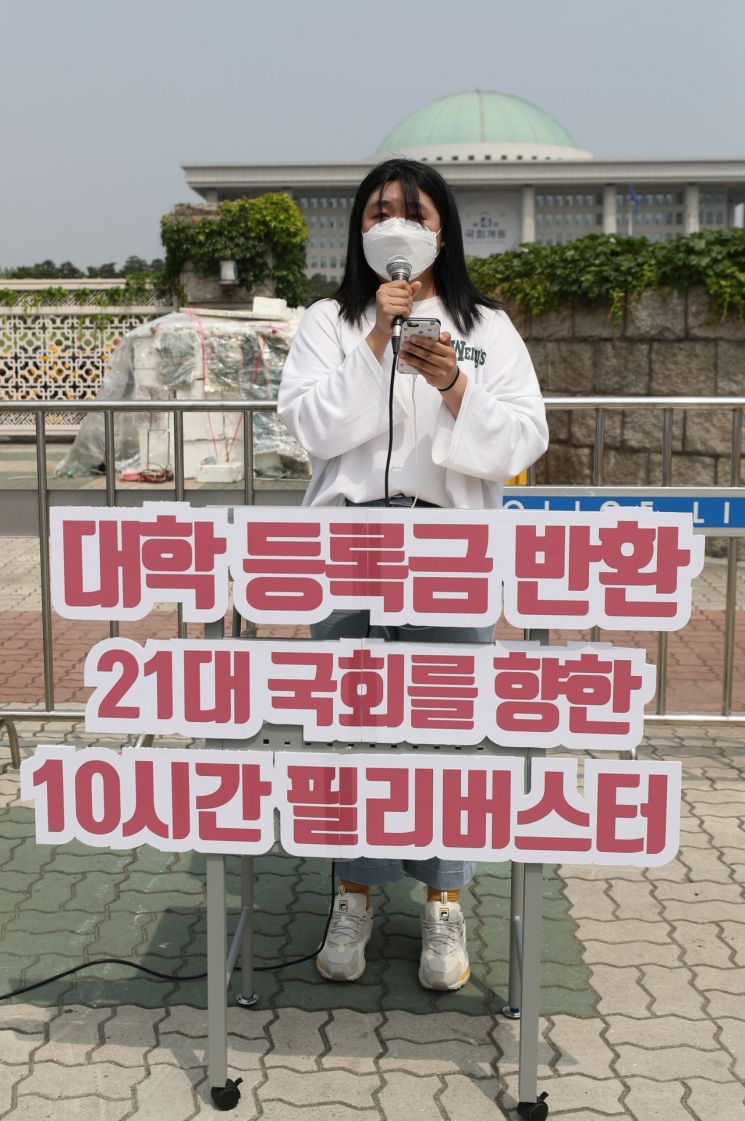
 On June 5th, in front of the National Assembly in Yeouido, Seoul, a participant is speaking out urging the return of university tuition fees during a 10-hour filibuster directed at the 21st National Assembly.
 [Image source=Yonhap News]
[Asia Economy Reporter Choi Eun-young] On the 24th, the National Assembly plenary session passed the 'Partial Amendment to the Higher Education Act,' making it possible to exempt or reduce university tuition fees.
Yu Ui-dong, a 49-year-old member of the People Power Party who sponsored the bill, introduced a provision stating that "tuition fees may be exempted or reduced if it is recognized that normal classes are significantly difficult due to natural disasters or infectious diseases." Accordingly, the tuition review committees established at each university will be able to specifically discuss tuition exemption and reduction.
Rep. Yu emphasized, "As the COVID-19 situation prolongs, it is not appropriate to pass the entire burden onto students who have not been able to attend normal classes or use school facilities," adding, "Now that the legal basis has passed the National Assembly, we will continuously monitor to ensure that universities can specifically discuss tuition exemption and reduction due to the COVID-19 situation."
Meanwhile, as the COVID-19 crisis continues, most universities are conducting remote classes instead of face-to-face instruction. However, with the sudden implementation of remote classes, a significant number of students have demanded tuition exemption or refunds. On June 15, the National University Student Council Network (Jeondaenet), a coalition of student councils from 32 universities nationwide, held a "150km Tuition March of Anger" demanding tuition refunds from the Ministry of Education. On June 22 of the same month, the Ewha Womans University Student Council also went on a sit-in protest demanding tuition refunds.
© The Asia Business Daily(www.asiae.co.kr). All rights reserved.
![Clutching a Stolen Dior Bag, Saying "I Hate Being Poor but Real"... The Grotesque Con of a "Human Knockoff" [Slate]](https://cwcontent.asiae.co.kr/asiaresize/183/2026021902243444107_1771435474.jpg)
















