The Key Contributor Supporting K-Quarantine
Faces Increased Workload and Infection Risk
Government to Announce Related Measures Possibly on the 28th
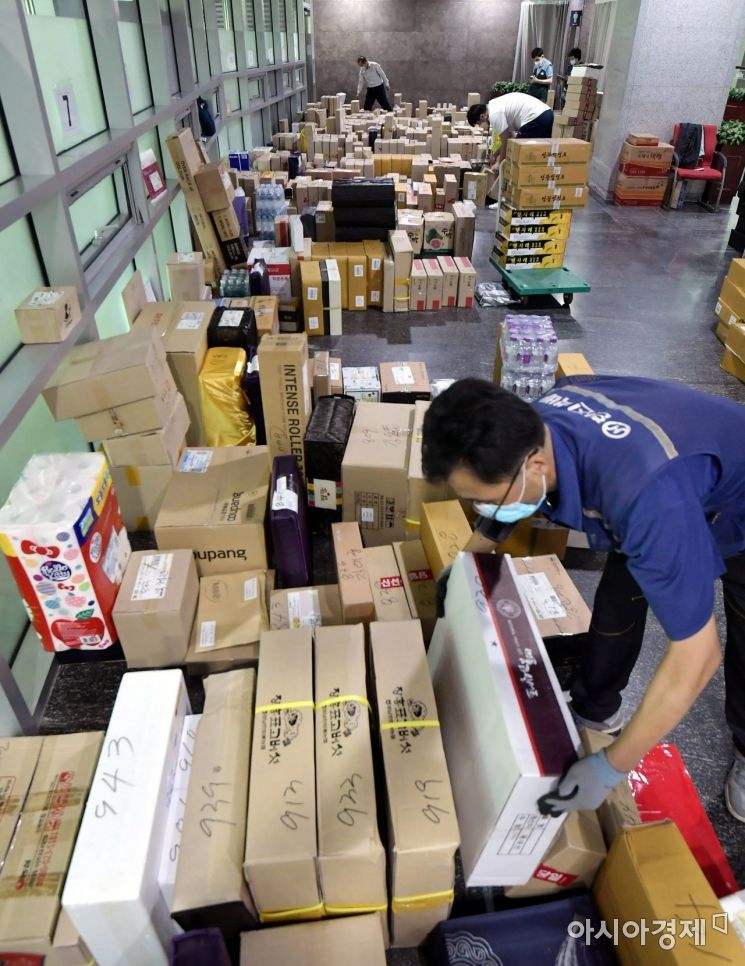 On the 21st, ahead of Chuseok, holiday gift packages are piled up in the lobby of the National Assembly Members' Office Building. Photo by Yoon Dong-joo doso7@
[Sejong=Asia Economy Reporter Kim Hyunjung] Interest is rising in 'essential workers,' whom President Moon Jae-in has urged related ministries to 'pay special attention to.' The government plans to concretely review support measures for these workers and is expected to outline them as early as the 28th.
Essential workers refer to employees in certain sectors who cannot avoid face-to-face contact despite the spread of the novel coronavirus disease (COVID-19) and whose workload has actually increased. Representative fields include healthcare, childcare, caregiving, safety, policing, transportation, logistics, and delivery. These workers enable daily life to continue even in emergencies like the COVID pandemic. Some countries have already decided to support them, calling them 'Essential Workers' or 'Key Workers.'
However, in South Korea, the related terms are unfamiliar, and it has been difficult for these workers to receive proper recognition for their social value and contributions. In fact, many have suffered from severe overwork and low wages, especially during situations like the COVID-19 outbreak.
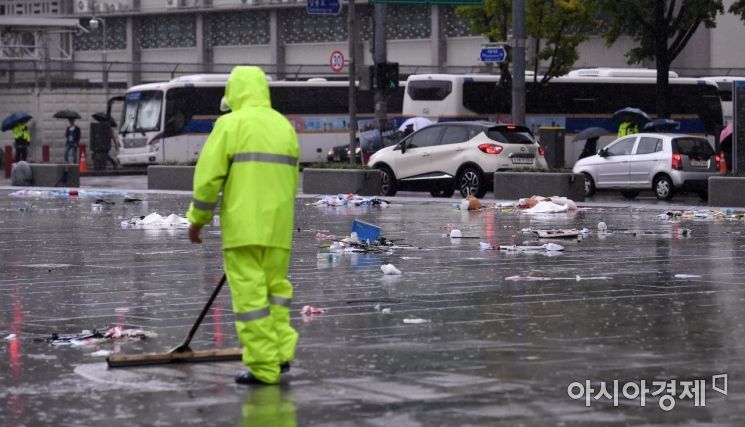 On the 7th, when rain fell in most regions nationwide, a sanitation worker was cleaning up trash from the previous day's event at Gwanghwamun Square in Seoul. Photo by Hyunmin Kim kimhyun81@
The reason President Moon urged to 'pay special attention' during the Cabinet meeting on the 22nd lies here. The COVID-19 crisis has prompted a reassessment of the value of related labor through the establishment of concrete support measures and standards for these workers. At that time, President Moon directly mentioned specific sectors such as healthcare, caregiving, delivery workers, sanitation workers, manufacturing, logistics, transportation, construction, and telecommunications, stating, "They perform indispensable work that protects the lives and safety of the people and maintains our society." He added, "All government ministries should pay special attention to and take care of essential workers who are most exposed to the risk of COVID-19 infection and are placed in poor working conditions with low wages and unstable employment."
Some local governments are accelerating related initiatives. Seongdong-gu became the first local government nationwide to enact the 'Ordinance on the Protection and Support of Essential Workers' on the 10th, starting to prepare support measures. In this ordinance, Seongdong-gu defines essential industries as "sectors where face-to-face work and continuity of labor must be maintained to ensure residents' safety, minimum livelihood guarantees, and the maintenance of social functions even in emergencies such as disasters." After investigating the working conditions of essential workers employed within the district, it plans to provide support such as hazard pay, psychological treatment and health management support, and safety equipment subsidies.
At the Emergency Economic Central Countermeasures Headquarters meeting scheduled as early as the 28th, the government plans to discuss 'measures related to essential workers' and announce whether additional support will be provided. Currently, related measures are being reviewed by relevant ministries including the Ministry of Economy and Finance, Ministry of Employment and Labor, Ministry of Health and Welfare, Ministry of the Interior and Safety, and Ministry of Environment. Since the fourth supplementary budget for responding to the COVID-19 resurgence has already passed the National Assembly and is in the execution phase, the government intends to utilize existing contingency funds and reserves instead of securing additional resources separately. As the related funds are limited, the government is reportedly reviewing guidelines for improving working conditions that can be applied on-site, such as securing shift work and vacation days, in addition to direct financial support.
© The Asia Business Daily(www.asiae.co.kr). All rights reserved.
![Clutching a Stolen Dior Bag, Saying "I Hate Being Poor but Real"... The Grotesque Con of a "Human Knockoff" [Slate]](https://cwcontent.asiae.co.kr/asiaresize/183/2026021902243444107_1771435474.jpg)

















