Government Pushes Legislation to Expand Class Action Lawsuits
Retroactive Application Possible for Cases Before Law Enactment
Industry Opposes, Citing Concerns Over Class Action Abuse and Overuse
[Asia Economy Reporter Suyeon Woo] As the government pushes for the expansion of class action lawsuits and punitive damages, lawsuits in the automotive sector, a representative consumer goods industry, are expected to surge. With the newly enacted legislation potentially allowing for retroactive application, BMW, which is currently facing damages lawsuits related to a 2018 fire incident, is anticipated to become the first class action case in the automotive industry.
According to the legal community on the 25th, as of September this year, more than 2,500 vehicle owners are pursuing damages claims against BMW. They filed a joint lawsuit in 2018 to seek relief for damages caused by fires due to defects in the EGR cooler. As of the end of last year, there are 85 lawsuits pending against BMW Korea, marking an increase of over 670% in the past two years. This surge is largely due to the rise in lawsuits related to the 2018 fire incident.
However, at that time, only those who participated in the lawsuit could receive compensation upon winning, but now even if some consumers win, all vehicle owners with the same model can receive the same compensation. Furthermore, the government is allowing retroactive application of the new legislation to incidents that occurred before its enactment, raising the prospect that the 'BMW fire incident,' which has not yet passed the statute of limitations, could become the first class action case in the automotive sector.
Attorney Jongseon Ha, who handled the BMW lawsuit, said, "The new legislation includes provisions favorable to consumers, such as strengthening orders for companies to submit materials, so class action lawsuits protecting consumer rights are expected to increase. Existing participants in the BMW lawsuit may withdraw and join the new lawsuit, or the court may merge the existing and new cases at its discretion."
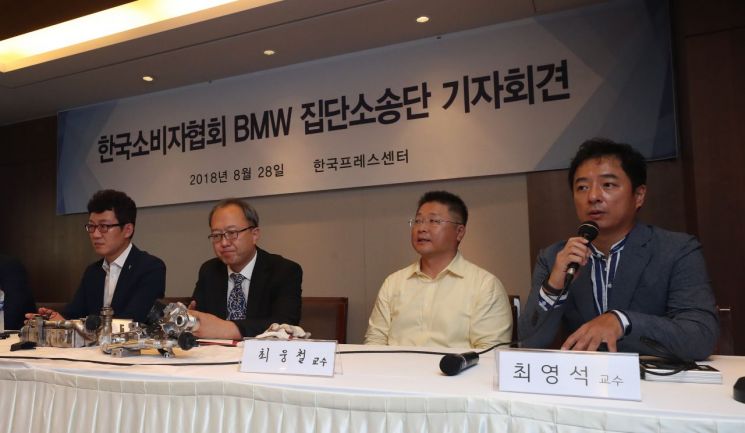 The Korea Consumer Association Litigation Support Group, which is conducting a class action lawsuit for recalled BMW vehicles, is holding a press conference in 2018 / Photo by Yonhap News
The finished car industry is concerned that the expansion of the class action system will lead to a flood of lawsuits like a second or third BMW case, increasing the litigation burden. For finished car manufacturers that sell thousands of vehicles daily, compensation amounts due to lawsuit losses could reach astronomical levels. The possibility of excessive lawsuits or misuse of lawsuits by competitors cannot be ruled out.
In the United States, where the class action system is already in place, finished car manufacturers are plagued by major lawsuits. Last year, Hyundai Kia Motors spent 900 billion KRW on domestic and international recalls and warranty costs to settle a class action lawsuit over Theta 2 engine defects. In 2009, Toyota had to pay fines of 1.2 billion USD (approximately 1.4 trillion KRW) related to sudden unintended acceleration lawsuits. In 2015, Volkswagen proposed a settlement for emissions manipulation charges amounting to 14.7 billion USD (approximately 17.2 trillion KRW), the largest in history.
Additionally, since last year, the 'Korean Lemon Law,' which mandates vehicle exchange or refund if the same defect recurs within one year of purchase, has been in effect. With the added burden of class action lawsuits, there are criticisms of double regulation. Ultimately, companies have no choice but to consider raising consumer prices to prepare for litigation risk reserves.
Jang Manki, chairman of the Korea Automobile Manufacturers Association, said, "With amendments to the Fair Trade Act and Commercial Act underway, and the strengthening of the class action system, the burden on companies is increasing. We plan to propose to the government that the uniform application of laws without considering industry-specific characteristics is unreasonable."
© The Asia Business Daily(www.asiae.co.kr). All rights reserved.
![Clutching a Stolen Dior Bag, Saying "I Hate Being Poor but Real"... The Grotesque Con of a "Human Knockoff" [Slate]](https://cwcontent.asiae.co.kr/asiaresize/183/2026021902243444107_1771435474.jpg)















