Trump Hints at Possible Election Rejection Again Following Previous Day
Republicans on Edge Amid Growing Fallout
Senate Adopts Bipartisan Resolution for Peaceful Power Transfer
Angry Citizens Shout "Let's Oust Him by Voting" as Trump Appears
[Asia Economy New York=Correspondent Baek Jong-min] President Donald Trump once again hinted at the possibility of rejecting the election results. As the repercussions grew, Republican figures stepped in to prevent the situation from worsening, but President Trump stubbornly continued his refusal to accept the election outcome.
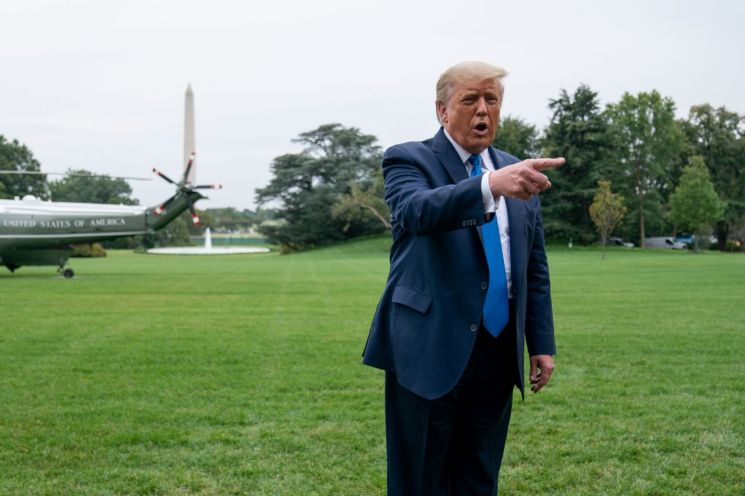 U.S. President Donald Trump is speaking to reporters on the 24th before leaving for North Carolina, stating, "I cannot believe this year's presidential election will be fair."
 [Image source=EPA Yonhap News]
On the afternoon of the 24th (local time), before heading to North Carolina, President Trump met with reporters at the White House and, when asked whether he believes the election is only legitimate if he wins, he did not answer directly but said, "We have to be very careful with (mail-in) ballots. This is a complete fraud." He went on to emphasize his strong distrust of mail-in voting, saying, "I cannot be sure that this election is honest."
President Trump's remarks came after Republican and White House officials denied the possibility of rejecting the election results earlier that day, trying hard to minimize the fallout. Earlier, in an interview with Fox Radio, when asked, "Senator Lindsey Graham, a Republican, said that if the Supreme Court decides in favor of Democratic candidate Joe Biden, then Biden wins. Do you agree?" Trump replied, "I agree." He added, "But I think there is a long way to go until then," and called the ballots "a terrifying show."
In a press briefing the day before, President Trump also hinted at the possibility of rejecting the election results by emphasizing the need to nominate and confirm a new Supreme Court justice. When asked if he could promise a peaceful transfer of power after the November election, he said, "We'll have to see what happens," arguing that the election results would go to the Supreme Court and that the successor to Justice Ruth Bader Ginsburg should be nominated and confirmed quickly.
As criticism arose not only from the opposition but also within the Republican Party due to President Trump's remarks, Republican leadership and the White House set aside other issues to defend him. Senate Majority Leader Mitch McConnell, who had been pressuring for the early confirmation of Justice Ginsburg's successor, posted on Twitter, "The winner of the election will (as is customary) be inaugurated on January 20. Since 1792, every four years, an orderly transfer of power has taken place."
House Majority Leader Kevin McCarthy, while adding a caveat that President Trump would win re-election, also mentioned that "a smooth transition will take place." White House Press Secretary Kayleigh McEnany, during a regular briefing amid reporters' questions, firmly stated, "The President will accept the results of a free and fair election." However, when asked a follow-up question whether the results are only legitimate if President Trump wins, McEnany did not respond.
The Democratic Party launched a full-scale offensive. House Speaker Nancy Pelosi harshly criticized, saying in the morning, "This is not North Korea or Turkey. This is the United States and democracy. Can you not respect the oath to the Constitution even for a moment?" Senate Minority Leader Chuck Schumer also condemned President Trump as "the greatest threat to democracy."
President Trump's remarks triggered bipartisan backlash. That day, the Senate unanimously adopted a resolution supporting a normal transfer of power. The resolution stated that the Senate reaffirms its commitment to an orderly and peaceful transfer of power as required by the U.S. Constitution. It emphasized that there should be no chaos aimed at overturning the will of the American people by the President or anyone in power. This showed a bipartisan consensus that rejecting the election results is unacceptable.
Ordinary citizens also openly expressed their aversion to President Trump. When President Trump appeared at the memorial service for Justice Ginsburg held at the Supreme Court that day, citizens repeatedly shouted "vote him out." The cheers were loud enough to be heard through TV broadcasts, but President Trump brushed it off, saying, "Someone said there were chants, but I hardly heard them." CNN pointed out that President Trump looked at the crowd after hearing the cheers and noted that it was unusual for him to directly face opponents.
© The Asia Business Daily(www.asiae.co.kr). All rights reserved.
![Clutching a Stolen Dior Bag, Saying "I Hate Being Poor but Real"... The Grotesque Con of a "Human Knockoff" [Slate]](https://cwcontent.asiae.co.kr/asiaresize/183/2026021902243444107_1771435474.jpg)















