Passage of Higher Education Act Amendment
Private University Reserve Funds Can Be Reallocated After Board Approval
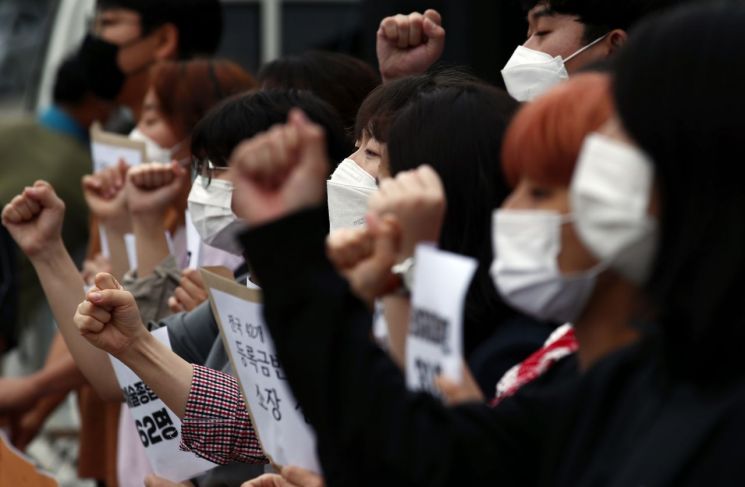 A press conference declaring a class-action lawsuit for tuition refund involving 3,500 university students from 42 universities nationwide was held on July 1 in front of the Seoul Central District Court in Seocho-gu, Seoul. [Image source=Yonhap News]
[Asia Economy Reporter Hyunju Lee] If the use of school facilities and experiments/practices are restricted or academic operations are not properly conducted due to disasters such as the novel coronavirus infection (COVID-19), universities must exempt or reduce tuition fees.
The Ministry of Education announced on the 24th that seven bills, including the Higher Education Act containing such provisions, were passed at the National Assembly plenary session.
According to the partial amendment to the Higher Education Act, if classes cannot be conducted due to a disaster situation, universities may exempt or reduce tuition fees after deliberation by the Tuition Review Committee, establishing a legal basis for this.
The composition of the Tuition Review Committee must ensure that members from each unit do not constitute a majority, and when appointing expert members, the school and students must consult according to the school regulations. Additionally, a legal basis was established allowing universities to replace classroom instruction with remote classes using broadcasting and information communication media when classroom teaching is difficult due to a disaster.
Through amendments to the Private School Act, the heads of university educational institutions and school corporation directors can change the use of existing reserves for student support purposes by resolution of the board of directors.
A legal basis was established to allow remote classes conducted in elementary, middle, and high schools, as well as activities conducted outside school such as field training, to be operated as classes, and related standards for the operation of remote classes at overseas Korean schools were also set.
Through partial amendments to the Special Education Act for Persons with Disabilities, a basis for remote classes for special education recipients was established, and the act was partially amended to allow them to receive itinerant education or remote classes when necessary for education.
When a crisis alert of 'caution' or higher is issued under the Framework Act on Disaster and Safety Management, the Minister of Education, in consultation with the Director of the Korea Disease Control and Prevention Agency, will have the legal basis to take measures such as prohibiting attendance or school closure for students or staff meeting certain criteria.
© The Asia Business Daily(www.asiae.co.kr). All rights reserved.
![Clutching a Stolen Dior Bag, Saying "I Hate Being Poor but Real"... The Grotesque Con of a "Human Knockoff" [Slate]](https://cwcontent.asiae.co.kr/asiaresize/183/2026021902243444107_1771435474.jpg)















