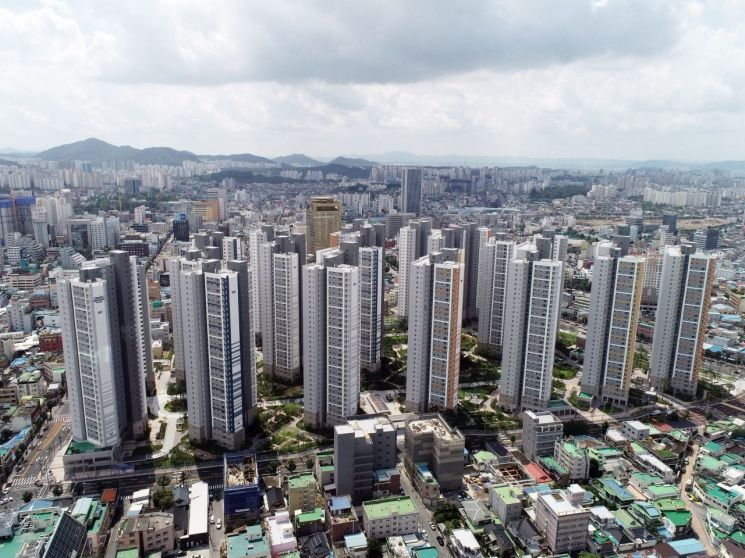
[Asia Economy Honam News Team, reporter Park Seon-gang] Gwangju Metropolitan City's Dong-gu District (headed by Lim Taek) has restored its population to 100,000, ushering in a new era of 100,000 residents.
This marks a rebound five years after its population fell below the 100,000 mark in 2015.
Notably, this natural population increase has occurred without any artificial measures such as boundary adjustments between autonomous districts or forced population inflows, which is raising expectations for a new turning point in Dong-gu's development. In response, Dong-gu is swiftly preparing measures to help both long-term residents and newcomers settle in the area.
According to Dong-gu on September 24, as of September 21, the district's population stood at 49,709 households and 100,351 residents.
This change began when residents started moving into the Grand Central Apartment complex in the Gyerim 8 District on September 10. By November 8, when all 2,336 households are expected to have moved in, an additional 5,377 people are projected to join the district.
The recovery of Dong-gu's population, which once dropped to 6.5% of Gwangju’s total population or about 95,000 people, is attributed less to short-term incentives and more to the long-term creation of a "livable residential environment."
Currently, among Dong-gu’s 14 redevelopment zones, 10 are either completed, under construction, or undergoing compensation procedures for losses.
Once these 10 redevelopment projects are finished, Dong-gu expects an influx of about 33,000 people across 13,000 households.
Combining urban development and redevelopment projects, the district estimates a potential population increase of 48,000 people across 19,000 households.
However, considering factors such as the resettlement of original residents and the lack of new residents from outside the area, the net population increase is expected to be closer to 30,000, with the total population likely to stabilize at around 130,000 by 2024.
Dong-gu anticipates that maintaining a population above 100,000 will make it easier to secure national funding, which would positively impact the resolution of long-standing resident demands and the expansion of social infrastructure.
If the population remains above 100,000 for the next two years, the vice district chief’s rank, which had been downgraded to Director (Grade 4), will be upgraded again to Deputy Director-General (Grade 3), and the district will be able to consistently operate four divisions.
This is expected to not only enhance the status of the autonomous district but also improve the quality of administrative services. In addition, there will be secondary benefits such as increased grants and local tax revenues.
In line with these developments, Dong-gu plans to expand and strengthen support measures in various areas to both prevent population outflow and encourage inflow, aiming to improve settlement conditions so that both long-term and new residents can put down roots smoothly.
As part of the urban regeneration leading area project, which invested 20 billion won, three key facilities?Pureun Village Community Center, Gung-dong Miro Center, and Chungjang 22?have recently opened in succession and are gaining popularity as communication spaces for residents, artists, and community activists.
The "Public Complex Library," considered a flagship resident benefit facility, is under construction with the goal of opening in December 2022.
Other lifestyle social overhead capital (SOC) facilities that enhance residents' quality of life, such as the Job Second Act Lifelong Learning Center, Infant Plaza, and Youth Culture House, are also being established one after another.
The construction of the Dongmyeong-dong Administrative Complex Center, which was recently selected for the Lifestyle SOC Complex Project and secured 3.6 billion won in funding, is also expected to gain momentum.
The district is also focusing on policies to encourage childbirth and address aging, targeting single-person households, newlyweds, prospective parents, and seniors.
In response to the growing trend of single-person households, Dong-gu became the first autonomous district in Gwangju to enact a "Single-Person Household Support Ordinance," which has been in effect since the end of June.
The district is also considering ways to expand support tailored to each stage of life, including pregnancy, childbirth, and childcare.
In particular, Dong-gu has already entered a super-aged society, with more than 22% of its population aged 65 or older, and was the first among Gwangju and Jeonnam autonomous districts to join the Age-Friendly City network. Accordingly, the district is supporting seniors in various ways so they can enjoy an active old age, including initiatives such as the Dementia Relief Center, Communication Senior Centers, Baekse School, and the provision of AI care robots called "Hyodori."
Lim Taek, head of Dong-gu District, stated, "Dong-gu is gradually transforming from a long period of decline into a cultural tourism city that will serve as a future growth engine for Gwangju," adding, "We will continue to establish a vision for a sustainable city by developing and implementing various policies for the stable settlement of new residents and for the benefit of all residents."
© The Asia Business Daily(www.asiae.co.kr). All rights reserved.