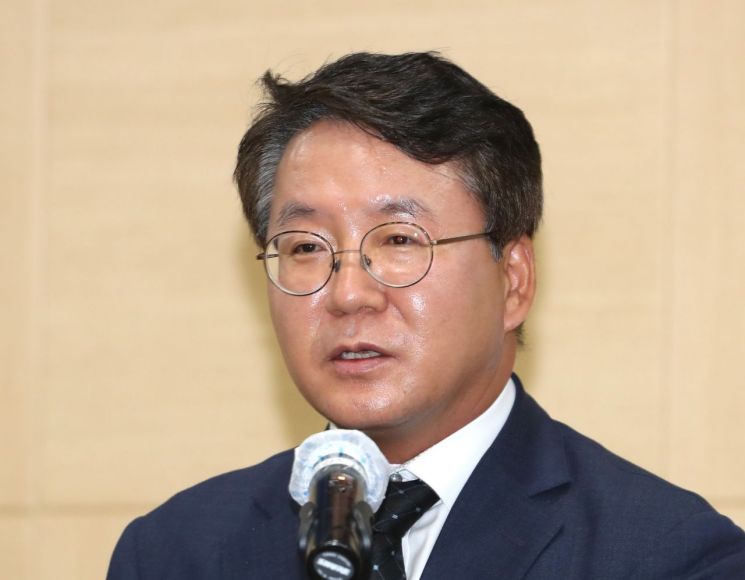
 Lee Seung-woo, Director of the National Institute of Technology and Standards, Ministry of Trade, Industry and Energy. (Photo by Yonhap News)
[Asia Economy Reporter Moon Chaeseok] The government has embarked on promoting international standards in the field of energy storage system (ESS) safety. It is challenging the establishment of international standards based on the experience and demonstration technology accumulated through investigations of fire accident causes.
The National Institute of Technology and Standards under the Ministry of Trade, Industry and Energy announced on the 24th that the "ESS System Safety Test Methods and Procedures" proposed by South Korea to the International Electrotechnical Commission has been adopted as a New Work Item Proposal (NP) by the ESS System Technical Committee (IEC/TC 120).
To be established as an international standard, after the NP stage, it must go through stages such as "Working Draft (WD) → Committee Draft (CD) → Draft International Standard (DIS) → Final Draft International Standard (FDIS)".
To be adopted at the first stage NP, it requires approval by at least two-thirds of the voting member countries and recommendations of experts participating in the international standard development work from at least five countries.
According to the National Institute of Technology and Standards, South Korea gained the support of the majority of the technical committee member countries. Experts were recommended from countries including the United States, Spain, Ireland, and China, marking the first step toward establishing the international standard.
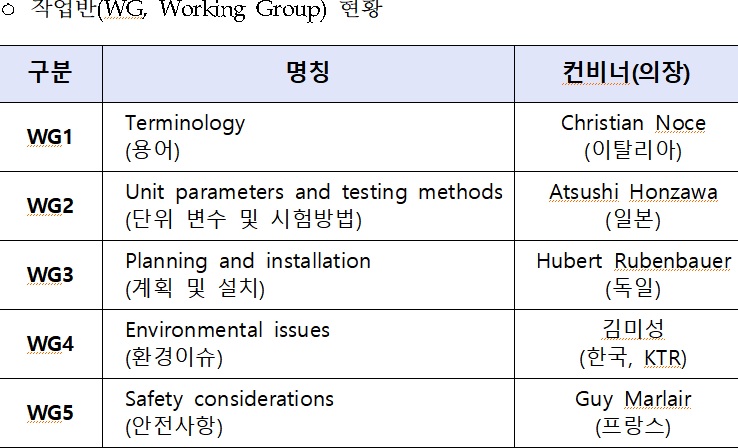
This standard is a technical document that specifically stipulates the test methods and procedures necessary to verify the safety of lithium-ion battery-based ESS systems.
It was drafted based on safety technology secured through the investigation of an ESS fire accident in South Korea last year and demonstration tests.
It contains detailed test methods for ESS safety factors such as electrical and mechanical hazards, gas leakage, communication control, and electromagnetic waves.
During the international standard proposal process, Kim Miseong, Senior Researcher at the Korea Testing & Research Institute (KTR), and Kim Jinyong, Center Director at the Korea Testing Laboratory (KTL), played leading roles.
Director Kim is expected to lead the international project team formed for this standard establishment and guide the international standard development.
Additionally, the "ESS System Protection Requirements According to Environmental Conditions" proposed by South Korea was adopted as a New Work Item Proposal in November last year, and the international standard development work is currently underway.
South Korea plans to actively promote the international standardization of its ESS technology by continuously reflecting its ESS system-related technologies in other international standards as well.
The ESS industry is a promising new industry expected to grow continuously worldwide as the share of renewable energy generation increases.
With Korean companies possessing advanced technology, the National Institute of Technology and Standards expects that leading international standards in the ESS system safety field will strengthen South Korea's competitiveness in the global market.
Lee Seungwoo, Director of the National Institute of Technology and Standards, said, "There were many difficulties due to past ESS fire accidents, but the experience gained by pioneering uncharted paths has become the foundation for today's international standard promotion."
He added, "Advanced countries developed various international standards based on trial and error in the past. We will also contribute to creating safer ESS systems and enhancing the global competitiveness of our companies through international standardization."
© The Asia Business Daily(www.asiae.co.kr). All rights reserved.
![Clutching a Stolen Dior Bag, Saying "I Hate Being Poor but Real"... The Grotesque Con of a "Human Knockoff" [Slate]](https://cwcontent.asiae.co.kr/asiaresize/183/2026021902243444107_1771435474.jpg)

















