'Sandbox Review Committee' to be Held on the 23rd
Delivery Robots, Special Navigation for Visually Impaired
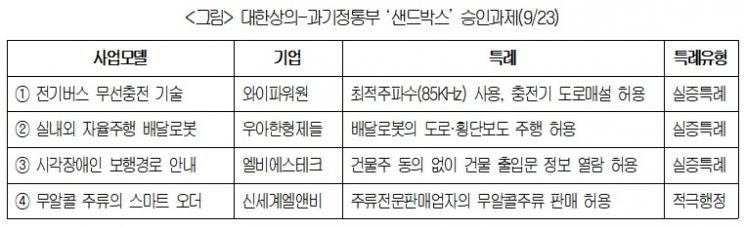
[Asia Economy Reporter Dongwoo Lee] The Korea Chamber of Commerce and Industry Sandbox Support Center and the Ministry of Science and ICT held the ‘ICT Sandbox Deliberation Committee’ on the 23rd and announced the approval of four cases: wireless charging technology for electric buses, indoor and outdoor autonomous delivery robots, walking route guidance service for the visually impaired, and non-alcoholic beverage sales service using smart order.
With this approval, the world’s first developed wireless charging electric bus will run on domestic roads. The country’s first autonomous delivery robot will deliver ordered food to the doorstep, and a ‘navigation’ system for the visually impaired that enables voice-guided directions as well as contactless ordering and payment will also be launched.
Electric Bus Charges Itself While Running or Stopped
The wireless charging for electric buses is a technology that charges automatically when the bus is running or stopped. It utilizes ‘magnetic resonance shaping technology’ that safely transmits large-capacity electrical energy wirelessly using magnetic fields. This technology was developed by a domestic startup for the first time in the world and was selected as one of Time magazine’s ‘50 Best Inventions in the World’ in 2010.
An electric bus equipped with a charging device (receiver) is charged wirelessly in real time by a charger (transmitter) embedded under the road using a wireless frequency (85kHz) when it stops or runs on the road.
Under domestic Radio Act regulations, the 85kHz frequency band was not allocated for wireless charging of electric buses, and conformity evaluation for broadcasting and communication equipment requiring frequency allocation was difficult. Additionally, the project was blocked by seven regulations including tuning approval requirements for installing wireless charging devices on electric buses, standards for embedding wireless chargers in roads, and whether the product is subject to safety confirmation, making the business impossible.
The Deliberation Committee granted a two-year demonstration exemption considering the industrial ripple effects of this future new technology that simultaneously solves energy and environmental issues in the eco-friendly vehicle era. The applicant company, WiPowerOne, plans to test marketability and safety with up to seven electric buses on the circular electric bus route in the Daedeok Research and Development Special Zone in Daejeon.
Robot Delivers to Your Door When Ordered via App
Indoor and outdoor autonomous delivery robots (Woowa Brothers) will also begin operation. When ordering through the Baedal Minjok App, the autonomous delivery robot independently recognizes its location, route, and objects, picks up food from the store, and delivers it to the doorstep by taking the elevator. While delivery robots running on outdoor roads have passed the sandbox, no robots have operated indoors until now.
Under the Road Traffic Act, autonomous robots are classified as ‘vehicles’ rather than pedestrians, restricting their passage on sidewalks and crosswalks. Under the Park and Green Space Act, robots weighing over 30kg were prohibited from entering parks. Although cameras attached to the robots needed to record images of unspecified individuals to prevent collisions with pedestrians during food delivery, this was not allowed under the Personal Information Protection Act, and wireless control of elevators by robots was also difficult.
The Deliberation Committee allowed market testing on the condition of securing driving safety, implementing personal information protection measures, and recognizing elevator safety inspection exemptions to advance autonomous robot technology and activate the market. The applicant company, Woowa Brothers, plans to conduct a two-year demonstration test around Gwanggyo Lake Park in Suwon, Gyeonggi Province, and Konkuk University in Seoul.
Navigation for the Visually Impaired: Voice Guidance from Directions to Ordering and Payment
The walking route guidance service for the visually impaired (LBS Tech) also received a ‘demonstration exemption.’ This service uses the location information of a visually impaired person’s smartphone to provide voice guidance about commercial, public, and convenience facilities around the user. Based on sensor information (GPS, accelerometer) collected from the smartphone as the visually impaired person moves, it detects stairs and obstacles to ensure walking safety. Upon reaching the destination, it links with the in-store POS system to enable contactless ordering and payment.
To guide visually impaired people to building entrances and internal routes, access to and issuance of building floor plans were required, but under current law, issuing building floor plans requires the consent of the building owner.
The Deliberation Committee allowed access to and issuance of building floor plans for public offices, public institutions, and commercial buildings on the condition of submitting a security plan to improve the rights of visually impaired people. LBS Tech plans to first test safety and marketability in the Jungwon-gu area of Seongnam City and then expand the demonstration area.
Non-Alcoholic Beverage Sales Allowed
The non-alcoholic beverage sales service allows customers to pre-order non-alcoholic beverages via an app and pick them up face-to-face at specialty liquor stores. Under current law, specialty liquor stores could sell wine glasses, cheese, and other liquor-related items, but the sale of non-alcoholic beverages was unclear.
The Deliberation Committee judged that ‘temporary permission’ was necessary as non-alcoholic beverages expand consumer choice, are sold in various locations, and have little impact on liquor distribution order. Accordingly, the National Tax Service completed regulatory improvements by actively allowing the purchase of non-alcoholic beverages at all liquor stores during the discussion process.
Meanwhile, the Ministry of Science and ICT Sandbox Deliberation Committee granted demonstration exemptions for two other cases, including a mobile-linked open karaoke booth, and temporary permission for one case of mobile credit information linkage service. It also approved changes to designation conditions for the previously approved temporary permission case of a remote power management system for unmanned base stations of telecommunications companies.
The committee was held three weeks after a written review earlier this month (approval of delivery-only shared kitchens and non-face-to-face mobile subscriptions). The Korea Chamber of Commerce and Industry and the Ministry of Science and ICT plan to hold the sandbox deliberation committee regularly to enable innovative companies to quickly commercialize and launch their products.
Woo Tae-hee, the full-time vice chairman, said, “Despite difficulties caused by COVID-19, after dozens of video conferences and exchanging hundreds of documents with 12 departments from five ministries, we have launched innovative technologies that open future industries to the market. We will continue to actively utilize the sandbox to ensure that startups trying new ventures do not face difficulties due to laws and regulations.”
© The Asia Business Daily(www.asiae.co.kr). All rights reserved.
![Clutching a Stolen Dior Bag, Saying "I Hate Being Poor but Real"... The Grotesque Con of a "Human Knockoff" [Slate]](https://cwcontent.asiae.co.kr/asiaresize/183/2026021902243444107_1771435474.jpg)















