Yong Hye-in, the Only No Vote from the Basic Income Party
"Selective Alliance Causes Conflict and Division"
6 Justice Party Lawmakers and Others Abstain
[Asia Economy Reporter Jeon Jin-young] The supplementary budget (추경) bill worth 7.8148 trillion won was passed on the 22nd with 272 votes in favor out of 282 members present. However, all non-negotiating parties cast 'against' or 'abstain' votes.
These minority parties, which have emphasized the necessity of introducing basic income, have continuously voiced concerns about the selective distribution of this disaster relief fund. Although the supplementary budget was based on the principle of selective support, it was criticized as a 'patchwork' due to budget allocations such as expanding the scope of special care expenses and providing support funds to businesses subject to gathering bans.
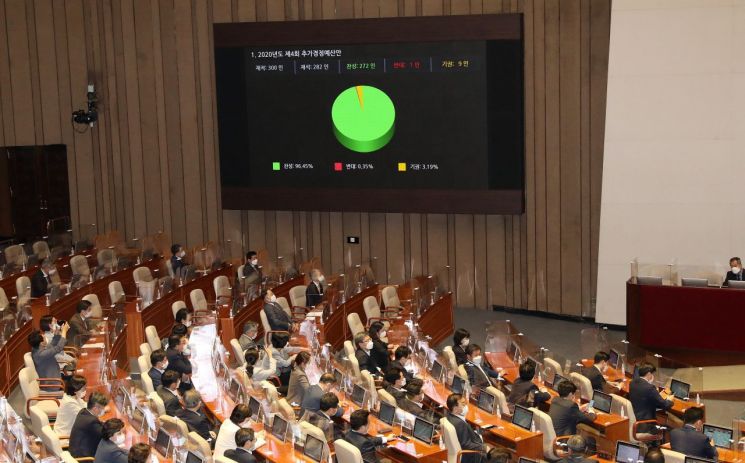
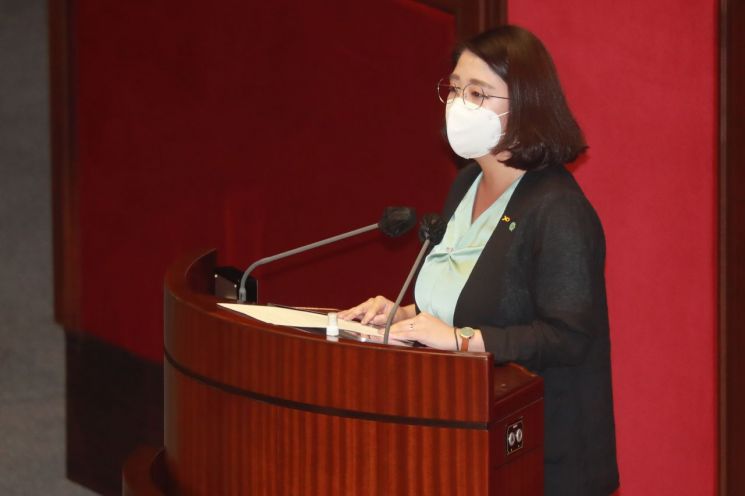
Of the 282 members, 272 voted in favor, while the remaining 10 votes consisted of 1 against and 9 abstentions. The sole opposing vote was cast by Yong Hye-in, a member of the Basic Income Party. Representative Yong requested to speak in opposition during the plenary session. She explained her opposition by stating, "I stand here to oppose this supplementary budget bill that intends to assess and selectively support the suffering of the people even in disaster situations." She criticized, "The 'selective alliance' between the aging industrialization generation and the outdated democratization generation is causing conflict and division among the people over who is more difficult and suffering. Even in the selective distribution of the 20,000 won communication fee given as a favor, the selective alliance was solidified."
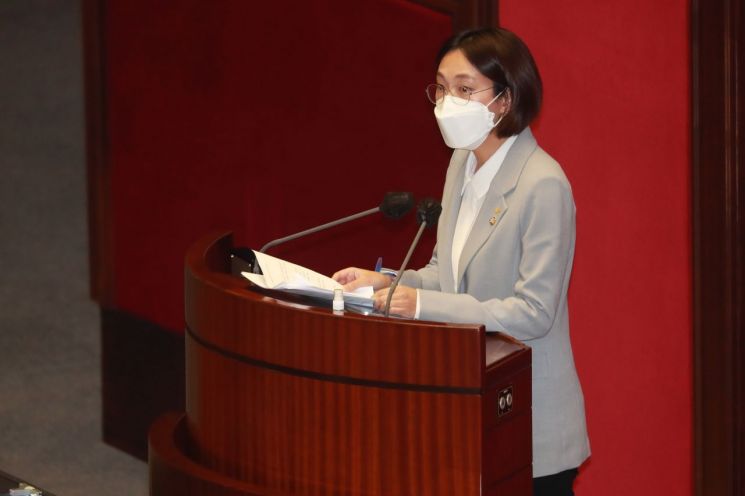
All six members of the Justice Party who attended the plenary session abstained from voting. Jang Hye-young, a member of the Planning and Finance Committee, also requested to speak in opposition, stating, "This agreement makes us question why we are taking on debt to pass this supplementary budget." She pointed out, "The government and ruling party said that selective support should provide stronger assistance to the more vulnerable groups, but in reality, they could not shake off excessive concerns about national debt."
Representative Jang added, "If selective support was pushed through, the necessary budget should have been provided to those in need, but during the discussion of this supplementary budget, the controversy over selective versus universal support was repeated again. We are now facing the shadow of economic contraction, which has only happened twice in history. At this rate, we do not know when the fifth supplementary budget discussion will take place," expressing her concerns.
Jo Jung-hoon of the Transition Era Party, who proposed the first basic income bill in the 21st National Assembly, abstained by not casting a vote. A representative from Jo's office told Asia Economy on the 23rd, "There was a great sense of regret. Even in the fourth supplementary budget, which is the first in 59 years, the 'selective controversy' showed that the logic of needing to help the vulnerable through welfare has not been overcome. However, since the budget was formulated with the purpose of helping the people and the urgency is well understood, he expressed his opinion by abstaining rather than opposing."
Jo also pointed out on Facebook the day before, "To revive the economy, both demand and supply sides must be stimulated, but the current selective welfare policy only stimulates supply." He emphasized the need for a disaster recovery fund, stating, "After the disaster relief fund is distributed, a disaster recovery fund, which is the money needed for restoration, is absolutely necessary."
Meanwhile, abstentions also came from the negotiating party People Power Party. Representatives Kang Ki-yoon and Yoon Han-hong abstained on the day.
© The Asia Business Daily(www.asiae.co.kr). All rights reserved.



















